383 posters, 2 videos, 1 audios, 8 topics, 28 sessions, 328 authors, 225 institutions
ePostersLive by SciGen Technologies S.A. All rights reserved.
50th Annual Regional Anesthesiology and Acute Pain Medicine Meeting
May 1 - 3, 2025 | Orlando, Florida

6471
ULTRASOUND-GUIDED PUDENDAL NERVE BLOCK FOR ANALGESIA IN NEEDLE PLACEMENT FOR PROSTATIC SEEDING BRACHYTHERAPY
Poster Presenter
Authors
Affiliations
Part of Topic
Medically Challenging Cases
Ultrasound-Guided Pudendal Nerve Block for Analgesia in Needle Placement for Prostatic Seeding Brachytherapy
Dat Pham MD, Alyssa Heintschel MD, Jeffrey Rouse MD Virginia Mason Franciscan Health, Seattle, WA
Introduction
-
The pudendal nerve arises from the sacral plexus with contributions from the ventral rami of S2-S4 to provide innervation to the urethral muscles, clitoris, penis, perineum, pelvic floor sphincter, urethra, and bladder triangle
-
A pudendal nerve block (PNB) is a regional technique that can be used as an adjunct for analgesia
-
The block can be performed via anatomic landmarks as well as guidance with fluoroscopy or ultrasound
-
It has been shown to reduce the post-anesthesia care unit (PACU) narcotic requirements in certain genitourinary and anorectal surgeries
Case Presentation
-
74-year-old male with a history of hypertension, obstructive sleep apnea, and prostate cancer presented for a second session of ultrasound-guided prostatic needle placement for seeding brachytherapy by an oncologist
-
Previous motor vehicle accident with bladder rupture status-post exploratory laparotomy with pelvic reconstruction complicated by incisional hernia (now repaired) with screws near bladder and pelvis, therefore was not a surgical candidate
-
During the first session of brachytherapy, the patient reported perineal pain from the needles requiring initiation of a hydromorphone patient-controlled analgesia pump (PCA)
-
Proceduralist requested that a regional anesthetic technique be used during this session of brachytherapy; an epidural was not a viable option due to insufficient staffing for patient monitoring in radiology suite during brachytherapy
Intraoperative Course
-
Monitors were applied including pulse oximetry and blood pressure cuff. Oxygen was administered via a face mask at five liters per minute. The patient was then instructed to lie in a prone position
-
A safety time-out was performed confirming the patient and procedure before sedation via propofol and midazolam was administered
-
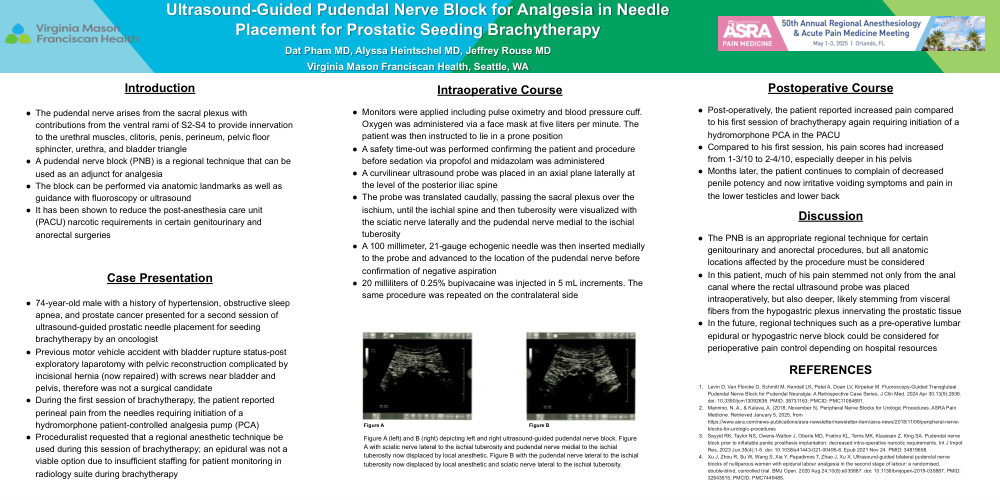
A curvilinear ultrasound probe was placed in an axial plane laterally at the level of the posterior iliac spine
-
The probe was translated caudally, passing the sacral plexus over the ischium, until the ischial spine and then tuberosity were visualized with the sciatic nerve laterally and the pudendal nerve medial to the ischial tuberosity
-
A 100 millimeter, 21-gauge echogenic needle was then inserted medially to the probe and advanced to the location of the pudendal nerve before confirmation of negative aspiration
-
20 milliliters of 0.25% bupivacaine was injected in 5 mL increments. The same procedure was repeated on the contralateral side
Postoperative Course
-
Post-operatively, the patient reported increased pain compared to his first session of brachytherapy again requiring initiation of a hydromorphone PCA in the PACU
-
Compared to his first session, his pain scores had increased from 1-3/10 to 2-4/10, especially deeper in his pelvis
-
Months later, the patient continues to complain of decreased penile potency and now irritative voiding symptoms and pain in the lower testicles and lower back
Discussion
-
The PNB is an appropriate regional technique for certain genitourinary and anorectal procedures, but all anatomic locations affected by the procedure must be considered
-
In this patient, much of his pain stemmed not only from the anal canal where the rectal ultrasound probe was placed intraoperatively, but also deeper, likely stemming from visceral fibers from the hypogastric plexus innervating the prostatic tissue
-
In the future, regional techniques such as a pre-operative lumbar epidural or hypogastric nerve block could be considered for perioperative pain control depending on hospital resources