383 posters, 2 videos, 1 audios, 8 topics, 28 sessions, 328 authors, 225 institutions
ePostersLive by SciGen Technologies S.A. All rights reserved.
50th Annual Regional Anesthesiology and Acute Pain Medicine Meeting
May 1 - 3, 2025 | Orlando, Florida

6426
REGIONAL ANESTHESIA APPROACHES FOR COMPLEX UPPER EXTREMITY BURN SURGERY AND ANESTHESIA CARE
Poster Presenter
Authors
Affiliations
Part of Topic
Medically Challenging Cases
Regional Anesthesia Approaches for Complex Upper Extremity Burn Surgery and Anesthesia Care
Lei Yang, MD, PhD, Ariana Prinzbach, MD, Vladislav Shick, MD
Department of Anesthesiology, University of Pittsburgh Medical Center
INTRODUCTION
- Burn injuries are associated with severe and prolonged pain through various stages of treatment, often requiring increased opioid doses and leading to rapid tolerance development, necessitating effective multimodal pain management 1.
- Regional anesthesia is critical for providing targeted analgesia, reducing opioid consumption, and facilitating enhanced recovery. However, these techniques carry risks such as infection, bleeding, or local anesthetic toxicity, requiring careful monitoring 2.
- Upper extremity burns pose unique management challenges due to sensitive anatomical regions and potential comorbidities, such as airway compromise from edema or inhalation injuries.
- Brachial plexus nerve blocks can provide effective analgesia but require careful consideration of potential complications, including respiratory compromise from diaphragmatic paralysis and local anesthetic systemic toxicity.
- Selecting the appropriate block technique while monitoring respiratory function and using ultrasound guidance can optimize safety and efficacy in managing pain for upper extremity burn patients.
CASE REPORT
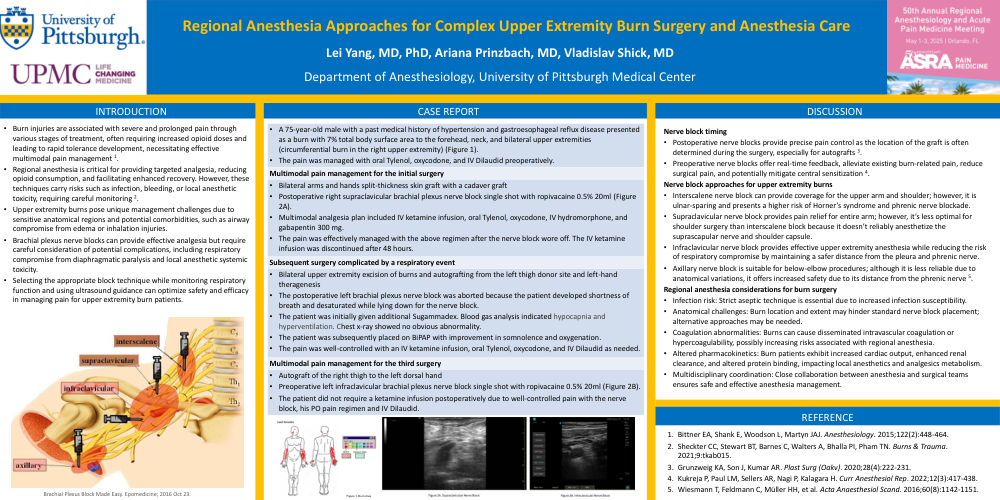
- A 75-year-old male with a past medical history of hypertension and gastroesophageal reflux disease presented as a burn with 7% total body surface area to the forehead, neck, and bilateral upper extremities (circumferential burn in the right upper extremity) (Figure 1).
- The pain was managed with oral Tylenol, oxycodone, and IV Dilaudid preoperatively.
Multimodal pain management for the initial surgery
- Bilateral arms and hands split-thickness skin graft with a cadaver graft
- Postoperative right supraclavicular brachial plexus nerve block single shot with ropivacaine 0.5% 20ml (Figure 2A).
- Multimodal analgesia plan included IV ketamine infusion, oral Tylenol, oxycodone, IV hydromorphone, and gabapentin 300 mg.
- The pain was effectively managed with the above regimen after the nerve block wore off. The IV ketamine infusion was discontinued after 48 hours.
Subsequent surgery complicated by a respiratory event
- Bilateral upper extremity excision of burns and autografting from the left thigh donor site and left-hand theragenesis
- The postoperative left brachial plexus nerve block was aborted because the patient developed shortness of breath and desaturated while lying down for the nerve block.
- The patient was initially given additional Sugammadex. Blood gas analysis indicated hypocapnia and hyperventilation. Chest x-ray showed no obvious abnormality.
- The patient was subsequently placed on BiPAP with improvement in somnolence and oxygenation.
- The pain was well-controlled with an IV ketamine infusion, oral Tylenol, oxycodone, and IV Dilaudid as needed.
Multimodal pain management for the third surgery
- Autograft of the right thigh to the left dorsal hand
- Preoperative left infraclavicular brachial plexus nerve block single shot with ropivacaine 0.5% 20ml (Figure 2B).
- The patient did not require a ketamine infusion postoperatively due to well-controlled pain with the nerve block, his PO pain regimen and IV Dilaudid.
DISCUSSION
Nerve block timing
- Postoperative nerve blocks provide precise pain control as the location of the graft is often determined during the surgery, especially for autografts 3.
- Preoperative nerve blocks offer real-time feedback, alleviate existing burn-related pain, reduce surgical pain, and potentially mitigate central sensitization 4.
Nerve block approaches for upper extremity burns
- Interscalene nerve block can provide coverage for the upper arm and shoulder; however, it is ulnar-sparing and presents a higher risk of Horner’s syndrome and phrenic nerve blockade.
- Supraclavicular nerve block provides pain relief for entire arm; however, it’s less optimal for shoulder surgery than interscalene block because it doesn’t reliably anesthetize the suprascapular nerve and shoulder capsule.
- Infraclavicular nerve block provides effective upper extremity anesthesia while reducing the risk of respiratory compromise by maintaining a safer distance from the pleura and phrenic nerve.
- Axillary nerve block is suitable for below-elbow procedures; although it is less reliable due to anatomical variations, it offers increased safety due to its distance from the phrenic nerve 5.
Regional anesthesia considerations for burn surgery
- Infection risk: Strict aseptic technique is essential due to increased infection susceptibility.
- Anatomical challenges: Burn location and extent may hinder standard nerve block placement; alternative approaches may be needed.
- Coagulation abnormalities: Burns can cause disseminated intravascular coagulation or hypercoagulability, possibly increasing risks associated with regional anesthesia.
- Altered pharmacokinetics: Burn patients exhibit increased cardiac output, enhanced renal clearance, and altered protein binding, impacting local anesthetics and analgesics metabolism.
- Multidisciplinary coordination: Close collaboration between anesthesia and surgical teams ensures safe and effective anesthesia management.
REFERENCE
- Bittner EA, Shank E, Woodson L, Martyn JAJ. Anesthesiology. 2015;122(2):448-464.
- Sheckter CC, Stewart BT, Barnes C, Walters A, Bhalla PI, Pham TN. Burns & Trauma. 2021;9:tkab015.
- Grunzweig KA, Son J, Kumar AR. Plast Surg (Oakv). 2020;28(4):222-231.
- Kukreja P, Paul LM, Sellers AR, Nagi P, Kalagara H. Curr Anesthesiol Rep. 2022;12(3):417-438.
- Wiesmann T, Feldmann C, Müller HH, et al. Acta Anaesthesiol Scand. 2016;60(8):1142-1151.