383 posters, 2 videos, 1 audios, 8 topics, 28 sessions, 328 authors, 225 institutions
ePostersLive by SciGen Technologies S.A. All rights reserved.
50th Annual Regional Anesthesiology and Acute Pain Medicine Meeting
May 1 - 3, 2025 | Orlando, Florida

6837
INTRATHECAL DRUG PUMPS & ITS CHALLENGES: HOW TO PROCEED & IMPLICATIONS IN OUR PRACTICE
Poster Presenter
Authors
Affiliations
Part of Topic
Medically Challenging Cases
Intrathecal Drug Pumps & Its Challenges: How to Proceed & Implications in our Practice
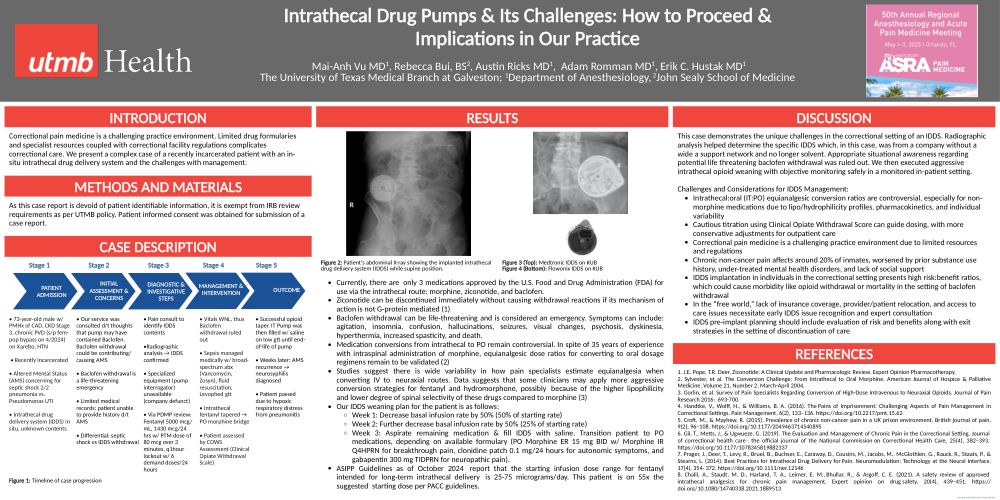
Correctional pain medicine is a challenging practice environment. Limited drug formularies and specialist resources coupled with correctional facility regulations complicates correctional care. We present a complex case of a recently incarcerated patient with an in-situ intrathecal drug delivery system and the challenges with management.
As this case report is devoid of patient identifiable information, it is exempt from IRB review requirements as per UTMB policy. Patient informed consent was obtained for submission of a case report.
Stage 1 - Patient Admission:
• 73-year-old male w/ PMHx of CAD, CKD Stage 3, chronic PVD (s/p fem-pop bypass on 4/2024) on Xarelto, HTN
• Recently incarcerated
• Altered Mental Status (AMS) concerning for septic shock 2/2 pneumonia vs. Pseudomonas UTI
• Intrathecal drug delivery system (IDDS) in situ, unknown contents
Stage 2 – Initial Assessment & Concerns:
• Our service was consulted d/t thoughts that pump may have contained Baclofen. Baclofen withdrawal could be contributing/causing AMS
• Baclofen withdrawal is a life-threatening emergency
• Limited medical records; patient unable to provide history d/t AMS
• Differential: septic shock vs IDDS withdrawal
Stage 3 – Diagnostic & Investigative Steps:
• Pain consult to identify IDDS contents
• Radiographic analysis → IDDS confirmed
• Specialized
equipment (pump interrogator) unavailable (company defunct)
• Via PDMP review: Fentanyl 5000 mcg/mL, 1430 mcg/24 hrs w/ PTM dose of 80 mcg over 3 minutes, q1hour lockout w/ 6 demand doses/24 hours
Stage 4 – Management & Intervention:
• Vitals WNL, thus Baclofen withdrawal ruled out
• Sepsis managed medically w/ broad-spectrum abx (Vancomycin, Zosyn), fluid resuscitation, Levophed gtt
• Intrathecal fentanyl tapered → PO morphine bridge
• Patient assessed by COWS Assessment (Clinical Opiate Withdrawal Scale)
Stage 5 – Outcome:
• Successful opioid taper. IT Pump was then filled w/ saline on low gtt until end-of-life of pump
• Weeks later: AMS recurrence → neurosyphilis diagnosed
• Patient passed due to hypoxic respiratory distress from pneumonitis
- Currently, there are only 3 medications approved by the U.S. Food and Drug Administration (FDA) for use via the intrathecal route: morphine, ziconotide, and baclofen.
- Ziconotide can be discontinued immediately without causing withdrawal reactions if its mechanism of action is not G-protein mediated (1)
- Baclofen withdrawal can be life-threatening and is considered an emergency. Symptoms can include: agitation, insomnia, confusion, hallucinations, seizures, visual changes, psychosis, dyskinesia, hyperthermia, increased spasticity, and death.
- Medication conversions from intrathecal to PO remain controversial. In spite of 35 years of experience with intraspinal administration of morphine, equianalgesic dose ratios for converting to oral dosage regimens remain to be validated (2)
- Studies suggest there is wide variability in how pain specialists estimate equianalgesia when converting IV to neuraxial routes. Data suggests that some clinicians may apply more aggressive conversion strategies for fentanyl and hydromorphone, possibly because of the higher lipophilicity and lower degree of spinal selectivity of these drugs compared to morphine (3)
- Our IDDS weaning plan for the patient is as follows:
- Week 1: Decrease basal infusion rate by 50% (50% of starting rate)
- Week 2: Further decrease basal infusion rate by 50% (25% of starting rate)
- Week 3: Aspirate remaining medication & fill IDDS with saline. Transition patient to PO medications, depending on available formulary (PO Morphine ER 15 mg BID w/ Morphine IR Q4HPRN for breakthrough pain, clonidine patch 0.1 mg/24 hours for autonomic symptoms, and gabapentin 300 mg TIDPRN for neuropathic pain).
- ASIPP Guidelines as of October 2024 report that the starting infusion dose range for fentanyl intended for long-term intrathecal delivery is 25-75 micrograms/day. This patient is on 55x the suggested starting dose per PACC guidelines.
This case demonstrates the unique challenges in the correctional setting of an IDDS. Radiographic analysis helped determine the specific IDDS which, in this case, was from a company without a wide a support network and no longer solvent. Appropriate situational awareness regarding potential life threatening baclofen withdrawal was ruled out. We then executed aggressive intrathecal opioid weaning with objective monitoring safely in a monitored in-patient setting.
Challenges and Considerations for IDDS Management:
- Intrathecal:oral (IT:PO) equianalgesic conversion ratios are controversial, especially for non-morphine medications due to lipo/hydrophilicity profiles, pharmacokinetics, and individual variability
- Cautious titration using Clinical Opiate Withdrawal Score can guide dosing, with more conservative adjustments for outpatient care
- Correctional pain medicine is a challenging practice environment due to limited resources and regulations
- Chronic non-cancer pain affects around 20% of inmates, worsened by prior substance use history, under-treated mental health disorders, and lack of social support
- IDDS implantation in individuals in the correctional setting presents high risk:benefit ratios, which could cause morbidity like opioid withdrawal or mortality in the setting of baclofen withdrawal
- In the “free world,” lack of insurance coverage, provider/patient relocation, and access to care issues necessitate early IDDS issue recognition and expert consultation
- IDDS pre-implant planning should include evaluation of risk and benefits along with exit strategies in the setting of discontinuation of care