383 posters, 2 videos, 1 audios, 8 topics, 28 sessions, 328 authors, 225 institutions
ePostersLive by SciGen Technologies S.A. All rights reserved.
50th Annual Regional Anesthesiology and Acute Pain Medicine Meeting
May 1 - 3, 2025 | Orlando, Florida

6738
HEMODYNAMIC INSTABILITY AND DYSPNEA DURING INTRATHECAL DRUG DELIVERY SYSTEM EVALUATION AND REVISION: A CASE REPORT OF HIGH SPINAL
Poster Presenter
Authors
Affiliations
Part of Topic
Medically Challenging Cases
Hemodynamic instability and dyspnea during intrathecal drug delivery system evaluation and revision: a case report of high spinal.
Juliet Velhagen, BA, Sagar A. Patel, BS, Thomas Ferrer, BS, Tim Petersen, PhD, Jacob Schreiner MD, Radhika Grandhe, MD, Codruta Soneru, MD.
Juliet Velhagen, BA, Sagar A. Patel, BS, Tim Petersen, PhD, Jacob Schreiner MD, Radhika Grandhe, MD, Codruta Soneru, MD.
Materials and Methods:
As the case report is devoid of patient-identifiable information, it is exempt from IRB review requirements as per the University of New Mexico policy.
Introduction:
Intrathecal drug delivery systems (ITDD) have been used for the management of intractable chronic pain, with the benefit of targeted therapy with reduced systemic side effects in comparison to other routes of pain medication administration [1,2]. Although this method of pain management has many benefits, risks include pump or catheter malfunction. When pump malfunction is suspected, diagnostic approaches such as catheter dye and pump roller studies are necessary to evaluate their function. Unintended high spinal anesthesia can occur with intrathecal bolus injections, potentially causing acute respiratory compromise, hypotension, or other hemodynamic instability [1,3,4]. In this case report, we describe a case of high spinal following a small bolus of hydromorphone and bupivacaine during ITDD evaluation and revision.
Case Report:
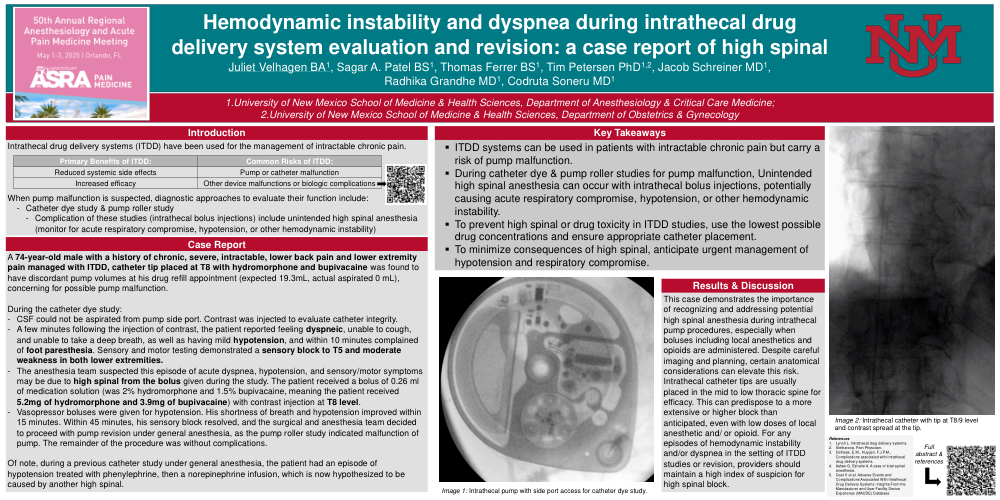
A 74-year-old male with a history of chronic, severe, intractable, lower back pain and lower extremity pain managed with ITDD with hydromorphone and bupivacaine was found to have discordant pump volumes at his drug refill appointment (expected 19.3mL, actual aspirated 0 mL), concerning for possible pump malfunction. Although he was asymptomatic at the time, he was scheduled for further pump studies and possible revision of the pump in the OR. Of note, the catheter tip was identified to be at T8 level from imaging review.
Intrathecal catheter dye study was planned to be performed with the patient being awake and in the presence of anesthesia team in the OR. CSF could not be aspirated from pump side port but catheter dye study had to be performed to evaluate catheter integrity. A few minutes following the injection of contrast through the catheter, the patient reported feeling dyspneic, inability to cough, and to take a deep enough breath, had mild hypotension, and within 10 minutes complained of foot paresthesia. Sensory and motor testing demonstrated a sensory block to T5 and moderate weakness in both lower extremities. The anesthesia team suspected this episode of acute dyspnea, hypotension, and sensory/motor symptoms may be due to high spinal from the bolus given during the study. The patient received a bolus of 0.26 ml of medication solution (this was the volume of intrathecal catheter) of medication solution, with contrast injection. The concentration of the medication in the pump was 2% hydromorphone and 1.5% bupivacaine, meaning the patient received 5.2mg of hydromorphone and 3.9mg of bupivacaine at T8 level. Vasopressor boluses were given for hypotension. His subjective complaint of shortness of breath and hypotension improved within 15 minutes. Within 45 minutes, his sensory block resolved, and the surgical and anesthesia team decided to proceed with pump revision under general anesthesia, as the pump roller study indicated malfunction of pump. The remainder of the procedure was without complications.
Of note, during a previous catheter study under general anesthesia, the patient had an episode of hypotension treated with phenylephrine, then a norepinephrine infusion, which is now hypothesized to be caused by another high spinal.
Discussion:
This case demonstrates the importance of recognizing and addressing potential high spinal anesthesia during intrathecal pump procedures, especially when boluses including local anesthetics and opioids are administered. Despite careful imaging and planning, certain anatomical considerations can elevate this risk. Intrathecal catheter tips are usually placed in the mid to low thoracic spine for efficacy. This can predispose to a more extensive or higher block than anticipated, even with low doses of local anesthetic and/ or opioid. For any episodes of hemodynamic instability and/or dyspnea in the setting of ITDD studies or revision, providers should maintain a high suspicion of high spinal block [4].
References:
- Lynch L. Intrathecal drug delivery systems. Continuing Education in Anaesthesia, Critical Care and Pain. 2014;14(1):27-31. doi:10.1093/bjaceaccp/mkt030
- Stetkarova. Pain Physician 2015; 18:E633-E641
- Delhaas, E.M., Huygen, F.J.P.M., Complications associated with intrathecal drug delivery systems, BJA Education, Volume 20, Issue 2, 2020, Pages 51-57, ISSN 2058-5349, https://doi.org/10.1016/j.bjae.2019.11.002.
- Asfaw G, Eshetie A. A case of total spinal anesthesia. Int J Surg Case Rep. 2020;76:237-239. doi:10.1016/j.ijscr.2020.09.177
- Goel V et al. Adverse Events and Complications Associated With Intrathecal Drug Delivery Systems: Insights From the Manufacturer and User Facility Device Experience (MAUDE) Database. Neuromodulation. 2021 Oct;24(7):1181-1189. doi: 10.1111/ner.13325. Epub 2020 Dec 11. PMID: 33306248; PMCID: PMC9034464.