383 posters, 2 videos, 1 audios, 8 topics, 28 sessions, 328 authors, 225 institutions
ePostersLive by SciGen Technologies S.A. All rights reserved.
50th Annual Regional Anesthesiology and Acute Pain Medicine Meeting
May 1 - 3, 2025 | Orlando, Florida

6737
FEMORAL ARTERY BLOCK ATTENUATES ISCHEMIC FOOT PAIN IN PATIENT WITH THROMBOTIC OCCLUSION OF THE COMMON FEMORAL ARTERY: CASE REPORT
Poster Presenter
Authors
Affiliations
Part of Topic
Medically Challenging Cases
TITLE
Femoral artery block attenuates ischemic foot pain
in a patient with thrombotic occlusion of
the common femoral artery: case report
AUTHORS
Ichite P, Morgenstern D, Wisniewski M, Rojas A, Mauck M, Nanda M, Creighton D
INSTITUTION
University of North Carolina at Chapel Hill - School of Medicine
INTRODUCTION
The sympathetic nervous system plays a key role in the pathophysiology of vaso-occlusive ischemic limb pain. Lumbar sympathetic ganglion blockade provides effective analgesia, but is an invasive procedure requiring advanced imaging guidance, and is typically reserved for patients not eligible for surgical revascularization[1]. Traditional lower extremity peripheral nerve blocks provide effective motor and sensory blockade, but minimal relief for ischemic pain[2]. Recent studies have shown a novel ultrasound-guided femoral artery block (FAB) to have benefit for lower limb vaso-occlusive ischemic pain[3,4]. We present a case of FAB in a medically complex patient with severe acute-on-chronic ischemic limb pain.
METHODS
The patient provided informed consent for submission of this case report. As the case report is devoid of identifiable patient information, it is exempt from IRB review requirements as per UNC policy.
CASE REPORT
A 70-year-old woman with type 2 diabetes, chronic kidney disease, peripheral artery disease, thrombocytopenia, and newly diagnosed acute myeloid leukemia presented with three weeks of worsening left leg and foot pain. Arterial duplex imaging revealed an "impenetrable plaque" in the common femoral artery (CFA) with dampened flow distally. Revascularization was deferred given the chronic nature of the occlusion and the need for medical optimization by the oncology team. The patient’s pain remained refractory to high-dose hydromorphone and standard multimodal analgesia.
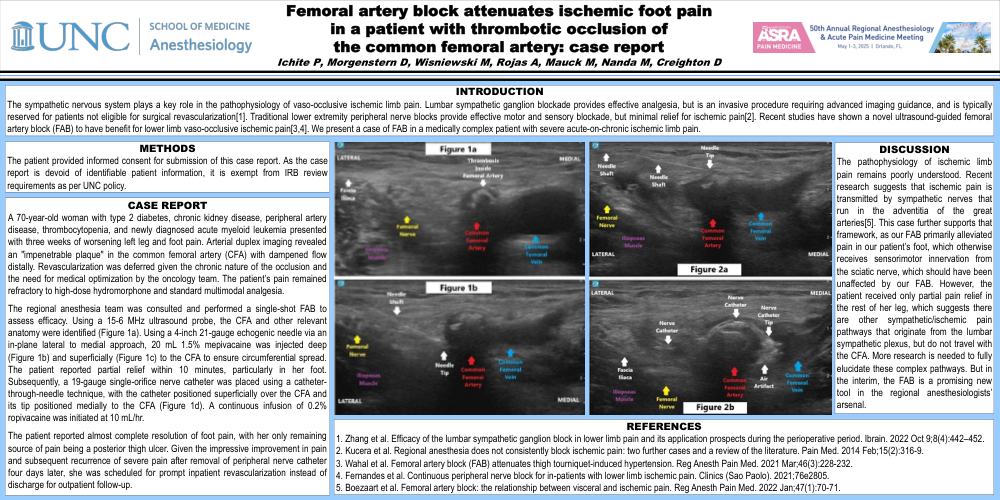
The regional anesthesia team was consulted and performed a single-shot FAB to assess efficacy. Using a 15-6 MHz ultrasound probe, the CFA and other relevant anatomy were identified (Figure 1a). Using a 4-inch 21-gauge echogenic needle via an in-plane lateral to medial approach, 20 mL 1.5% mepivacaine was injected deep (Figure 1b) and superficially (Figure 1c) to the CFA to ensure circumferential spread. The patient reported partial relief within 10 minutes, particularly in her foot. Subsequently, a 19-gauge single-orifice nerve catheter was placed using a catheter-through-needle technique, with the catheter positioned superficially over the CFA and its tip positioned medially to the CFA (Figure 1d). A continuous infusion of 0.2% ropivacaine was initiated at 10 mL/hr.
The patient reported almost complete resolution of foot pain, with her only remaining source of pain being a posterior thigh ulcer. Given the impressive improvement in pain and subsequent recurrence of severe pain after removal of peripheral nerve catheter four days later, she was scheduled for prompt inpatient revascularization instead of discharge for outpatient follow-up.
DISCUSSION
The pathophysiology of ischemic limb pain remains poorly understood. Recent research suggests that ischemic pain is transmitted by sympathetic nerves that run in the adventitia of the great arteries[5]. This case further supports that framework, as our FAB primarily alleviated pain in our patient’s foot, which otherwise receives sensorimotor innervation from the sciatic nerve, which should have been unaffected by our FAB. However, the patient received only partial pain relief in the rest of her leg, which suggests there are other sympathetic/ischemic pain pathways that originate from the lumbar sympathetic plexus, but do not travel with the CFA. More research is needed to fully elucidate these complex pathways. But in the interim, the FAB is a promising new tool in the regional anesthesiologists’ arsenal.
REFERENCES
1. Zhang et al. Efficacy of the lumbar sympathetic ganglion block in lower limb pain and its application prospects during the perioperative period. Ibrain. 2022 Oct 9;8(4):442–452.
2. Kucera et al. Regional anesthesia does not consistently block ischemic pain: two further cases and a review of the literature. Pain Med. 2014 Feb;15(2):316-9.
3. Wahal et al. Femoral artery block (FAB) attenuates thigh tourniquet-induced hypertension. Reg Anesth Pain Med. 2021 Mar;46(3):228-232.
4. Fernandes et al. Continuous peripheral nerve block for in-patients with lower limb ischemic pain. Clinics (Sao Paolo). 2021;76e2805.
5. Boezaart et al. Femoral artery block: the relationship between visceral and ischemic pain. Reg Anesth Pain Med. 2022 Jan;47(1):70-71.