383 posters, 2 videos, 1 audios, 8 topics, 28 sessions, 328 authors, 225 institutions
ePostersLive by SciGen Technologies S.A. All rights reserved.
50th Annual Regional Anesthesiology and Acute Pain Medicine Meeting
May 1 - 3, 2025 | Orlando, Florida

6705
STELLATE GANGLION CATHETER AS A BRIDGE TO ABLATION IN PATIENT WITH REFRACTORY VENTRICULAR TACHYCARDIA STORM
Poster Presenter
Authors
Affiliations
UCLA Department of Anesthesiology and Perioperative Medicine
Part of Topic
Medically Challenging Cases
Stellate Ganglion Catheter as a Bridge to Ablation in Patient with Refractory Ventricular Tachycardia Storm
Christopher Yoon, MD, Thang Tran, MD,Tsione Holly, FNP, MSN, Andrea Poon, MD
Introduction:
The stellate ganglion block (SGB) is a widely used regional anesthesia technique, often used to treat complex regional pain syndrome, Raynaud’s syndrome, postherpetic neuralgia, and other upper extremity pain syndromes associated with severe peripheral vascular disease. Alternatively, the SGB has been utilized as an effective therapy for refractory cardiac arrhythmias.
Case Report:
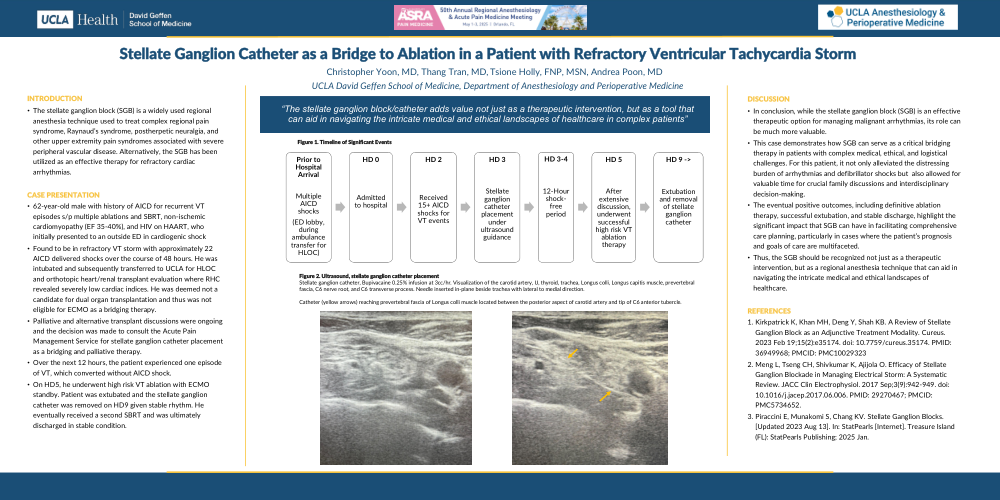
62-year-old male with history of AICD for recurrent VT episodes s/p multiple ablations and SBRT, non-ischemic cardiomyopathy (EF 35-40%), and HIV on HAART, who initially presented to an outside ED in cardiogenic shock due to VT storm with approximately 22 AICD delivered shocks over the course of 48 hours. He was intubated and subsequently transferred to UCLA for HLOC and orthotopic heart/renal transplant evaluation where RHC revealed severely low cardiac indices. He was deemed not a candidate for dual organ transplantation and thus was not eligible for ECMO as a bridging therapy. During his hospital course he continued to have recurrent VT episodes including 15-plus AICD shocks on HD2. Palliative and alternative transplant discussions were ongoing and the decision was made to consult the Acute Pain Management Service for stellate ganglion catheter placement as a hopeful bridging/palliative therapy. On HD3, a left stellate ganglion block and catheter was placed under ultrasound guidance using the paratracheal approach. The patient tolerated the procedure well with no complications and a Bupivicaine 0.25% infusion was started at 3cc/hr. Over the next 12 hours, the patient experienced one episode of VT, which converted without AICD shock. The patient progressively developed more episodes of VT over the next 24 hours (VT x4, AICD shock x3). On HD5, he underwent high risk VT ablation with ECMO standby. Patient was extubated and the stellate ganglion catheter was removed on HD9 given stable rhythm. He eventually received a second SBRT and was ultimately discharged in stable condition.
Discussion:
In conclusion, while the stellate ganglion block (SGB) is an effective therapeutic option for managing malignant arrhythmias, its role can be much more valuable. This case demonstrates how SGB can serve as a critical bridging therapy in patients with complex medical, ethical, and logistical challenges. For this patient, it not only alleviated the distressing burden of arrhythmias and defibrillator shocks but also allowed for valuable time for crucial family discussions and interdisciplinary decision-making. The eventual positive outcomes, including definitive ablation therapy, successful extubation, and stable discharge, highlight the significant impact that SGB can have in facilitating comprehensive care planning, particularly in cases where the patient’s prognosis and goals of care are multifaceted. Thus, the SGB should be recognized not just as a therapeutic intervention, but as a tool that can aid in navigating the intricate medical and ethical landscapes of healthcare.