383 posters, 2 videos, 1 audios, 8 topics, 28 sessions, 328 authors, 225 institutions
ePostersLive by SciGen Technologies S.A. All rights reserved.
50th Annual Regional Anesthesiology and Acute Pain Medicine Meeting
May 1 - 3, 2025 | Orlando, Florida

6694
DO YOU FEEL IT NOW? - A CASE REPORT ON LOCAL ANESTHETIC RESISTANCE
Poster Presenter
Part of Topic
Medically Challenging Cases
Local anesthetic (LA) resistance is a rare but clinically challenging phenomenon. Existing literature suggests several contributing factors and potential pitfalls in LA failures. This case report highlights an instance of LA resistance and explores possible explanations. Patient informed consent was obtained for this medically challenging case submission, and since no patient-identifiable information is included, HRRC review and approval by this organization is not required.
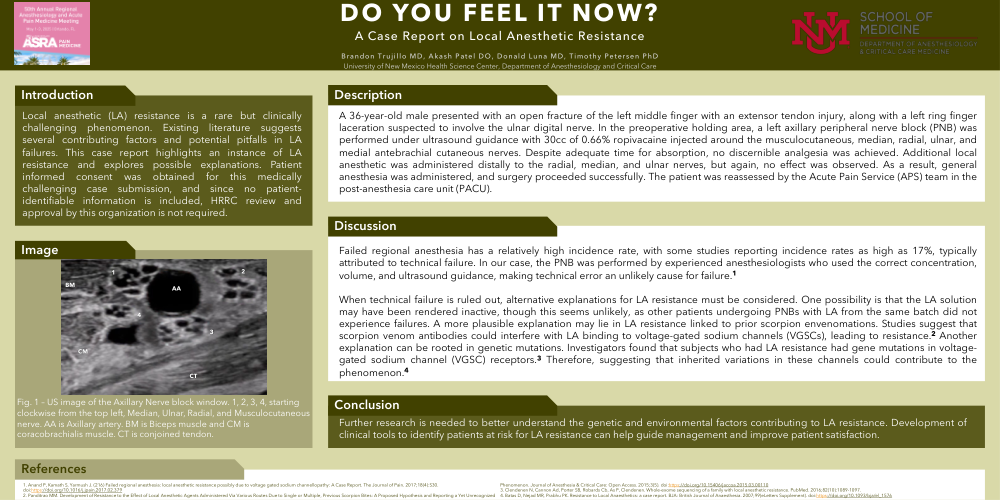
A 36-year-old male presented with an open fracture of the left middle finger with an extensor tendon injury, along with a left ring finger laceration suspected to involve the ulnar digital nerve. In the preoperative holding area, a left axillary peripheral nerve block (PNB) was performed under ultrasound guidance with 30cc of 0.66% ropivacaine injected around the musculocutaneous, median, radial, ulnar, and medial antebrachial cutaneous nerves. Despite adequate time for absorption, no discernible analgesia was achieved. Additional local anesthetic was administered distally to the radial, median, and ulnar nerves, but again, no effect was observed. As a result, general anesthesia was administered, and surgery proceeded successfully. The patient was reassessed by the Acute Pain Service (APS) team in the post-anesthesia care unit (PACU).
Failed regional anesthesia has a relatively high incidence rate, with some studies reporting incidence rates as high as 17%, typically attributed to technical failure. In our case, the PNB was performed by experienced anesthesiologists who used the correct concentration, volume, and ultrasound guidance, making technical error an unlikely cause for failure.1
When technical failure is ruled out, alternative explanations for LA resistance must be considered. One possibility is that the LA solution may have been rendered inactive, though this seems unlikely, as other patients undergoing PNBs with LA from the same batch did not experience failures. A more plausible explanation may lie in LA resistance linked to prior scorpion envenomations. Studies suggest that scorpion venom antibodies could interfere with LA binding to voltage-gated sodium channels (VGSCs), leading to resistance.2 Another explanation can be rooted in genetic mutations. Investigators found that subjects who had LA resistance had gene mutations in voltage-gated sodium channel (VGSC) receptors.3 Therefore, suggesting that inherited variations in these channels could contribute to the phenomenon.4
Further research is needed to better understand the genetic and environmental factors contributing to LA resistance. Development of clinical tools to identify patients at risk for LA resistance can help guide management and improve patient satisfaction.