383 posters, 2 videos, 1 audios, 8 topics, 28 sessions, 328 authors, 225 institutions
ePostersLive by SciGen Technologies S.A. All rights reserved.
50th Annual Regional Anesthesiology and Acute Pain Medicine Meeting
May 1 - 3, 2025 | Orlando, Florida

6671
NOVEL USE OF TRANSVERSUS THORACIC PLANE BLOCK FOR MANAGING ACUTE POST-CPR STERNAL PAIN DURING BUPRENORPHINE INDUCTION
Poster Presenter
Part of Topic
Medically Challenging Cases
Sternal Blocks Beyond the OR: successful use of transversus thoracic plane blocks for CPR-related sternal pain to facilitate buprenorphine induction
Reade E. Tillman MD, Kelly Kaneshiro DO, and Vineesh Mathur, MD
Regional Anesthesiology and Acute Pain Medicine, Johns Hopkins University School of Medicine, Baltimore, MD, USA
INTRODUCTION
Parasternal blocks (PSB) including superficial and deep intercostal plane blocks and transversus thoracic plane block (TTP), are frequently utilized in management of post-sternotomy pain. Less is published regarding the use of PSB for non-sternotomy indications, including traumatic sternal fractures or acute sternal pain after chest compressions during CPR. Patients with opioid use disorder (OUD) often experience severe acute pain that can be difficult to manage. Pharmacotherapy with buprenorphine or methadone is well-established for OUD treatment and initiation of either medication during acute pain episodes is critical for stabilizing baseline opioid tolerance. Until this occurs, opioid-based analgesia often offers limited relief. However, starting buprenorphine while treating acute pain with full opioid agonists risks precipitated withdrawal as the partial agonist/high affinity buprenorphine displaces the full agonist, resulting in abrupt decline of opioid receptor activation. In this context, microdosing buprenorphine can facilitate successful induction and leveraging non-opioid and interventional pain strategies can improve tolerability of this process.
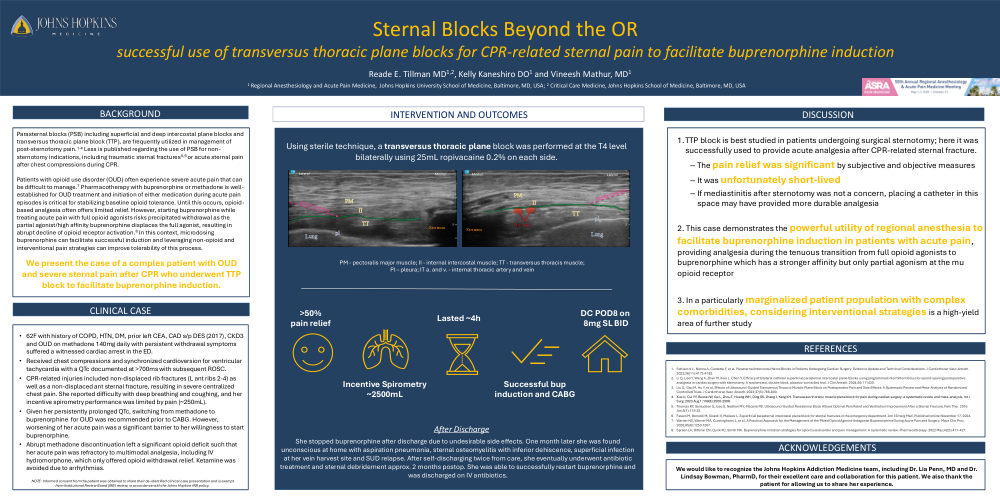
We present the case of a complex patient with OUD and severe sternal pain after CPR who underwent TTP block to facilitate buprenorphine induction.
NOTE: Informed consent from the patient was obtained to share their de-identified clinical case presentation and is exempt from Institutional Review Board (IRB) review, in accordance with the Johns Hopkins IRB policy.
CASE PRESENTATION
A 62F with history of COPD, HTN, DM, prior left CEA, CAD s/p DES (2017), CKD3 and OUD on methadone 140mg daily with persistent withdrawal symptoms suffered a witnessed cardiac arrest in the ED. She received chest compressions and synchronized cardioversion for ventricular tachycardia with a QTc documented at >700ms with subsequent ROSC. Her CPR-related injuries included non-displaced rib fractures (L anterior ribs 2-4) as well as a non-displaced anterior sternal fracture, resulting in severe centralized chest pain. She reported difficulty with deep breathing and coughing, and her incentive spirometry performance was limited by pain (~250mL). Given her persistently prolonged QTc, switching from methadone to buprenorphine for OUD was recommended prior to CABG. However, worsening of her acute pain was a significant barrier to her willingness to start buprenorphine. Abrupt methadone discontinuation left a significant opioid deficit such that her acute pain was refractory to multimodal analgesia, including IV hydromorphone, which only offered opioid withdrawal relief. Ketamine was avoided due to arrhythmias.
DISCUSSION
1.TTP block is best studied in patients undergoing surgical sternotomy; here it was successfully used to provide acute analgesia after CPR-related sternal fracture.
– The pain relief was significant by subjective and objective measures
– It was unfortunately short-lived
– If mediastinitis after sternotomy was not a concern, placing a catheter in this space may have provided more durable analgesia
2. This case demonstrates the powerful utility of regional anesthesia to facilitate buprenorphine induction in patients with acute pain, providing analgesia during the tenuous transition from full opioid agonists to buprenorphine which has a stronger affinity but only partial agonism at the mu opioid receptor
3. In a particularly marginalized patient population with complex comorbidities, considering interventional strategies is a high-yield area of further study