383 posters, 2 videos, 1 audios, 8 topics, 28 sessions, 328 authors, 225 institutions
ePostersLive by SciGen Technologies S.A. All rights reserved.
50th Annual Regional Anesthesiology and Acute Pain Medicine Meeting
May 1 - 3, 2025 | Orlando, Florida

6663
SUPRACLAVICULAR CATHETER PLACEMENT IN A PATIENT WITH A CERVICAL RIB
Poster Presenter
Authors
Affiliations
Part of Topic
Medically Challenging Cases
Supraclavicular Catheter Placement in a Patient with a Cervical Rib
Background
Cervical ribs arise from the seventh cervical vertebra and may attach to the first rib or terminate in the soft tissue ▪ Due to a congenital abnormality ▪ Prevalence in the healthy population is approximately 1% [1] ▪ Often clinically irrelevant and found incidentally, but can cause neurovascular compressive symptoms
Case Presentation
75-year-old female presenting for an open reduction and internal fixation of a left distal humerus fracture ▪ No significant past medical history ▪ Physical exam ▪ Intact sensation and motor function of the left upper extremity ▪ Significantly limited shoulder mobility due to pain precluding infraclavicular approach ▪ Anesthesia plan: general anesthesia + supraclavicular catheter for analgesia
Perioperative Course
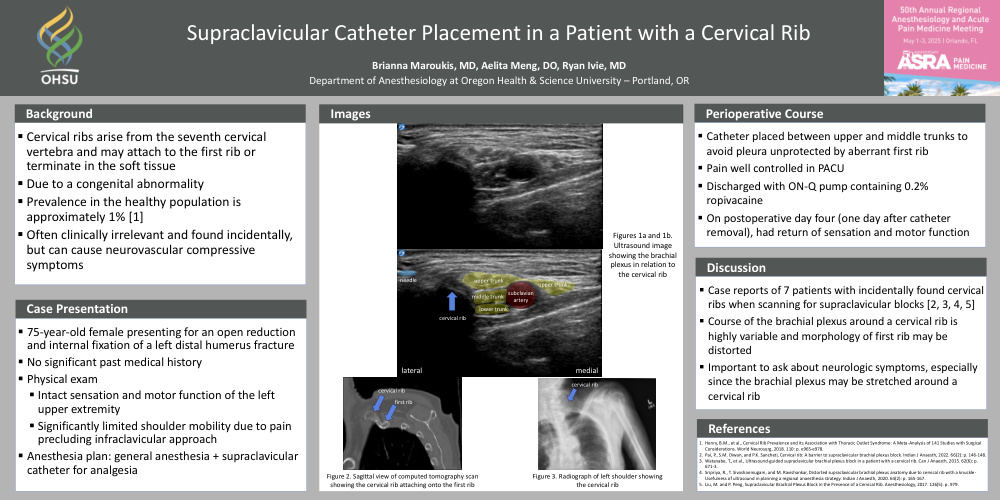
Catheter placed between upper and middle trunks to avoid pleura unprotected by aberrant first rib ▪ Pain well controlled in PACU ▪ Discharged with ON-Q pump containing 0.2% ropivacaine ▪ On postoperative day four (one day after catheter removal), had return of sensation and motor function
Discussion
Case reports of 7 patients with incidentally found cervical ribs when scanning for supraclavicular blocks [2, 3, 4, 5] ▪ Course of the brachial plexus around a cervical rib is highly variable and morphology of first rib may be distorted ▪ Important to ask about neurologic symptoms, especially since the brachial plexus may be stretched around a cervical rib