383 posters, 2 videos, 1 audios, 8 topics, 28 sessions, 328 authors, 225 institutions
ePostersLive by SciGen Technologies S.A. All rights reserved.
50th Annual Regional Anesthesiology and Acute Pain Medicine Meeting
May 1 - 3, 2025 | Orlando, Florida

6595
ERECTOR SPINAE PLANE BLOCK FOR COMPLETE SURGICAL ANESTHETIC IN BILATERAL PERCUTANEOUS KYPHOPLASTY OF A HIGH-RISK ELDERLY PATIENT
Poster Presenter
Authors
Affiliations
Part of Topic
Medically Challenging Cases
Erector Spinae Plane Block as Complete Surgical Anesthetic in Percutaneous Kyphoplasty
Patrick Einhorn MD MSc, Susan Zhao MD, Carmen Charlemagne MD, & Monika Nanda MBBS MPH FASA
Department of Anesthesiology, University of North Carolina at Chapel Hill/UNC Hospitals
Introduction
Advanced age and comorbidities present unique challenges in managing surgical anesthesia. General anesthesia (GA) in this demographic carries increased risk of hemodynamic instability, postoperative delirium, and respiratory complications. Neuraxial anesthesia, while effective, may also precipitate hypotension and is not always feasible in frail patients. As an alternative, ultrasound-guided fascial plane blocks have gained traction due to their safety profile and expanding utility.
The erector spinae plane (ESP) block, first described in 2016, is a regional technique that provides both somatic and visceral analgesia by targeting the dorsal and ventral rami of spinal nerves. While its role in postoperative pain management is increasingly well-documented, its use as a primary anesthetic technique in spine surgery remains limited.
This case demonstrates the successful use of an ESP block as the sole anesthetic, with sedation, for bilateral percutaneous kyphoplasty of a traumatic vertebral compression fracture in a 90-year-old female with significant medical complexity, extreme frailty, and elevated cardiovascular risk.
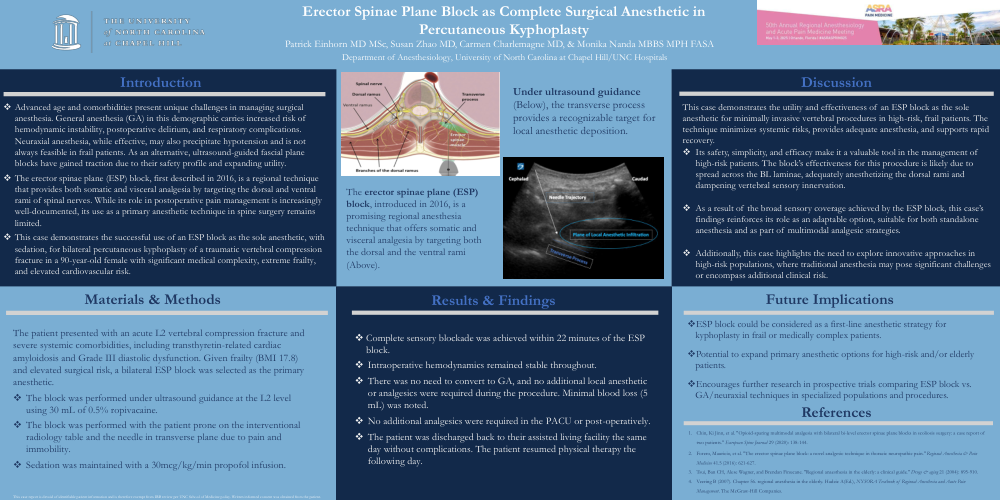
The erector spinae plane (ESP) block, introduced in 2016, is a promising regional anesthesia technique that offers somatic and visceral analgesia by targeting both the dorsal and the ventral rami (Above).
Under ultrasound guidance (Above), the transverse process provides a recognizable target for local anesthetic deposition.
Materials & Methods
The patient presented with an acute L2 vertebral compression fracture and severe systemic comorbidities, including transthyretin-related cardiac amyloidosis and Grade III diastolic dysfunction. Given frailty (BMI 17.8) and elevated surgical risk, a bilateral ESP block was selected as the primary anesthetic.
The block was performed under ultrasound guidance at the L2 level using 30 mL of 0.5% ropivacaine.
The block was performed with the patient prone on the interventional radiology table and the needle in transverse plane due to pain and immobility.
Sedation was maintained with a 30mcg/kg/min propofol infusion.
The case report is devoid of identifiable patient information and is therefore exempt from IRB review per UNC School of Medicine policy. Written informed consent was obtained from the patient.
Results & Findings
Complete sensory blockade was achieved within 22 minutes of the ESP block.
Intraoperative hemodynamics remained stable throughout.
There was no need to convert to GA, and no additional local anesthetic or analgesics were required during the procedure. Minimal blood loss (5 mL) was noted.
No additional analgesics were required in the PACU or post-operatively.
The patient was discharged back to their assisted living facility the same day without complications. The patient resumed physical therapy the following day.
Discussion
This case demonstrates the utility and effectiveness of an ESP block as the sole anesthetic for minimally invasive vertebral procedures in high-risk, frail patients. The technique minimizes systemic risks, provides adequate anesthesia, and supports rapid recovery.
Its safety, simplicity, and efficacy make it a valuable tool in the management of high-risk patients. The block’s effectiveness for this procedure is likely due to spread across the BL laminae, adequately anesthetizing the dorsal rami and dampening vertebral sensory innervation.
As a result of the broad sensory coverage achieved by the ESP block, this case’s findings reinforces its role as an adaptable option, suitable for both standalone anesthesia and as part of multimodal analgesic strategies.
Additionally, this case highlights the need to explore innovative approaches in high-risk populations, where traditional anesthesia may pose significant challenges or encompass additional clinical risk.
Future Implications
ESP block could be considered as a first-line anesthetic strategy for kyphoplasty in frail or medically complex patients.
Potential to expand primary anesthetic options for high-risk and/or elderly patients.
Encourages further research in prospective trials comparing ESP block vs. GA/neuraxial techniques in specialized populations and procedures.
References
Chin, Ki Jinn, et al. "Opioid-sparing multimodal analgesia with bilateral bi-level erector spinae plane blocks in scoliosis surgery: a case report of two patients."European Spine Journal29 (2020): 138-144.
Forero, Mauricio, et al. "The erector spinae plane block: a novel analgesic technique in thoracic neuropathic pain."Regional Anesthesia & Pain Medicine41.5 (2016): 621-627.
Tsui, Ban CH, Alese Wagner, and Brendan Finucane. "Regional anaesthesia in the elderly: a clinical guide."Drugs & aging21 (2004): 895-910.
Veering B(2007). Chapter 56. regional anesthesia in the elderly.Hadzic A(Ed.),NYSORA Textbook of Regional Anesthesia and Acute Pain Management. The McGraw-Hill Companies.