383 posters, 2 videos, 1 audios, 8 topics, 28 sessions, 328 authors, 225 institutions
ePostersLive by SciGen Technologies S.A. All rights reserved.
50th Annual Regional Anesthesiology and Acute Pain Medicine Meeting
May 1 - 3, 2025 | Orlando, Florida

6704
NEURAXIAL ANESTHESIA FOR AMPUTATION OF SARCOMA IN SETTING OF SEVERE PULMONARY COMORBIDITIES
Poster Presenter
Authors
Affiliations
Part of Topic
Medically Challenging Cases
Introduction:
Patients with pre-existing pulmonary dysfunction have increased risk of postoperative complications. Anesthetic agents as well as perioperative analgesics can significantly impact pulmonary function and respiratory drive, especially in patients with chronic lung disease. Neuraxial or regional anesthesia can function as a primary anesthetic modality while also providing reliable analgesia in patients that are unable to tolerate the systemic impact of general anesthesia. We present a case report demonstrating the utility of neuraxial anesthesia as primary anesthetic technique for above-knee amputation for sarcoma in an elderly patient with numerous pulmonary comorbidities.
Case Report:
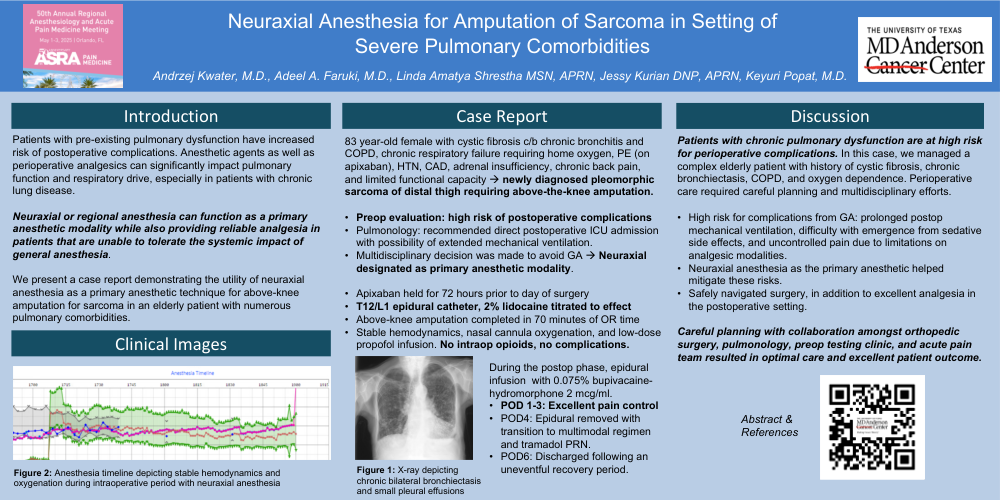
An 83 year-old female with history of cystic fibrosis complicated by chronic bronchitis and COPD, chronic respiratory failure requiring home oxygen, pulmonary embolism on apixaban, hypertension, coronary artery disease, adrenal insufficiency, chronic back pain, and limited functional capacity (Figure 1). She presented with a newly diagnosed pleomorphic sarcoma of the distal thigh with definitive surgical plan involving above-the-knee amputation.
Preoperative evaluation deemed the patient to be high risk for potential postoperative complications. The pulmonologist recommendation included direct postoperative ICU admission with possible need for extended period of mechanical ventilation. Given the patient’s high complication risk, a multidisciplinary decision was made to avoid general anesthesia and proceed with neuraxial anesthesia as the primary anesthetic modality.
In the preoperative area, a T12/L1 epidural catheter was placed and once in the OR, 2% lidocaine was titrated through the catheter to achieve adequate level of surgical anesthesia. The above-knee amputation was completed in 70 minutes of operating time and the patient tolerated it well with stable hemodynamics, nasal cannula oxygenation, and low dose propofol infusion for comfort (Figure 2). She did not require intraoperative opioids and had no complications.
During the postoperative phase, the patient was maintained on an epidural infusion of 0.075% bupivacaine-hydromorphone 2 mcg/ml. On postoperative days (POD) 1-3, she reported excellent pain control, and on POD4, the epidural was removed with transition to a multimodal regimen and tramadol as needed. She was eventually discharged on POD6 following an uneventful recovery period.
Discussion:
Patients with chronic pulmonary dysfunction are at high risk for perioperative complications. In this particular case, we managed a complex elderly patient with history of cystic fibrosis, chronic bronchiectasis, COPD, and oxygen dependence. Perioperative care of such patients requires careful planning and multidisciplinary efforts. Our patient was at risk for complications from general anesthesia, including need for prolonged postoperative mechanical ventilation, difficulty with emergence from sedative side effects, and uncontrolled pain due to limitations on analgesic modalities. With neuraxial anesthesia as the primary anesthetic, our team was able to mitigate these risks. In addition to safely navigating the surgery, our patient had excellent analgesia in the postoperative setting. Careful planning and successful collaboration with orthopedic surgery, pulmonology, preoperative testing clinic, and the acute pain team resulted in optimal care and an excellent patient outcome.