383 posters, 2 videos, 1 audios, 8 topics, 28 sessions, 328 authors, 225 institutions
ePostersLive by SciGen Technologies S.A. All rights reserved.
50th Annual Regional Anesthesiology and Acute Pain Medicine Meeting
May 1 - 3, 2025 | Orlando, Florida

6648
THE USE OF POCUS IN CRITICAL POST-OPERATIVE HYPOTENSION TO DIAGNOSE INTRA-ABDOMINAL HEMORRHAGE FOLLOWING MYOMECTOMY: A CASE REPORT
Poster Presenter
Authors
Affiliations
Part of Topic
Medically Challenging Cases
Use of POCUS in critical post-operative hypotension to diagnose intra-abdominal hemorrhage following myomectomy: a case report.
Peterson K, MD1; Quiroz C, MD1 ; Hall J, MD1; Jacoby M, MD1; Goehl C, MD1; Nakazawa L, MD1 ; de Haan JB, MD1; Hernandez N, MD1
1Department of Anesthesiology, Critical Care and Pain Medicine; McGovern Medical School at UTHealth, Houston, TX
Introduction
Point-of-care ultrasound (POCUS) is used for intravascular access, peripheral nerve blocks, and focused assessed thoracic echocardiography (FATE).
Increasing POCUS education in anesthesiology residency has expanded its perioperative use. (1) POCUS is now used to evaluate patients for causes of postoperative hypotension and hypoxia, reducing PACU length of stay. (2)
We present using POCUS in PACU to diagnose uterine hemorrhage after myomectomy, expediting emergent return to the operating room.
Case Report
51-year-old female with a history of uterine fibroids and abnormal uterine bleeding underwent repeat open abdominal myomectomy.
In PACU, the patient’s blood pressure began to decline to a nadir of 60/30 mmHg, requiring significant hemodynamic support with phenylephrine.
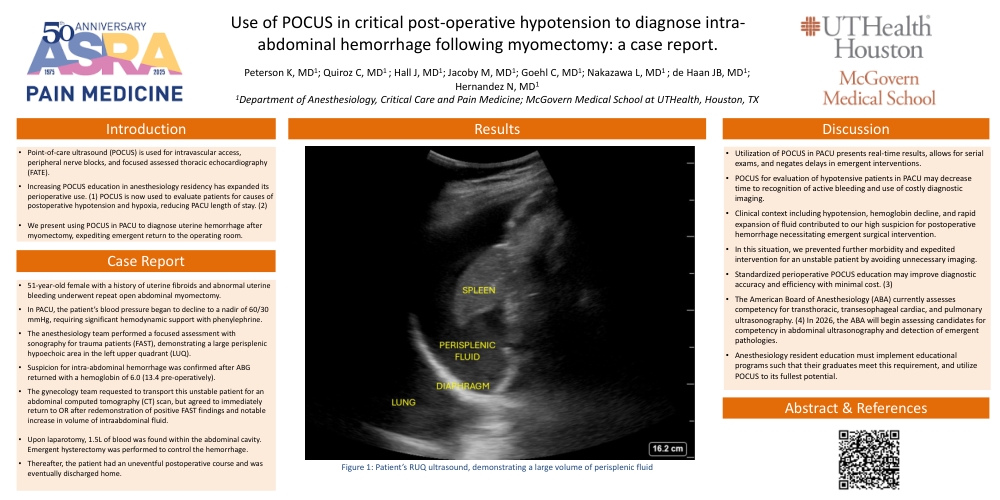
The anesthesiology team performed a focused assessment with sonography for trauma patients (FAST), demonstrating a large perisplenic hypoechoic area in the left upper quadrant (LUQ).
Suspicion for intra-abdominal hemorrhage was confirmed after ABG returned with a hemoglobin of 6.0 (13.4 pre-operatively).
The gynecology team requested to transport this unstable patient for an abdominal computed tomography (CT) scan, but agreed to immediately return to OR after redemonstration of positive FAST findings and notable increase in volume of intraabdominal fluid.
Upon laparotomy, 1.5L of blood was found within the abdominal cavity. Emergent hysterectomy was performed to control the hemorrhage.
Thereafter, the patient had an uneventful postoperative course and was eventually discharged home.
Discussion
Utilization of POCUS in PACU presents real-time results, allows for serial exams, and negates delays in emergent interventions.
POCUS for evaluation of hypotensive patients in PACU may decrease time to recognition of active bleeding and use of costly diagnostic imaging.
Clinical context including hypotension, hemoglobin decline, and rapid expansion of fluid contributed to our high suspicion for postoperative hemorrhage necessitating emergent surgical intervention.
In this situation, we prevented further morbidity and expedited intervention for an unstable patient by avoiding unnecessary imaging.
Standardized perioperative POCUS education may improve diagnostic accuracy and efficiency with minimal cost. (3)
The American Board of Anesthesiology (ABA) currently assesses competency for transthoracic, transesophageal cardiac, and pulmonary ultrasonography. (4) In 2026, the ABA will begin assessing candidates for competency in abdominal ultrasonography and detection of emergent pathologies.
Anesthesiology resident education must implement educational programs such that their graduates meet this requirement, and utilize POCUS to its fullest potential.