383 posters, 2 videos, 1 audios, 8 topics, 28 sessions, 328 authors, 225 institutions
ePostersLive by SciGen Technologies S.A. All rights reserved.
50th Annual Regional Anesthesiology and Acute Pain Medicine Meeting
May 1 - 3, 2025 | Orlando, Florida

6444
SPINAL ANESTHESIA FOR REPEAT CESAREAN SECTION IN A PATIENT WITH VENTRICULOPERITONEAL SHUNT AND CAVERNOUS MALFORMATION
Poster Presenter
Part of Topic
Medically Challenging Cases
Spinal Anesthesia for Repeat Cesarean Section In a Patient With Ventriculoperitoneal Shunt and Cavernous Malformation.
There is limited data on the safety and efficacy of neuraxial anesthesia in patients with ventriculoperitoneal (VP) shunts. It is traditionally thought that neuraxial anesthesia in these patients is associated with a high risk of complications, with risks outweighing benefits. Potential risks of neuraxial anesthesia in these patients include shunt malfunction or infection, increased epidural pressure, or brain herniation. However, the general anesthesia-sparing benefits of neuraxial anesthesia should also be considered, especially in the VP shunt population who often have major comorbidities.
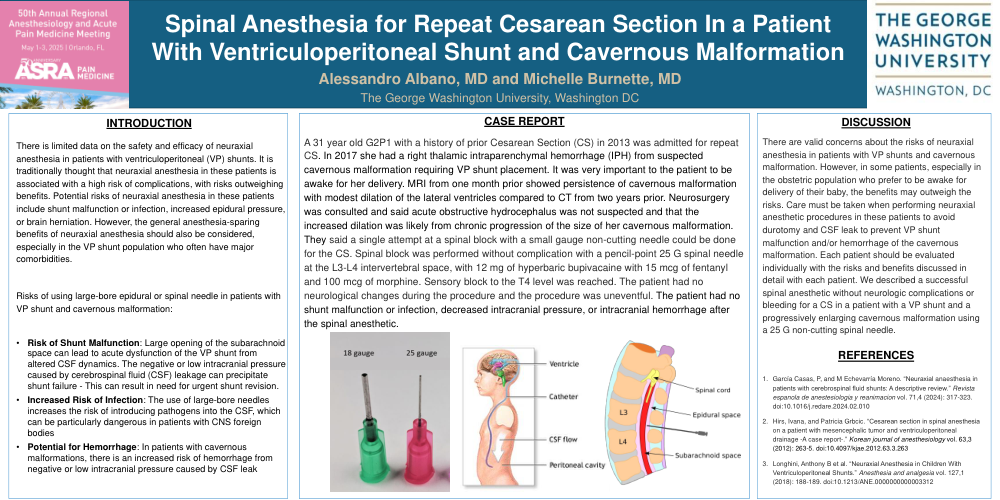
Risks of using large-bore epidural or spinal needle in patients with VP shunt and cavernous malformation:
A 31 year old G2P1 with a history of prior Cesarean Section (CS) in 2013 was admitted for repeat CS. In 2017 she had a right thalamic intraparenchymal hemorrhage (IPH) from suspected cavernous malformation requiring VP shunt placement. It was very important to the patient to be awake for her delivery. MRI from one month prior showed persistence of cavernous malformation with modest dilation of the lateral ventricles compared to CT from two years prior. Neurosurgery was consulted and said acute obstructive hydrocephalus was not suspected and that the increased dilation was likely from chronic progression of the size of her cavernous malformation. They said a single attempt at a spinal block with a small gauge non-cutting needle could be done for the CS. Spinal block was performed without complication with a pencil-point 25 G spinal needle at the L3-L4 intervertebral space, with 12 mg of hyperbaric bupivacaine with 15 mcg of fentanyl and 100 mcg of morphine. Sensory block to the T4 level was reached. The patient had no neurological changes during the procedure and the procedure was uneventful. The patient had no shunt malfunction or infection, decreased intracranial pressure, or intracranial hemorrhage after the spinal anesthetic.
There are valid concerns about the risks of neuraxial anesthesia in patients with VP shunts and cavernous malformation. However, in some patients, especially in the obstetric population who prefer to be awake for delivery of their baby, the benefits may outweigh the risks. Care must be taken when performing neuraxial anesthetic procedures in these patients to avoid durotomy and CSF leak to prevent VP shunt malfunction and/or hemorrhage of the cavernous malformation. Each patient should be evaluated individually with the risks and benefits discussed in detail with each patient. We described a successful spinal anesthetic without neurologic complications or bleeding for a CS in a patient with a VP shunt and a progressively enlarging cavernous malformation using a 25 G non-cutting spinal needle.