383 posters, 2 videos, 1 audios, 8 topics, 28 sessions, 328 authors, 225 institutions
ePostersLive by SciGen Technologies S.A. All rights reserved.
50th Annual Regional Anesthesiology and Acute Pain Medicine Meeting
May 1 - 3, 2025 | Orlando, Florida

6438
RAYNAUD’S PHENOMENON: WHEN NOTHING ELSE WORKS, JUST BLOCK IT
Poster Presenter
Authors
Affiliations
Part of Topic
Medically Challenging Cases
U
pper extremity ischemia & necrosis in a patient with severe secondary
Raynaud’s phenomenon, improved with an infraclavicular nerve block.
Case Presentation
A 60 y/o F
PMH: multiple sclerosis, secondary Raynaud’s phenomenon due to
limited systemic sclerosis, hypothyroidism, Dupuytren’s contracture
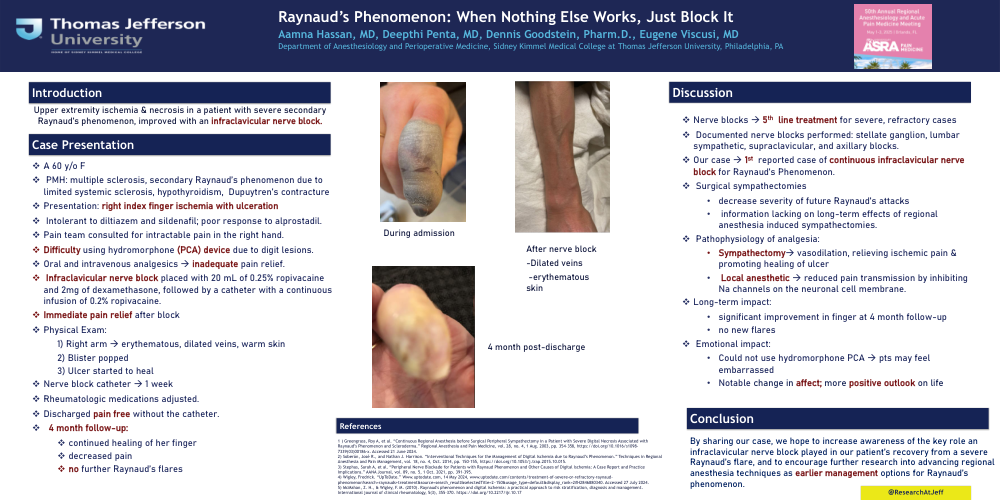
Presentation: right index finger ischemia with ulceration
Intolerant to diltiazem and sildenafil; poor response to alprostadil.
P ain team consulted for intractable pain in the right hand.
D ifficulty using hydromorphone (PCA) device due to digit lesions.
Oral and intravenous analgesics in adequate pain relief.
I nfraclavicular nerve block placed with 20 mL of 0.25% ropivacaine
and 2mg of dexamethasone, followed by a catheter with a continuous
infusion of 0.2% ropivacaine.
I mmediate pain relief after block
Physical Exam:
1)
R ight arm erythematous, dilated veins , warm skin
2)
B lister popped
3) U
lcer started to heal
Nerve block catheter 1 week
R heumatologic medications adjusted.
D ischarged pain free without the catheter.
4 month follow up:
continued healing of her finger
decreased pain
no further Raynaud’s flares
Nerve blocks 5 th line treatment for severe, refractory cases
Do cumented nerve blocks performed: stellate ganglion, lumbar
sympathetic, supraclavicular, and axillary blocks.
Our case 1 st reported case of continuous infraclavicular nerve
block for Raynaud’s Phenomenon.
S urgical sympathectomies
•
decrease severity of future Raynaud’s attacks
•
information lacking on long term effects of regional
anesthesia induced sympathectomies.
Pathophysiology of analgesia:
•
Sympathectomy vasodilation, relieving ischemic pain &
promoting healing of ulcer
•
Local anesthetic reduced pain transmission by inhibiting
Na channels on the neuronal cell membrane.
L ong term impact:
•
significant improvement in finger at 4 month follow up
•
no new flares
Emotional impact:
•
Could not use hydromorphone PCA pts may feel
embarrassed
•
N otable change in affect more positive outlook on life
By sharing our case, we hope to increase awareness of the key role an infraclavicular nerve block played in our patient’s recovery from a severe Raynaud’s flare, and to encourage further research into advancing regional anesthesia techniques as earlier management options for Raynaud’s phenomenon.