383 posters, 2 videos, 1 audios, 8 topics, 28 sessions, 328 authors, 225 institutions
ePostersLive by SciGen Technologies S.A. All rights reserved.
50th Annual Regional Anesthesiology and Acute Pain Medicine Meeting
May 1 - 3, 2025 | Orlando, Florida

6391
DIGITAL ISCHEMIA SECONDARY TO ULNAR ARTERY PUNCTURE SUCCESSFULLY TREATED BY BRACHIAL PLEXUS BLOCK
Poster Presenter
Authors
Affiliations
Part of Topic
Medically Challenging Cases
DIGITAL ISCHEMIA SECONDARY TO ULNAR ARTERY PUNCTURE SUCCESSFULLY TREATED BY BRACHIAL PLEXUS BLOCK
After vascular puncture, arteries can have many complications that impede blood flow such as vasospasm, thrombosis, and emboli generation1,2. Treatment depends on severity of ischemic symptoms and can range from as mild as applying local heat packs to surgical thrombectomy3. We present a case of digital ischemia secondary to vascular puncture that was successfully treated with a supraclavicular nerve block (SCB), resulting in the vascular surgery team canceling an emergent surgery.
Written patient informed consent was obtained prior to presentation of this case. This case report is devoid of patient identifiable information and is exempt from IRB review requirements as per Lahey Hospital and Medical Center policy.
The patient was a 75-year-old woman with severe symptomatic aortic stenosis who underwent
left heart catheterization (LHC) as a part of Transcatheter Aortic Valve Replacement planning.
During her LHC, the interventional cardiology team had difficulty obtaining arterial access via
the left radial artery, therefore the team then attempted left ulnar artery access.
Upon completion of LHC, the patient had duskiness of her left third through fifth fingers, along
with lack of palpable left radial and ulnar pulse, and absent doppler signal through her palmar
arch. Vascular surgery assessed the patient and noted her left hand to have diminished
sensation with no oxygen saturation on plethysmography and no doppler signal in the ulnar
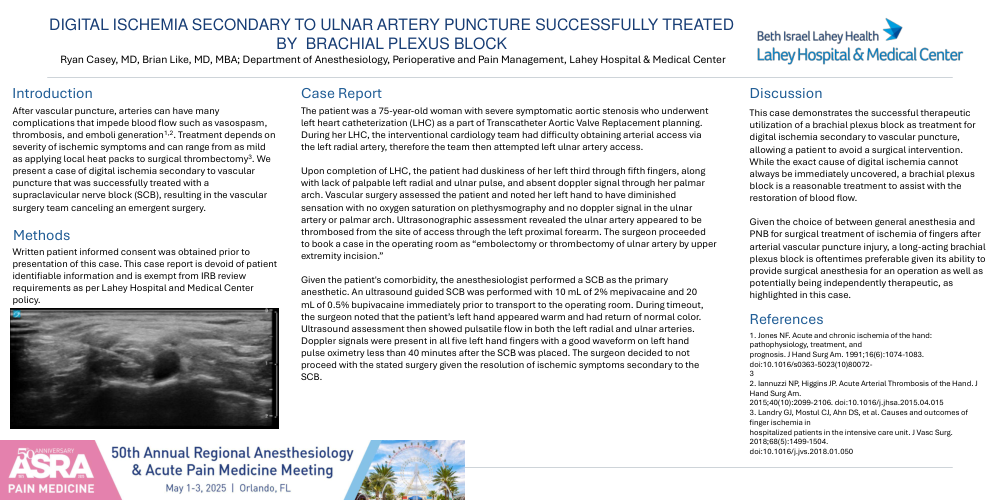
artery or palmar arch. Ultrasonographic assessment revealed the ulnar artery appeared to be
thrombosed from the site of access through the left proximal forearm. The surgeon proceeded
to book a case in the operating room as "embolectomy or thrombectomy of ulnar artery by upper
extremity incision."
Given the patient's comorbidity, the anesthesiologist performed a SCB as the primary
anesthetic. An ultrasound guided SCB was performed with 10 mL of 2% mepivacaine and 20
mL of 0.5% bupivacaine immediately prior to transport to the operating room. During timeout,
the surgeon noted that the patient's left hand appeared warm and had return of normal color.
Ultrasound assessment then showed pulsatile flow in both the left radial and ulnar arteries.
Doppler signals were present in all five left hand fingers with a good waveform on left hand
pulse oximetry less than 40 minutes after the SCB was placed. The surgeon decided to not
proceed with the stated surgery given the resolution of ischemic symptoms secondary to the
SCB.
This case demonstrates the successful therapeutic utilization of a brachial plexus block as treatment for digital ischemia secondary to vascular puncture, allowing a patient to avoid a surgical intervention. While the exact cause of digital ischemia cannot always be immediately uncovered, a brachial plexus block is a reasonable treatment to assist with the restoration of blood flow.
Given the choice of between general anesthesia and PNB for surgical treatment of ischemia of fingers after arterial vascular puncture injury, a long-acting brachial plexus block is oftentimes preferable given its ability to provide surgical anesthesia for an operation as well as potentially being independently therapeutic, as highlighted in this case.