383 posters, 2 videos, 1 audios, 8 topics, 28 sessions, 328 authors, 225 institutions
ePostersLive by SciGen Technologies S.A. All rights reserved.
50th Annual Regional Anesthesiology and Acute Pain Medicine Meeting
May 1 - 3, 2025 | Orlando, Florida

6559
REAL-TIME ULTRASOUND-GUIDED THORACIC EPIDURAL BLOCKADE VIA THE CAUDAL APPROACH FOR POSTOPERATIVE ANALGESIA IN AN AWAKE INFANT
Poster Presenter
Authors
Affiliations
Part of Topic
Medically Challenging Cases
INTRODUCTION
•Caudal epidural blockade is widely used in pediatric anesthesia but requires high volumes for thoracic coverage, increasing the risk of unintended lumbar or sacral nerve blockade.
•Advancing caudal catheters to the thoracic epidural space enables targeted analgesia with lower anesthetic doses and fewer complications.
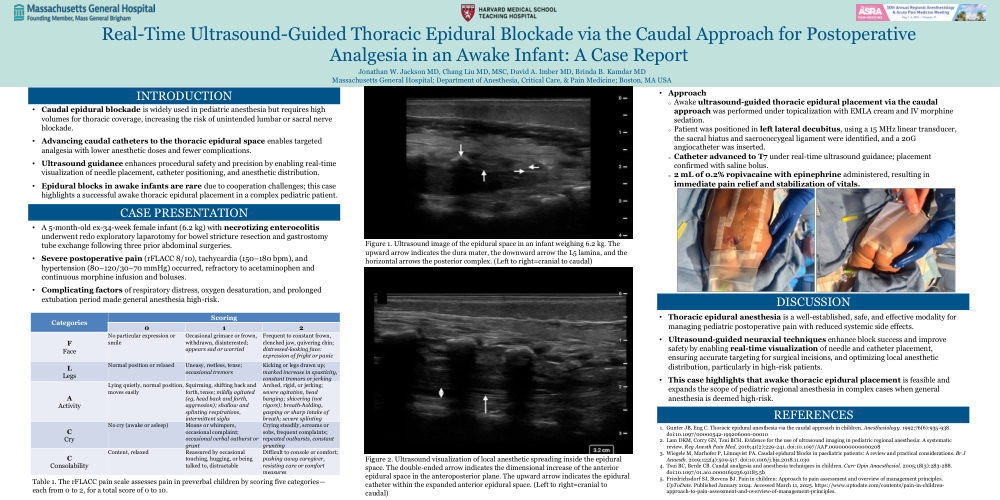
•Ultrasound guidance enhances procedural safety and precision by enabling real-time visualization of needle placement, catheter positioning, and anesthetic distribution.
•Epidural blocks in awake infants are rare due to cooperation challenges; this case highlights a successful awake thoracic epidural placement in a complex pediatric patient.
CASE PRESENTATION
•A 5-month-old ex-34-week female infant (6.2 kg) with necrotizing enterocolitis underwent redo exploratory laparotomy for bowel stricture resection and gastrostomy tube exchange following three prior abdominal surgeries.
•Severe postoperative pain (rFLACC 8/10), tachycardia (150–180 bpm), and hypertension (80–120/30–70 mmHg) occurred, refractory to acetaminophen and continuous morphine infusion and boluses.
•Complicating factors of respiratory distress, oxygen desaturation, and prolonged extubation period made general anesthesia high-risk.
•Approach
oAwake ultrasound-guided thoracic epidural placement via the caudal approach was performed under topicalization with EMLA cream and IV morphine sedation.
oPatient was positioned in left lateral decubitus, using a 15 MHz linear transducer, the sacral hiatus and sacrococcygeal ligament were identified, and a 20G angiocatheter was inserted.
oCatheter advanced to T7 under real-time ultrasound guidance; placement confirmed with saline bolus.
o2 mL of 0.2% ropivacaine with epinephrine administered, resulting in immediate pain relief and stabilization of vitals.
DISCUSSION
•Thoracic epidural anesthesia is a well-established, safe, and effective modality for managing pediatric postoperative pain with reduced systemic side effects.
•Ultrasound-guided neuraxial techniques enhance block success and improve safety by enabling real-time visualization of needle and catheter placement, ensuring accurate targeting for surgical incisions, and optimizing local anesthetic distribution, particularly in high-risk patients.
•This case highlights that awake thoracic epidural placement is feasible and expands the scope of pediatric regional anesthesia in complex cases when general anesthesia is deemed high-risk.