383 posters, 2 videos, 1 audios, 8 topics, 28 sessions, 328 authors, 225 institutions
ePostersLive by SciGen Technologies S.A. All rights reserved.
50th Annual Regional Anesthesiology and Acute Pain Medicine Meeting
May 1 - 3, 2025 | Orlando, Florida

6851
MANAGEMENT OF SURGICAL PATIENT WITH SEVERE REACTIONS TO OPIATE ADMINISTRATION
Poster Presenter
Authors
Affiliations
Part of Topic
Medically Challenging Cases
Management of Surgical Trauma Patient with Severe Reaction to Opiate Administration
Cory Johnson, MD Resident, University of Colorado School of Medicine – Department of Anesthesiology
Adrian Hendrickse, MD Professor, University of Colorado – Department of Anesthesiology
Background
· Drug induced dystonia – Acute uncoordinated muscle contractions/tetany after exposure to triggering substance.
· Common culprits - dopamine receptor antagonists, anti-dopaminergics, and antipsychotics
· Signs/Symptoms - involuntary muscle contractions, often involving the face, neck, and trunk, accompanied by significant pain or discomfort. Clear mental status, normal electrolytes, absence of other pathologies
· Management - antiepileptics, benzodiazepines, barbiturates, and anticholinergics
· Opioid Induced Movement Disorders – involuntary myoclonic movements after opioid administration, most commonly neuraxial
· No clear mechanism, but possibilities include brainstem interactions, metabolites, external pathway inhibition
· Extremely rare for patients to develop after oral or IV administration
Methods
Patient informed consent was obtained for this case report. All information and images were deidentified. Any information that may impact patient care was reported to the primary service provider and patient. Per Colorado Multiple Institutional Review Board policy, IRB review is not required for de-identified, single patient case reports.
Case Report
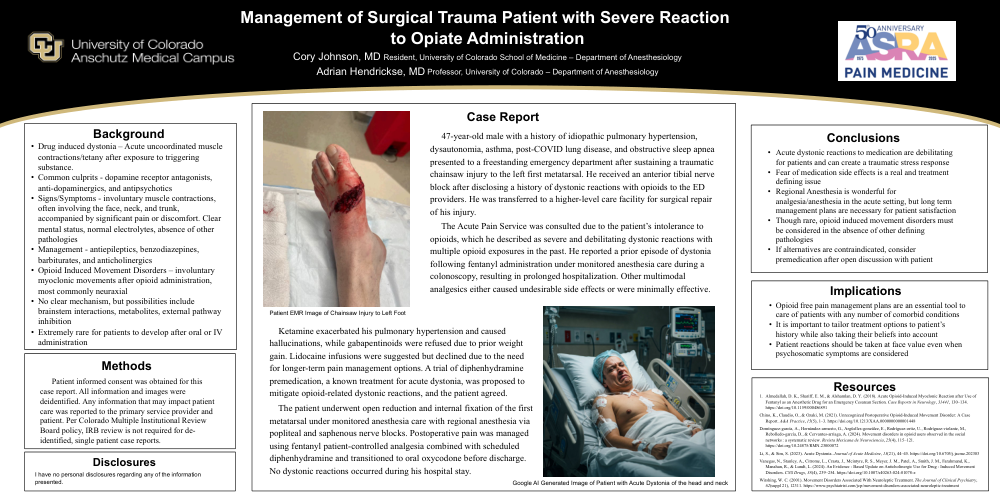
47-year-old male with a history of idiopathic pulmonary hypertension, dysautonomia, asthma, post-COVID lung disease, and obstructive sleep apnea presented to a freestanding emergency department after sustaining a traumatic chainsaw injury to the left first metatarsal. He received an anterior tibial nerve block after disclosing a history of dystonic reactions with opioids to the ED providers. He was transferred to a higher-level care facility for surgical repair of his injury.
The Acute Pain Service was consulted due to the patient’s intolerance to opioids, which he described as severe and debilitating dystonic reactions with multiple opioid exposures in the past. He reported a prior episode of dystonia following fentanyl administration under monitored anesthesia care during a colonoscopy, resulting in prolonged hospitalization. Other multimodal analgesics either caused undesirable side effects or were minimally effective.
Ketamine exacerbated his pulmonary hypertension and caused hallucinations, while gabapentinoids were refused due to prior weight gain. Lidocaine infusions were suggested but declined due to the need for longer-term pain management options. A trial of diphenhydramine premedication, a known treatment for acute dystonia, was proposed to mitigate opioid-related dystonic reactions, and the patient agreed.
The patient underwent open reduction and internal fixation of the first metatarsal under monitored anesthesia care with regional anesthesia via popliteal and saphenous nerve blocks. Postoperative pain was managed using fentanyl patient-controlled analgesia combined with scheduled diphenhydramine and transitioned to oral oxycodone before discharge. No dystonic reactions occurred during his hospital stay.
Conclusions
· Acute dystonic reactions to medication are debilitating for patients and can create a traumatic stress response
· Fear of medication side effects is a real and treatment defining issue
· Regional Anesthesia is wonderful for analgesia/anesthesia in the acute setting, but long term management plans are necessary for patient satisfaction
· Though rare, opioid induced movement disorders must be considered in the absence of other defining pathologies
· If alternatives are contraindicated, consider premedication after open discussion with patient
Implications
· Opioid free pain management plans are an essential tool to care of patients with any number of comorbid conditions
· It is important to tailor treatment options to patient’s history while also taking their beliefs into account
· Patient reactions should be taken at face value even when psychosomatic symptoms are considered
Disclosures
I have no personal disclosures regarding any of the information presented.
Resources
1. Almedallah, D. K., Shariff, E. M., & Alshamlan, D. Y. (2018). Acute Opioid-Induced Myoclonic Reaction after Use of Fentanyl as an Anesthetic Drug for an Emergency Cesarean Section. Case Reports in Neurology, 31441, 130–134. https://doi.org/10.1159/000486891
Chino, K., Claudio, O., & Ozaki, M. (2021). Unrecognized Postoperative Opioid-Induced Movement Disorder: A Case Report. A&A Practice, 15(5), 1–3. https://doi.org/10.1213/XAA.0000000000001448
Domínguez-garcía, A., Hernández-armesto, G., Argüelles-gonzález, E., Rodríguez-ortiz, U., Rodríguez-violante, M., Rebolledo-garcía, D., & Cervantes-arriaga, A. (2024). Movement disorders in opioid users observed in the social networks: a systematic review. Revista Mexicana de Neurociencia, 25(4), 115–121. https://doi.org/10.24875/RMN.23000072
Li, S., & Sim, S. (2023). Acute Dystonia. Journal of Acute Medicine, 13(21), 44–45. https://doi.org/10.6705/j.jacme.202303
Vanegas, N., Stanley, A., Citrome, L., Crasta, J., Mcintyre, R. S., Meyer, J. M., Patel, A., Smith, J. M., Farahmand, K., Manahan, R., & Lundt, L. (2024). An Evidence - Based Update on Anticholinergic Use for Drug - Induced Movement Disorders. CNS Drugs, 38(4), 239–254. https://doi.org/10.1007/s40263-024-01078-z
Wirshing, W. C. (2001). Movement Disorders Associated With Neuroleptic Treatment. The Journal of Clinical Psychiatry, 62(suppl 21), 12311. https://www.psychiatrist.com/jcp/movement-disorders-associated-neuroleptic-treatment
Photo Captions
Patient EMR Image of Chainsaw Injury to Left Foot
Google AI Generated Image of Patient with Acute Dystonia of the head and neck