383 posters, 2 videos, 1 audios, 8 topics, 28 sessions, 328 authors, 225 institutions
ePostersLive by SciGen Technologies S.A. All rights reserved.
50th Annual Regional Anesthesiology and Acute Pain Medicine Meeting
May 1 - 3, 2025 | Orlando, Florida

6612
ULNAR NERVE BLOCKADE FROM PERIPHERAL INTRAVENOUS CATHETER INFILTRATION OF LIDOCAINE AND PROPOFOL
Poster Presenter
Authors
Affiliations
Part of Topic
Medically Challenging Cases
Ulnar Nerve Blockade from Peripheral Intravenous Catheter Infiltration of Lidocaine and Propofol.
Alyssa Poentis, B.S.1, Christopher Chiang, M.D.2
1University of Illinois College of Medicine, Chicago, IL, USA, 2Department of Anesthesiology, University of Illinois at Chicago, Chicago, IL, USA
Introduction: Peripheral intravenous catheters are ubiquitously used in anesthesia, with subcutaneous infiltration a common complication, potentially to acute compartment syndrome with long term neurological sequelae.[i].
Case Report: A 62-year-old male with history of type 2 diabetes, hypertension with no prior history of peripheral neuropathy, presented for elective goniotomy under general anesthesia. Attempted induction of general anesthesia occurred with 80 mg lidocaine, 140 mg propofol, 120 mg succinylcholine, and 6 mg dexamethasone, given in divided dose. During injection, the patient reported significant right arm pain and failed to lose consciousness, raising suspicion for IV infiltration. Consequently, the surgical procedure was cancelled, and ice packs applied to the catheter site with elevation of the right arm. Initially, the patient reported only localized pain, but subsequently reported altered temperature and light touch sensation.
At the time of the first evaluation, the right arm compartments were mildly tense but not rigid, and radial pulses were palpable. The patient reported decreased sensation in the right 3rd, 4th, and 5th digits and weakness of right-hand grip. Three hours later, the compartments of the forearm showed improvement; however, sensory exam noted changes in two-point discrimination of the 4th and 5th digit, and progressive inability to abduct all digits. Wrist flexion / extension and motion at the elbow and shoulder remained intact, with no pain on palpation, but the 4th and 5th digits exhibited a mild claw positioning, with unchanged distal pulses and rapid capillary refill.
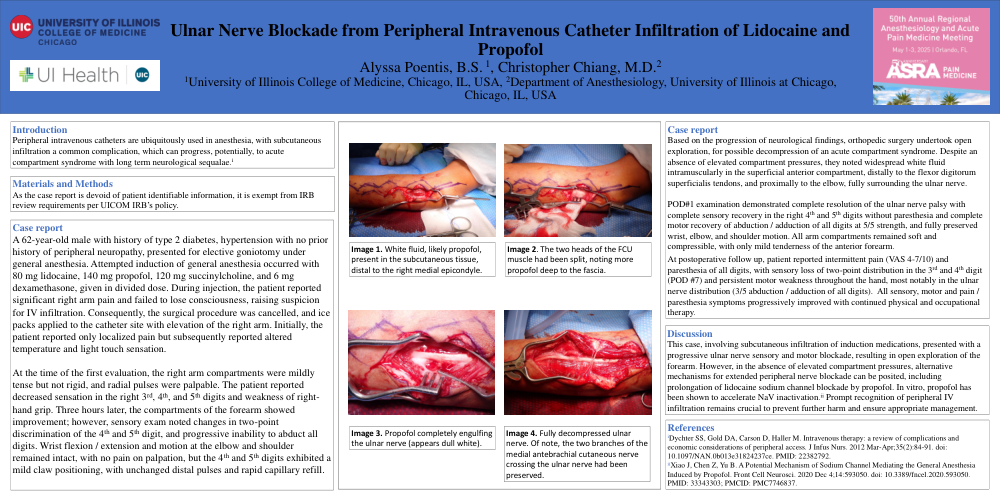
Based on the progression of neurological findings, orthopedic surgery undertook open exploration, for possible decompression of an acute compartment syndrome. Despite an absence of elevated compartment pressures, they noted widespread white fluid intramuscularly in the superficial anterior compartment, distally to the flexor digitorum superficialis tendons, and proximally to the elbow, fully surrounding the ulnar nerve.
POD#1 examination demonstrated complete resolution of the ulnar nerve palsy with complete sensory recovery in the right 4th and 5th digits without paresthesia and complete motor recovery of abduction / adduction of all digits at 5/5 strength, and fully preserved wrist, elbow, and shoulder motion. All arm compartments remained soft and compressible, with only mild tenderness of the anterior forearm.
At postoperative followup, patient reported intermittent pain (VAS 4-7/10) and paresthesia of all digits, with sensory loss of two point distribution in the 3rd and 4th digit (POD #7) and persistent motor weakness throughout the hand, most notably in the ulnar nerve distribution (3/5 abduction / adduction of all digits). All sensory, motor and pain / paresthesia symptoms progressively improved with continued physical and occupational therapy.
Discussion: This case, involving subcutaneous infiltration of induction medications, presented with a progressive ulnar nerve sensory and motor blockade, resulting in open exploration of the forearm. However, in the absence of elevated compartment pressures, alternative mechanisms for extended peripheral nerve blockade can be posited, including prolongation of lidocaine sodium channel blockade by propofol. In vitro, propofol has been shown to accelerate NaV inactivation[ii]. Prompt recognition of peripheral IV infiltration remains crucial to prevent further harm and ensure appropriate management.