383 posters, 2 videos, 1 audios, 8 topics, 28 sessions, 328 authors, 225 institutions
ePostersLive by SciGen Technologies S.A. All rights reserved.
50th Annual Regional Anesthesiology and Acute Pain Medicine Meeting
May 1 - 3, 2025 | Orlando, Florida

6854
STELLATE GANGLION BLOCKADE FOR REFRACTORY VENTRICULAR ELECTRICAL STORM IN A SEDATED AND ANTICOAGULATED PATIENT
Poster Presenter
Authors
Affiliations
Part of Topic
Medically Challenging Cases
Stellate Ganglion Blockade for Refractory Ventricular Electrical Storm in a Sedated and Anticoagulated Patient
Alexander Nguyen, MD; Juan Salgado, MD; Josianna Henson, MD
INTRO
•Electrical Storm (ES) is a life-threatening condition often managed with antiarrhythmic drugs; however, some ventricular arrhythmias remain resistant to pharmacologic (e.g., beta-blockers, antiarrhythmics, sedation) and surgical (e.g., circulatory support devices, catheter ablation) treatments.
•Stellate Ganglion Blocks (SGB) have recently emerged as a therapeutic option to reduce ventricular ES events by modulating myocardial sympathetic tone.
•We describe a case where SGB was successfully used to manage refractory ventricular ES in the setting of giant cell myocarditis and rapid-onset cardiogenic shock.
METHODS
•Written consent for the case report was obtained from the patient.
CASE REPORT
•61-year-old male with PMH of hypertension, dilated ascending aorta, and recent admissions for rapidly progressive heart failure and complete heart block necessitating pacemaker placement.
•He presented to an outside hospital in cardiogenic shock with concerns for giant cell myocarditis. TTE revealed EF <20% while right heart catheterization demonstrated a cardiac index of 1.06 (Fick) and 0.6 (thermodilution).
•The patient required Impella CP support, inotropes, and vasopressors prior to transport.
•A multidisciplinary team initiated VA ECMO, optimized pacemaker settings, and started lidocaine and amiodarone infusions.
•Despite these interventions, the patient experienced >30 daily episodes of ventricular tachycardia (VT) requiring defibrillation.
•This led to increased sedation, antiarrhythmic therapy, and Impella 5.5 placement for left ventricular venting.
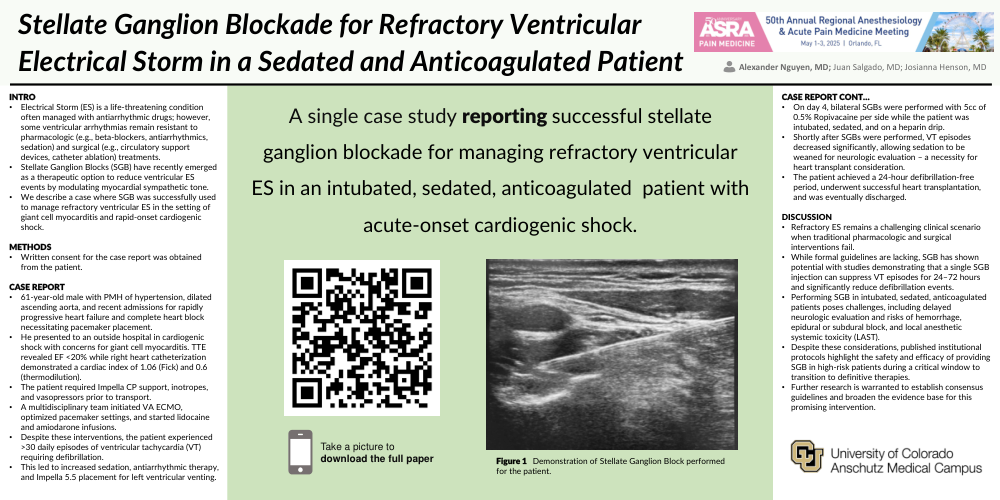
•On day 4, bilateral SGBs were performed with 5cc of 0.5% Ropivacaine per side while the patient was intubated, sedated, and on a heparin drip.
•Shortly after SGBs were performed, VT episodes decreased significantly, allowing sedation to be weaned for neurologic evaluation – a necessity for heart transplant consideration.
•The patient achieved a 24-hour defibrillation-free period, underwent successful heart transplantation, and was eventually discharged.
DISCUSSION
•Refractory ES remains a challenging clinical scenario when traditional pharmacologic and surgical interventions fail.
•While formal guidelines are lacking, SGB has shown potential with studies demonstrating that a single SGB injection can suppress VT episodes for 24–72 hours and significantly reduce defibrillation events.
•Performing SGB in intubated, sedated, anticoagulated patients poses challenges, including delayed neurologic evaluation and risks of hemorrhage, epidural or subdural block, and local anesthetic systemic toxicity (LAST).
•Despite these considerations, published institutional protocols highlight the safety and efficacy of providing SGB in high-risk patients during a critical window to transition to definitive therapies.
•Further research is warranted to establish consensus guidelines and broaden the evidence base for this promising intervention.