383 posters, 2 videos, 1 audios, 8 topics, 28 sessions, 328 authors, 225 institutions
ePostersLive by SciGen Technologies S.A. All rights reserved.
50th Annual Regional Anesthesiology and Acute Pain Medicine Meeting
May 1 - 3, 2025 | Orlando, Florida

6384
MULTI-TARGET PHRENIC NERVE SPARING TECHNIQUE AS PRIMARY ANESTHETIC FOR SHOULDER SURGERY IN PATIENT WITH CARDIOPULMONARY CONCERNS
Poster Presenter
Authors
Affiliations
Part of Topic
Medically Challenging Cases
|
Kathy Zhang1, Aaron Schweitzer1, Lizbeth Hu1, Anis Dizdarevic1 1Columbia University Irving Medical Center Department of Anesthesiology |
|
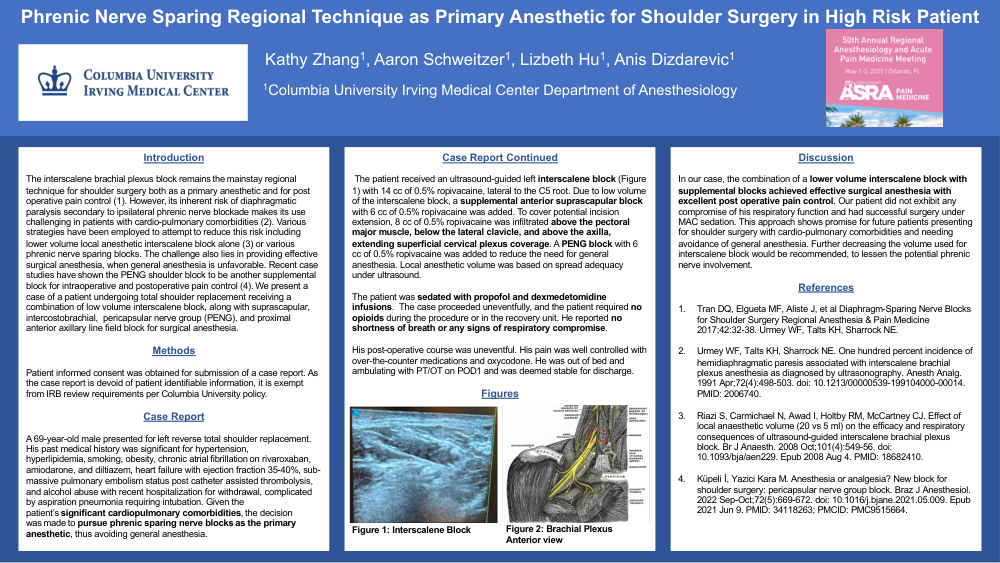
Introduction The interscalene brachial plexus block remains the mainstay regional technique for shoulder surgery both as a primary anesthetic and for post operative pain control (1). However, its inherent risk of diaphragmatic paralysis secondary to ipsilateral phrenic nerve blockade makes its use challenging in patients with cardio-pulmonary comorbidities (2). Various strategies have been employed to attempt to reduce this risk including lower volume local anesthetic interscalene block alone (3) or various phrenic nerve sparing blocks. The challenge also lies in providing effective surgical anesthesia, when general anesthesia is unfavorable. Recent case studies have shown the PENG shoulder block to be another supplemental block for intraoperative and postoperative pain control (4). We present a case of a patient undergoing total shoulder replacement receiving a combination of low volume interscalene block, along with suprascapular, intercostobrachial, pericapsular nerve group (PENG), and proximal anterior axillary line field block for surgical anesthesia. Methods Patient informed consent was obtained for submission of a case report. As the case report is devoid of patient identifiable information, it is exempt from IRB review requirements per Columbia University policy. Case Report A 69-year-old male presented for left reverse total shoulder replacement. His past medical history was significant for hypertension, Case Report Continued The patient received an ultrasound-guided left interscalene block (Figure 1) with 14 cc of 0.5% ropivacaine, lateral to the C5 root. Due to low volume of the interscalene block, a supplemental anterior suprascapular block with 6 cc of 0.5% ropivacaine was added. To cover potential incision extension, 8 cc of 0.5% ropivacaine was infiltrated above the pectoral major muscle, below the lateral clavicle, and above the axilla, extending superficial cervical plexus coverage. A PENG block with 6 cc of 0.5% ropivacaine was added to reduce the need for general anesthesia. Local anesthetic volume was based on spread adequacy under ultrasound. The patient was sedated with propofol and dexmedetomidine infusions. The case proceeded uneventfully, and the patient required no opioids during the procedure or in the recovery unit. He reported no shortness of breath or any signs of respiratory compromise. His post-operative course was uneventful. His pain was well controlled with over-the-counter medications and oxycodone. He was out of bed and ambulating with PT/OT on POD1 and was deemed stable for discharge. Discussion In our case, the combination of a lower volume interscalene block with supplemental blocks achieved effective surgical anesthesia with excellent post operative pain control. Our patient did not exhibit any compromise of his respiratory function and had successful surgery under MAC sedation. This approach shows promise for future patients presenting for shoulder surgery with cardio-pulmonary comorbidities and needing avoidance of general anesthesia. Further decreasing the volume used for interscalene block would be recommended, to lessen the potential phrenic nerve involvement. References
|