383 posters, 2 videos, 1 audios, 8 topics, 28 sessions, 328 authors, 225 institutions
ePostersLive by SciGen Technologies S.A. All rights reserved.
50th Annual Regional Anesthesiology and Acute Pain Medicine Meeting
May 1 - 3, 2025 | Orlando, Florida

6850
EFFECTIVE PAIN MANAGEMENT STRATEGIES IN TRAUMA: A CASE REPORT OF CHEST WALL INJURY WITH MULTIMODAL ANALGESIA
Poster Presenter
Part of Topic
Medically Challenging Cases
Effective Pain Management Strategies in Trauma: A Case Report of Chest Wall Injury With Multimodal Analgesia
Sahil Patel, OMS III; Roberto Echeverri, M.D.
Nova Southeastern University Kiran C. Patel College of Osteopathic Medicine, Miami VA Medical Center
Introduction: Severe blast injuries with third-degree burns from flashbang grenades are rare and challenging. Chest trauma is a major cause of morbidity in polytrauma. Early surgical repair of pectoralis major injuries improves function. Advances in reconstructive techniques using muscle flaps (latissimus dorsi, pectoralis major, serratus anterior, rectus abdominis) have lowered infection and mortality rates. Reconstruction restores chest wall integrity, pulmonary function, and organ protection. Full-thickness defects can often be repaired in one procedure, with the pectoralis major flap essential for sternal and anterior chest coverage. When skeletal stability is intact, skin grafts, local flaps, and negative-pressure therapy are useful. Postoperative rehabilitation is key, with obesity and psychiatric conditions posing risks for poor outcomes.
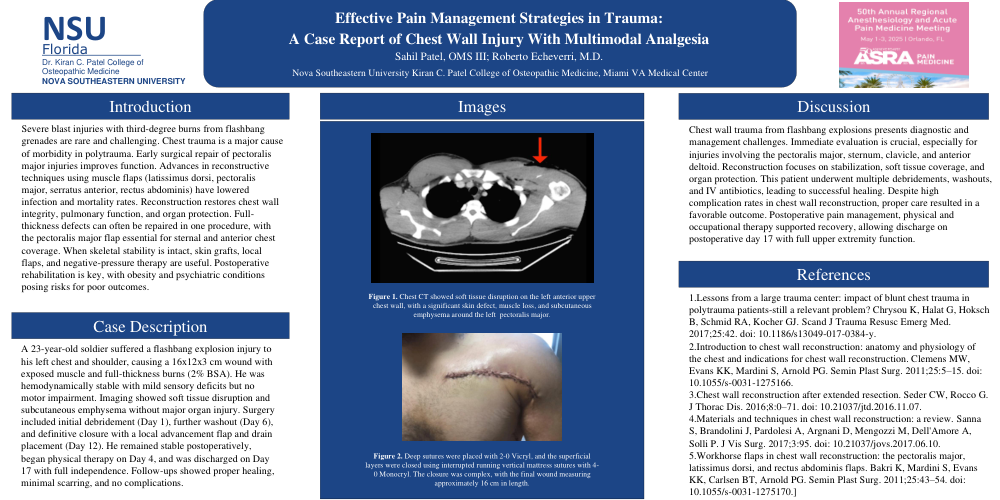
Case Description: A 23-year-old soldier suffered a flashbang explosion injury to his left chest and shoulder, causing a 16x12x3 cm wound with exposed muscle and full-thickness burns (2% BSA). He was hemodynamically stable with mild sensory deficits but no motor impairment. Imaging showed soft tissue disruption and subcutaneous emphysema without major organ injury. Surgery included initial debridement (Day 1), further washout (Day 6), and definitive closure with a local advancement flap and drain placement (Day 12). He remained stable postoperatively, began physical therapy on Day 4, and was discharged on Day 17 with full independence. Follow-ups showed proper healing, minimal scarring, and no complications.
Discussion: Chest wall trauma from flashbang explosions presents diagnostic and management challenges. Immediate evaluation is crucial, especially for injuries involving the pectoralis major, sternum, clavicle, and anterior deltoid. Reconstruction focuses on stabilization, soft tissue coverage, and organ protection. This patient underwent multiple debridements, washouts, and IV antibiotics, leading to successful healing. Despite high complication rates in chest wall reconstruction, proper care resulted in a favorable outcome. Postoperative pain management, physical and occupational therapy supported recovery, allowing discharge on postoperative day 17 with full upper extremity function.
Images:
Figure 1. Chest CT showed soft tissue disruption on the left anterior upper chest wall, with a significant skin defect, muscle loss, and subcutaneous emphysema around the left pectoralis major.
Figure 2. Deep sutures were placed with 2-0 Vicryl, and the superficial layers were closed using interrupted running vertical mattress sutures with 4-0 Monocryl. The closure was complex, with the final wound measuring approximately 16 cm in length.
References:
1.Lessons from a large trauma center: impact of blunt chest trauma in polytrauma patients-still a relevant problem? Chrysou K, Halat G, Hoksch B, Schmid RA, Kocher GJ. Scand J Trauma ResuscEmerg Med. 2017;25:42. doi: 10.1186/s13049-017-0384-y.
2.Introduction to chest wall reconstruction: anatomy and physiology of the chest and indications for chest wall reconstruction. Clemens MW, Evans KK, Mardini S, Arnold PG. Semin Plast Surg. 2011;25:5–15. doi: 10.1055/s-0031-1275166.
3.Chest wall reconstruction after extended resection. Seder CW, Rocco G. J Thorac Dis. 2016;8:0–71. doi: 10.21037/jtd.2016.11.07.
4.Materials and techniques in chest wall reconstruction: a review. Sanna S, Brandolini J, Pardolesi A, Argnani D, Mengozzi M, Dell'Amore A, Solli P. J Vis Surg. 2017;3:95. doi: 10.21037/jovs.2017.06.10.
5.Workhorse flaps in chest wall reconstruction: the pectoralis major, latissimus dorsi, and rectus abdominis flaps. Bakri K, Mardini S, Evans KK, Carlsen BT, Arnold PG. Semin Plast Surg. 2011;25:43–54. doi: 10.1055/s-0031-1275170.]