383 posters, 2 videos, 1 audios, 8 topics, 28 sessions, 328 authors, 225 institutions
ePostersLive by SciGen Technologies S.A. All rights reserved.
50th Annual Regional Anesthesiology and Acute Pain Medicine Meeting
May 1 - 3, 2025 | Orlando, Florida

6659
PERIPHERAL NERVE CATHETERS AS ADJUNCT TO ENHANCE SATISFACTION IN THE CHRONIC PAIN PATIENT WITH EXTREME OPIOID TOLERANCE
Poster Presenter
Authors
Affiliations
Part of Topic
Medically Challenging Cases
Introduction
• Peripheral nerve catheters are a safe and
effective way of providing continuous, targeted
anesthesia
• Can serve as adjunct to multimodal analgesic
regimen in the chronic pain patient
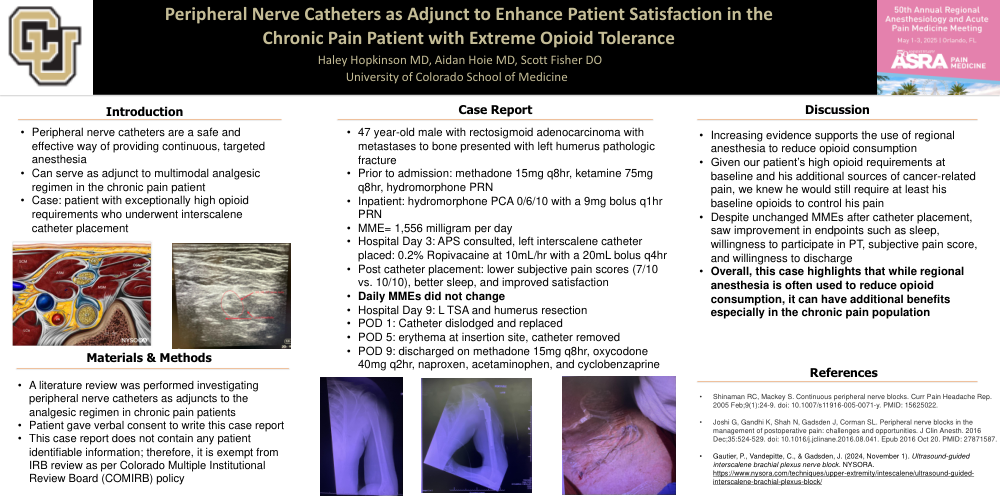
• Case: patient with exceptionally high opioid
requirements who underwent interscalene
catheter placement
Materials and Methods
• A literature review was performed investigating
peripheral nerve catheters as adjuncts to the
analgesic regimen in chronic pain patients
• Patient gave verbal consent to write this case report
• This case report does not contain any patient
identifiable information; therefore, it is exempt from
IRB review as per Colorado Multiple Institutional
Review Board (COMIRB) policy
Case Report
• 47 year-old male with rectosigmoid adenocarcinoma with
metastases to bone presented with left humerus pathologic
fracture
• Prior to admission: methadone 15mg q8hr, ketamine 75mg
q8hr, hydromorphone PRN
• Inpatient: hydromorphone PCA 0/6/10 with a 9mg bolus q1hr
PRN
• MME= 1,556 milligram per day
• Hospital Day 3: APS consulted, left interscalene catheter
placed: 0.2% Ropivacaine at 10mL/hr with a 20mL bolus q4hr
• Post catheter placement: lower subjective pain scores (7/10
vs. 10/10), better sleep, and improved satisfaction
• Daily MMEs did not change
• Hospital Day 9: L TSA and humerus resection
• POD 1: Catheter dislodged and replaced
• POD 5: erythema at insertion site, catheter removed
• POD 9: discharged on methadone 15mg q8hr, oxycodone
40mg q2hr, naproxen, acetaminophen, and cyclobenzaprine
Discussion
• Increasing evidence supports the use of regional
anesthesia to reduce opioid consumption
• Given our patient’s high opioid requirements at
baseline and his additional sources of cancer-related
pain, we knew he would still require at least his
baseline opioids to control his pain
• Despite unchanged MMEs after catheter placement,
saw improvement in endpoints such as sleep,
willingness to participate in PT, subjective pain score,
and willingness to discharge
• Overall, this case highlights that while regional
anesthesia is often used to reduce opioid
consumption, it can have additional benefits
especially in the chronic pain population
Resources
• Shinaman RC, Mackey S. Continuous peripheral nerve blocks. Curr Pain Headache Rep.
2005 Feb;9(1):24-9. doi: 10.1007/s11916-005-0071-y. PMID: 15625022.
• Joshi G, Gandhi K, Shah N, Gadsden J, Corman SL. Peripheral nerve blocks in the
management of postoperative pain: challenges and opportunities. J Clin Anesth. 2016
Dec;35:524-529. doi: 10.1016/j.jclinane.2016.08.041. Epub 2016 Oct 20. PMID: 27871587.
• Gautier, P., Vandepitte, C., & Gadsden, J. (2024, November 1). Ultrasound-guided
interscalene brachial plexus nerve block. NYSORA.
https://www.nysora.com/techniques/upper-