383 posters, 2 videos, 1 audios, 8 topics, 28 sessions, 328 authors, 225 institutions
ePostersLive by SciGen Technologies S.A. All rights reserved.
50th Annual Regional Anesthesiology and Acute Pain Medicine Meeting
May 1 - 3, 2025 | Orlando, Florida

6470
THROUGH-KNEE AMPUTATION UNDER PERIPHERAL REGIONAL ANESTHESIA WITHOUT SEDATION
Poster Presenter
Authors
Affiliations
Part of Topic
Medically Challenging Cases
THROUGH-KNEE AMPUTATION UNDER PERIPHERAL REGIONAL ANESTHESIA WITHOUT SEDATION
Pre-op nerve blocks in ICU prior to OR transfer:
Intra-operatively:
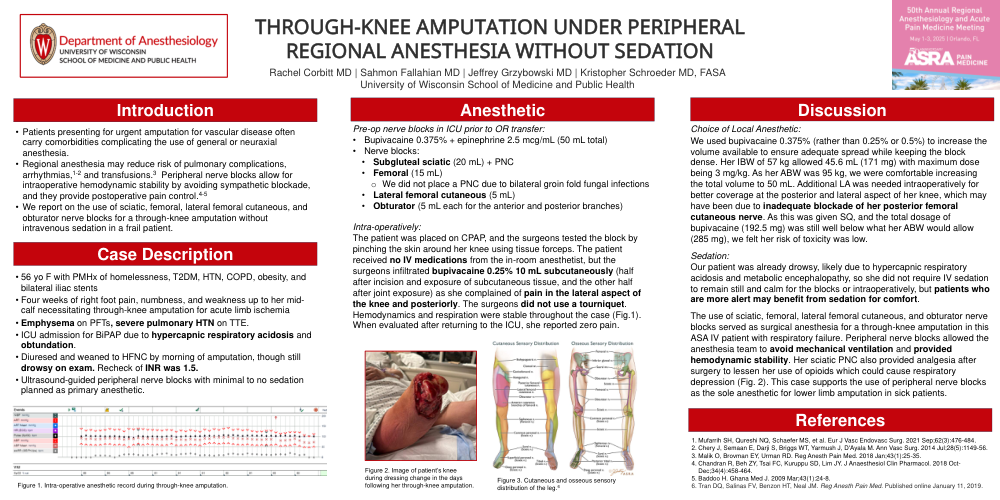
The patient was placed on CPAP, and the surgeons tested the block by pinching the skin around her knee using tissue forceps. The patient received no IV medications from the in-room anesthetist, but the surgeons infiltrated bupivacaine 0.25% 10 mL subcutaneously (half after incision and exposure of subcutaneous tissue, and the other half after joint exposure) as she complained of pain in the lateral aspect of the knee and posteriorly. The surgeons did not use a tourniquet. Hemodynamics and respiration were stable throughout the case (Fig.1). When evaluated after returning to the ICU, she reported zero pain.
Discussion:
Choice of Local Anesthetic: We used bupivacaine 0.375% (rather than 0.25% or 0.5%) to increase the volume available to ensure adequate spread while keeping the block dense. Her IBW of 57 kg allowed 45.6 mL (171 mg) with maximum dose being 3 mg/kg. As her ABW was 95 kg, we were comfortable increasing the total volume to 50 mL. Additional LA was needed intraoperatively for better coverage at the posterior and lateral aspect of her knee, which may have been due to inadequate blockade of her posterior femoral cutaneous nerve. As this was given SQ, and the total dosage of bupivacaine (192.5 mg) was still well below what her ABW would allow (285 mg), we felt her risk of toxicity was low.
Sedation:Our patient was already drowsy, likely due to hypercapnic respiratory acidosis and metabolic encephalopathy, so she did not require IV sedation to remain still and calm for the blocks or intraoperatively, but patients who are more alert may benefit from sedation for comfort.
The use of sciatic, femoral, lateral femoral cutaneous, and obturator nerve blocks served as surgical anesthesia for a through-knee amputation in this ASA IV patient with respiratory failure. Peripheral nerve blocks allowed the anesthesia team to avoid mechanical ventilation and provided hemodynamic stability. Her sciatic PNC also provided analgesia after surgery to lessen her use of opioids which could cause respiratory depression (Fig. 2). This case supports the use of peripheral nerve blocks as the sole anesthetic for lower limb amputation in sick patients.