383 posters, 2 videos, 1 audios, 8 topics, 28 sessions, 328 authors, 225 institutions
ePostersLive by SciGen Technologies S.A. All rights reserved.
50th Annual Regional Anesthesiology and Acute Pain Medicine Meeting
May 1 - 3, 2025 | Orlando, Florida

6395
HIDDEN BONE SHARD CAUSES LIFE-THREATENING AXILLARY ARTERY TRANSECTION DURING ELECTIVE TOTAL SHOULDER ARTHROPLASTY
Poster Presenter
Authors
Affiliations
Part of Topic
Medically Challenging Cases
Hidden Bone Shard Causes Life-Threatening Axillary Artery Transection During Elective Total Shoulder Arthroplasty.
Robert L. Owen, M.D., Punnose K. Kattil, M.B.B.S., M.D., Beth A. VanderWielen, M.D.
Mayo Clinic, Department of Anesthesiology and Perioperative Medicine
Introduction
• We describe an unpredictable clinical scenario involving an intraoperative vascular injury during an elective total shoulder arthroplasty (TSA).
• We aim to alert anesthesia practitioners and ambulatory surgical centers (ASCs) of this rare but life-threatening complication of TSA.
Case
• 72 y.o. woman
• Elective case, shoulder arthritis
• GERD, hiatal hernia, mild anemia
• B.M.I. 15 kg/m², 45 kg, 161 cm
• Ground-level fall 12-months prior
• Humeral fx, conservatively managed
• Pre-Op:
• Interscalene block for post-op pain
• Single-shot
• 10 mL of 1.3% liposomal bupivacaine
• 7 mL of 0.5% bupivacaine
• Intra-Op:
• GETA
• Beach chair position
• Early into the case:
• Acutely hypotensive
• Unable to register NIBP
• Critical event:
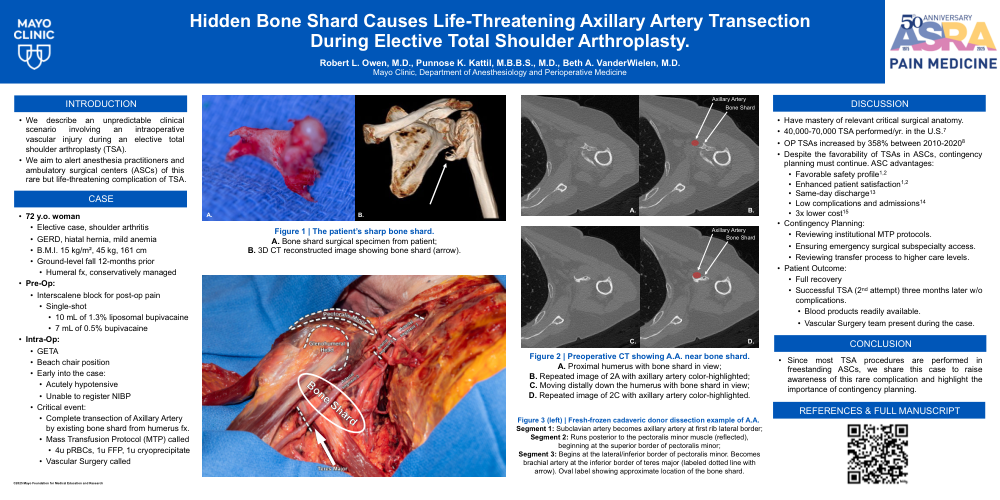
• Complete transection of Axillary Artery by existing bone shard from humerus fx.
• Mass Transfusion Protocol (MTP) called
• 4u pRBCs, 1u FFP, 1u cryoprecipitate
• Vascular Surgery called
Discussion
• Have mastery of relevant critical surgical anatomy.
• 40,000-70,000 TSA performed/yr. in the U.S.7
• OP TSAs increased by 358% between 2010-20208
• Despite the favorability of TSAs in ASCs, contingency planning must continue. ASC advantages:
• Favorable safety profile1,2
• Enhanced patient satisfaction1,2
• Same-day discharge13
• Low complications and admissions14
• 3x lower cost15
• Contingency Planning:
• Reviewing institutional MTP protocols.
• Ensuring emergency surgical subspecialty access.
• Reviewing transfer process to higher care levels.
• Patient Outcome:
• Full recovery
• Successful TSA (2nd attempt) three months later w/o complications.
• Blood products readily available.
• Vascular Surgery team present during case.
Conclusion
• Since most TSA procedures are performed in freestanding ASCs, we share this case to raise awareness of this rare complication and highlight the importance of contingency planning.
References & Full Manuscript
• https://drive.google.com/file/d/1w6whfyfuSA9EVU371ZH3_bsAXphPwBan/view?usp=sharing