383 posters, 2 videos, 1 audios, 8 topics, 28 sessions, 328 authors, 225 institutions
ePostersLive by SciGen Technologies S.A. All rights reserved.
50th Annual Regional Anesthesiology and Acute Pain Medicine Meeting
May 1 - 3, 2025 | Orlando, Florida

6896
LOCAL ANESTHESIA RESISTANCE: IS THERE A ROLE FOR LIPOSOMAL BUPIVACAINE?
Poster Presenter
Authors
Affiliations
Part of Topic
Medically Challenging Cases
Local Anesthetic Resistance: Is there a role for liposomal bupivacaine
Background
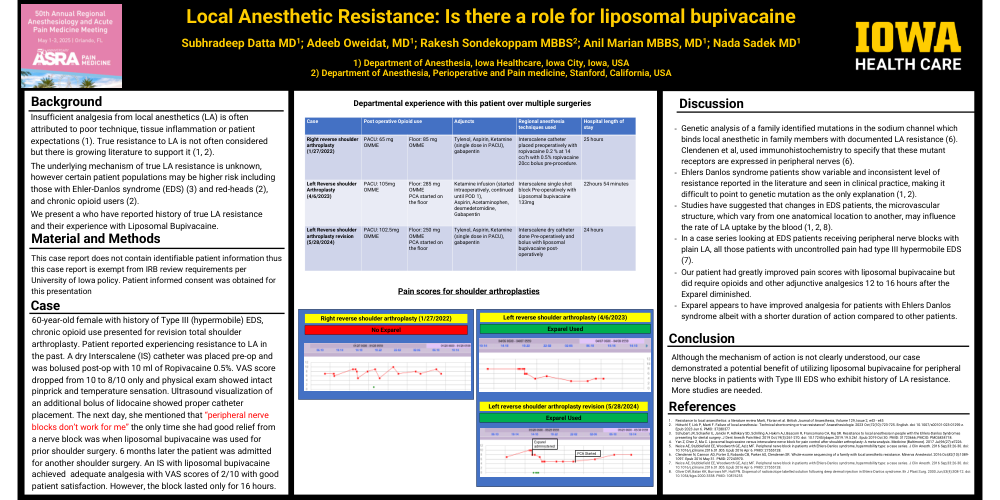
Insufficient analgesia from local anesthetics (LA) is often attributed to poor technique, tissue inflammation or patient expectations (1). True resistance to LA is not often considered but there is growing literature to support it (1, 2). The underlying mechanism of true LA resistance is unknown, however certain patient populations may be higher risk including those with Ehler-Danlos syndrome (EDS) (3) and red-heads (2), and chronic opioid users (2). We present a who have reported history of true LA resistance and their experience with Liposomal Bupivacaine.
Case
60-year-old female with history of Type III (hypermobile) EDS, chronic opioid use presented for revision total shoulder arthroplasty. Patient reported experiencing resistance to LA in the past. A dry Interscalene (IS) catheter was placed pre-op and was bolused post-op with 10 ml of Ropivacaine 0.5%. VAS score dropped from 10 to 8/10 only and physical exam showed intact pinprick and temperature sensation. Ultrasound visualization of an additional bolus of lidocaine showed proper catheter placement. The next day, she mentioned that “peripheral nerve blocks don’t work for me” the only time she had good relief from a nerve block was when liposomal bupivacaine was used for prior shoulder surgery. 6 months later the patient was admitted for another shoulder surgery. An IS with liposomal bupivacaine achieved adequate analgesia with VAS scores of 2/10 with good patient satisfaction. However, the block lasted only for 16 hours.
Discussion
Although the mechanism of action is not clearly understood, our case demonstrated a potential benefit of utilizing liposomal bupivacaine for peripheral nerve blocks in patients with Type III EDS who exhibit history of LA resistance. More studies are needed.