383 posters, 2 videos, 1 audios, 8 topics, 28 sessions, 328 authors, 225 institutions
ePostersLive by SciGen Technologies S.A. All rights reserved.
50th Annual Regional Anesthesiology and Acute Pain Medicine Meeting
May 1 - 3, 2025 | Orlando, Florida

6829
FASCIA ILIACA CATHETER FOR ANALGESIA AND PREOPERATIVE OPTIMIZATION OF PATHOLOGIC FEMUR FRACTURE
Poster Presenter
Authors
Affiliations
Part of Topic
Medically Challenging Cases
Title: Fascia Iliaca Catheter for Analgesia and Preoperative Optimization of Pathologic Femur Fracture
Submitting Author: Victor A. Garcia, M.D.
Authors:
Victor A. Garcia, M.D. (Presenting Author), victor.garcia@bcm.edu
Alexander Reskallah, M.D. (Co-Author), Areskallah@mdanderson.org
Julie M. Mani, M.D. (Co-Author), JMani@mdanderson.org
Cassius K.B. Mensah, M.D. (Co-Author), CMensah@mdanderson.org
Linda Amatya Shrestha MSN, APRN (Co-Author), LAmatya@mdanderson.org
Jessy Kurian DNP, APRN (Co-Author), JSKurian@mdadnerson.org
Andrzej P. Kwater, M.D. (Co-Author), APKwater@mdanderson.org
Department of Anesthesiology and Perioperative Medicine, The University of Texas MD Anderson Cancer Center, Houston, Texas
Introduction
Orthopedic fractures are common in elderly patients, particularly those with oncologic malignancies, which increase the risk of pathologic fractures. Pain management in this population can be difficult due to their susceptibility to delirium, postoperative cognitive dysfunction, and multiple comorbidities. This case illustrates the benefits of regional anesthetic intervention for an elderly patient with a pathologic femur fracture, highlighting its role in facilitating preoperative optimization.
Methods
Informed consent was obtained for regional anesthesia and inclusion in the case report. Since the report did not contain identifiable patient information, it was exempt from IRB review per MD Anderson Cancer Center policy.
Case Report
A 73-year-old male with metastatic renal cell carcinoma and pulmonary metastases complicated by recurrent pleural effusions presented with an acute femur fracture due to a newly identified osteolytic lesion. His medical history included chronic cancer pain, managed with oxycodone, prior total hip and knee arthroplasties, and limited functional capacity. The acute pain service recommended a regional anesthesia technique for preoperative pain management.
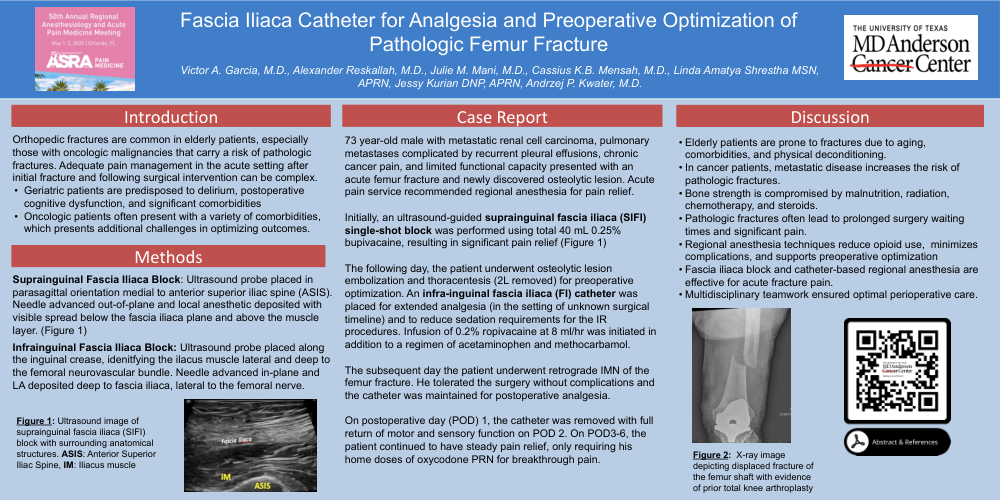
An ultrasound-guided suprainguinal fascia iliaca (SIFI) block was performed using the out-of-plane technique with 40 mL of 0.25% bupivacaine. The patient experienced significant pain relief, enabling him to sit up in bed and providing better dynamic pain control. The next day, the patient underwent embolization of the osteolytic lesion and thoracentesis for a large right pleural effusion. Due to the uncertainty of the surgical timeline, an infra-inguinal fascia iliaca (FI) catheter was placed for extended analgesia, allowing the patient to tolerate the procedures with minimal sedation. Two liters of fluid were removed during thoracentesis, and an infusion of 0.2% ropivacaine at 8 mL/hour was initiated, supplemented with acetaminophen and methocarbamol for multimodal pain control.
The patient subsequently underwent retrograde intramedullary nailing of the right femur fracture. The surgery was well-tolerated, and the fascia iliaca catheter was continued for postoperative analgesia. On postoperative day 1 (POD1), the catheter was removed, and the patient regained full motor and sensory function in the affected leg by POD2. From POD3-6, the patient had consistent pain relief, requiring only his home oxycodone for breakthrough pain.
Discussion
Elderly patients are more prone to fractures due to aging, comorbidities, and physical deconditioning. In cancer patients, metastatic disease further weakens bone integrity, increasing the risk of pathologic fractures. Factors such as malnutrition, radiation, chemotherapy, and steroid use also compromise bone strength. Following a pathologic fracture, these patients often endure prolonged waiting times for surgery and significant pain. Regional anesthesia can effectively manage perioperative pain, reducing opioid use and minimizing associated complications.
This case highlights the advantages of the fascia iliaca block and catheter-based regional anesthesia in managing acute pathologic fracture pain. In addition to providing postoperative analgesia, the regional anesthetic facilitated preoperative optimization, enabling the patient to tolerate necessary procedures that would have otherwise been difficult. The collaborative efforts of the multidisciplinary team ensured optimal perioperative management for this complex patient.
References:
1. Ma Y, Wu J, Xue J, Lan F and Wang T. Ultrasound-guided continuous fascia iliaca compartment block for pre-operative pain control in very elderly patients with hip fracture: A randomized controlled trial. Exp Ther Med. 2018 Sep; 16(3): 1944–1952.
2. A Comparison in Outcomes of Preoperative Single-shot versus Continuous Catheter Fascia Iliaca Regional Anesthesia in Geriatric Hip Fracture Patients Injury 2020, 51 (6): 1337-1342.
3. Chen, L., Shen, Y. Ultrasound-guided supra-inguinal fascia iliaca compartment block for older adults admitted to the emergency department with hip fracture: a randomized controlled, double-blind clinical trial. BMC Geriatr 2021; 21, 669.