383 posters, 2 videos, 1 audios, 8 topics, 28 sessions, 328 authors, 225 institutions
ePostersLive by SciGen Technologies S.A. All rights reserved.
50th Annual Regional Anesthesiology and Acute Pain Medicine Meeting
May 1 - 3, 2025 | Orlando, Florida

6783
INTRAOPERATIVE ACUPUNCTURE AND ENHANCED PATIENT RECOVERY AFTER TOTAL KNEE ARTHROPLASTY
Poster Presenter
Authors
Affiliations
Part of Topic
Medically Challenging Cases
Introduction
Perioperative acupuncture as an adjunct has shown promising results lowering the use of opioids after a variety of surgeries including total knee arthroplasty (1). This case offers a unique instance of a single patient who received the same surgery, total knee arthroplasty, bilaterally at different time points and received perioperative acupuncture for one surgery and not for the other, and experienced differing perioperative recovery outcomes.
Case Description
The patient was a 60 year old woman who presented initially for a right total knee arthroplasty. The patient received a right IPACK block with 15mL bupivacaine 0.5%, a adductor canal block with bupivacaine 0.5% 15mL. The surgery proceeded under spinal anesthetic with mepivacaine 1.5% 3.8mL and sedation with propofol. The patient received 20mg of ketamine and 5mg of midazolam as premedication. Intraoperatively, the patient received 30mg of ketamine, 1g of intravenous acetaminophen, and 15mg IV ketorolac. Additionally, the patient received auricular acupuncture at the ear unilateral to the surgical site, described below. In the post-anesthesia care unit (PACU), the patient’s pain score initially was 6/10. The patient received 5mg of oxycodone, 0.5mg hydromorphone IV push x2. After one hour the patient’s pain score improved to 0/10 and the patient continued to deny pain until discharge from the PACU.
Two months later, the patient presented once more this time for a left total knee arthroplasty. The patient similarly received a spinal anesthetic with mepivacaine 1.5% 4mL, an IPACK block with bupivacaine 0.25% 20mL, and an adductor canal block with bupivacaine 0.25% 20mL. The patient received the same premedication and intraoperative analgesics. In the PACU the patient upon wakeup noted a pain score of 7/10. The patient received 10mg oxycodone x3 and 15mg ketorolac. Five hours postoperatively the patient was noted to still have a pain score of 6/10.
Discussion
A 2017 meta-analysis of adjunctive therapies for TKA found that acupuncture and electrotherapy could reduce pain and opioid use (2). Auricular acupuncture, in addition to being a convenient location for treatment for the anesthesiologist, is useful as the anatomical innervation of the ear with branches of the vagus nerve, trigeminal nerve, and cervical plexus, can modulate pain responses throughout the body using stimulation of both the parasympathetic and sympathetic nervous systems.
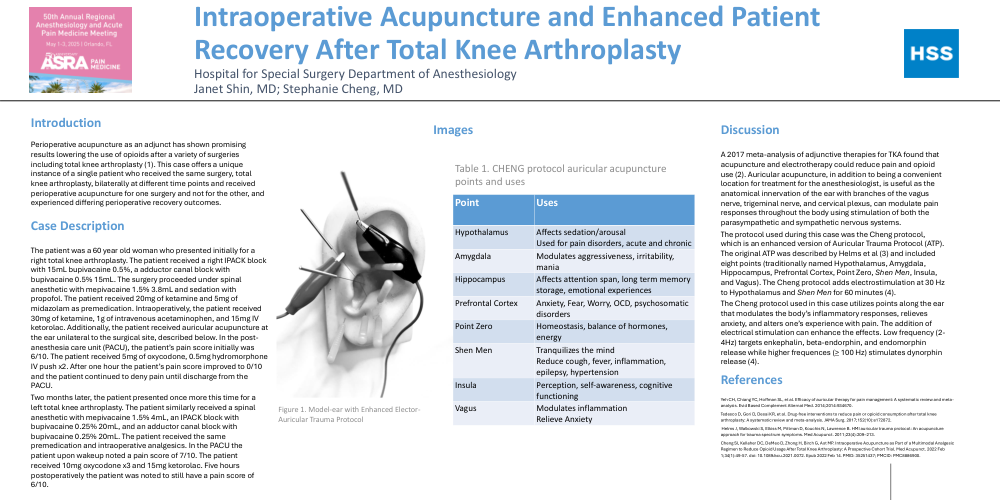
The protocol used during this case was the Cheng protocol, which is an enhanced version of Auricular Trauma Protocol (ATP). The original ATP was described by Helms et al (3) and included eight points (traditionally named Hypothalamus, Amygdala, Hippocampus, Prefrontal Cortex, Point Zero, Shen Men, Insula, and Vagus). The Cheng protocol adds electrostimulation at 30 Hz to Hypothalamus and Shen Men for 60 minutes (4).
The Cheng protocol used in this case utilizes points along the ear that modulates the body’s inflammatory responses, relieves anxiety, and alters one’s experience with pain. The addition of electrical stimulation can enhance the effects. Low frequency (2-4Hz) targets enkephalin, beta-endorphin, and endomorphin release while higher frequences (> 100 Hz) stimulates dynorphin release (4).