383 posters, 2 videos, 1 audios, 8 topics, 28 sessions, 328 authors, 225 institutions
ePostersLive by SciGen Technologies S.A. All rights reserved.
50th Annual Regional Anesthesiology and Acute Pain Medicine Meeting
May 1 - 3, 2025 | Orlando, Florida

6773
PERIPHERAL NERVE BLOCK FOR RECALCITRANT REFERRED PAIN POST MALIGNANT SPINAL CORD DECOMPRESSION AND CRYOABLATION
Poster Presenter
Authors
Affiliations
Part of Topic
Medically Challenging Cases
Case Report
We present the use of a peripheral nerve block for severe persistent referred pain crisis in a patient with advanced malignancy.
Our patient was a 29-year old male with metastatic thigh liposarcoma, presenting with severe unilateral medial knee and suprapatellar pain after T10-L1 spinal cord decompression of metastatic epidural tumour and instrumentation. This pain corresponded to the L3 dermatome, and was described as burning in nature, affecting his sleep.
Various treatment modalities were attempted, including the use of oral anti-neuropathic agents, high level intravenous opioids, intravenous lignocaine and ketamine infusions, and cryoablation of L2/3 nerve roots. However, these did not provide the patient any sustained relief. There was the additional urgency of analgesic control to facilitate his impending radiotherapy sessions. Therapeutic anti-coagulation, which had just been restarted for IVC thrombus, precluded central neuraxial blockade.
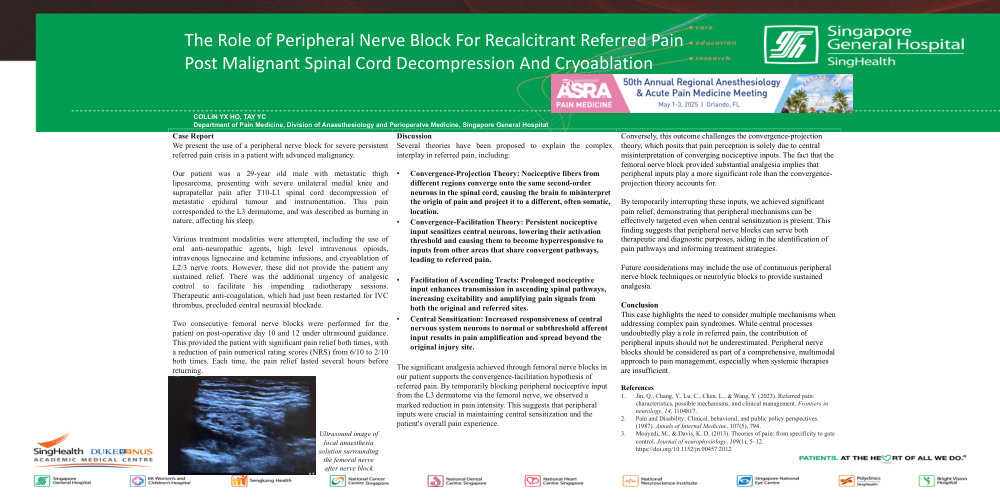
Two consecutive femoral nerve blocks were performed for the patient on post-operative day 10 and 12 under ultrasound guidance. This provided the patient with significant pain relief both times, with a reduction of pain numerical rating scores (NRS) from 6/10 to 2/10 both times. Each time, the pain relief lasted several hours before returning.
Discussion
Several theories have been proposed to explain the complex interplay in referred pain, including:
The significant analgesia achieved through femoral nerve blocks in our patient supports the convergence-facilitation hypothesis of referred pain. By temporarily blocking peripheral nociceptive input from the L3 dermatome via the femoral nerve, we observed a marked reduction in pain intensity. This suggests that peripheral inputs were crucial in maintaining central sensitization and the patient's overall pain experience.
Conversely, this outcome challenges the convergence-projection theory, which posits that pain perception is solely due to central misinterpretation of converging nociceptive inputs. The fact that the femoral nerve block provided substantial analgesia implies that peripheral inputs play a more significant role than the convergence-projection theory accounts for.
By temporarily interrupting these inputs, we achieved significant pain relief, demonstrating that peripheral mechanisms can be effectively targeted even when central sensitization is present. This finding suggests that peripheral nerve blocks can serve both therapeutic and diagnostic purposes, aiding in the identification of pain pathways and informing treatment strategies.
Future considerations may include the use of continuous peripheral nerve block techniques or neurolytic blocks to provide sustained analgesia.
Conclusion
This case highlights the need to consider multiple mechanisms when addressing complex pain syndromes. While central processes undoubtedly play a role in referred pain, the contribution of peripheral inputs should not be underestimated. Peripheral nerve blocks should be considered as part of a comprehensive, multimodal approach to pain management, especially when systemic therapies are insufficient.