383 posters, 2 videos, 1 audios, 8 topics, 28 sessions, 328 authors, 225 institutions
ePostersLive by SciGen Technologies S.A. All rights reserved.
50th Annual Regional Anesthesiology and Acute Pain Medicine Meeting
May 1 - 3, 2025 | Orlando, Florida

6882
THE VITAL ROLE OF REGIONAL ANESTHESIA IN THE INTERPRETIVE MANAGEMENT OF CRITICALLY ILL PATIENTS
Poster Presenter
Authors
Affiliations
Part of Topic
Medically Challenging Cases
Title: The Vital Role of Regional Anesthesia in the Intraoperative Management of Critically Ill Patients: A case report
Introduction:
•Regional anesthetic techniques are well accepted in the post-operative analgesic management of critically ill patients. However, their use as a primary intraoperative anesthetic technique is often overlooked.
•Barriers to the use of regional techniques in the most critically ill patients can include provider comfort level, concerns of local anesthetic toxicity, difficulty with patient positioning and concern for failed blocks.
•These barriers are significantly magnified when multiple regional techniques are required to achieve adequate surgical anesthesia.
•With appropriate planning and communication between clinical teams and thorough patient education, combined regional techniques allow for the benefits of avoiding general anesthesia or neuraxial techniques and can provide a safe, hemodynamically stable and comfortable anesthetic option for the most critically ill patients who would otherwise be at high risk for peri-operative anesthetic complications.
Case Presentation:
•A medically complex 57-year-old female presenting for surgical washout and closure with vac application for bilateral medial fasciotomy wounds of the lower extremities, eleven days after bilateral femoral thrombo-embolectomies. Her initial postoperative course following revascularization was complicated by bilateral lower extremity compartment syndrome requiring bilateral four-compartment fasciotomies.
•Pertinent comorbidities included severe ischemic cardiomyopathy (left ventricular ejection fraction of 15-20% on recent echocardiogram), biventricular ICD, bilateral ventricular thrombi with severe tricuspid regurgitation, coronary artery disease status post seven percutaneous interventions, chronic obstructive pulmonary disease with current tobacco and methamphetamine use and uncontrolled diabetes mellitus.
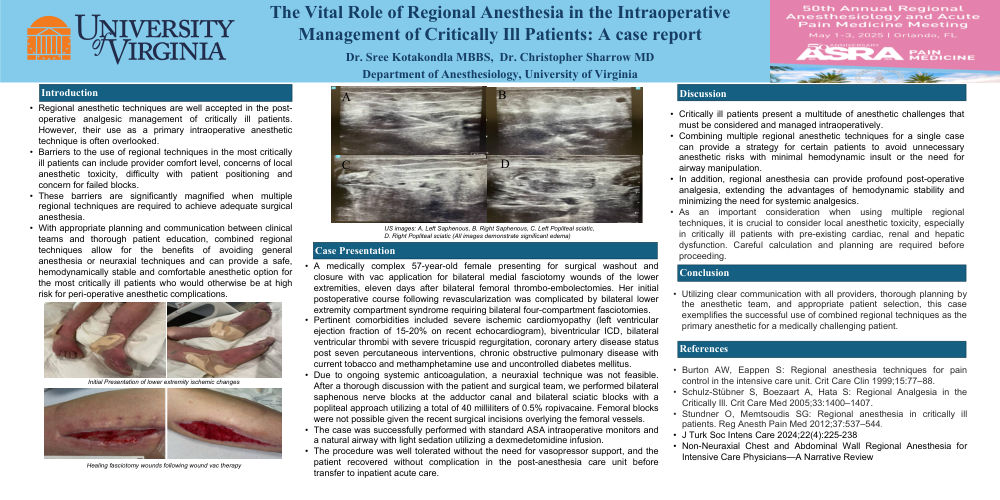
•Due to ongoing systemic anticoagulation, a neuraxial technique was not feasible. After a thorough discussion with the patient and surgical team, we performed bilateral saphenous nerve blocks at the adductor canal and bilateral sciatic blocks with a popliteal approach utilizing a total of 40 milliliters of 0.5% ropivacaine. Femoral blocks were not possible given the recent surgical incisions overlying the femoral vessels.
•The case was successfully performed with standard ASA intraoperative monitors and a natural airway with light sedation utilizing a dexmedetomidine infusion.
•The procedure was well tolerated without the need for vasopressor support, and the patient recovered without complication in the post-anesthesia care unit before transfer to inpatient acute care.
Discussion:
•Critically ill patients present a multitude of anesthetic challenges that must be considered and managed intraoperatively.
•Combining multiple regional anesthetic techniques for a single case can provide a strategy for certain patients to avoid unnecessary anesthetic risks with minimal hemodynamic insult or the need for airway manipulation.
•In addition, regional anesthesia can provide profound post-operative analgesia, extending the advantages of hemodynamic stability and minimizing the need for systemic analgesics.
•As an important consideration when using multiple regional techniques, it is crucial to consider local anesthetic toxicity, especially in critically ill patients with pre-existing cardiac, renal and hepatic dysfunction. Careful calculation and planning are required before proceeding.
Conclusion:
•Utilizing clear communication with all providers, thorough planning by the anesthetic team, and appropriate patient selection, this case exemplifies the successful use of combined regional techniques as the primary anesthetic for a medically challenging patient.
References:
•Burton AW, Eappen S: Regional anesthesia techniques for pain control in the intensive care unit. Crit Care Clin 1999;15:77–88.
•Schulz-Stübner S, Boezaart A, Hata S: Regional Analgesia in the Critically Ill. Crit Care Med 2005;33:1400–1407.
•Stundner O, Memtsoudis SG: Regional anesthesia in critically ill patients. Reg Anesth Pain Med 2012;37:537–544.
•J Turk Soc Intens Care 2024;22(4):225-238
•Non-Neuraxial Chest and Abdominal Wall Regional Anesthesia for Intensive Care Physicians—A Narrative Review