383 posters, 2 videos, 1 audios, 8 topics, 28 sessions, 328 authors, 225 institutions
ePostersLive by SciGen Technologies S.A. All rights reserved.
50th Annual Regional Anesthesiology and Acute Pain Medicine Meeting
May 1 - 3, 2025 | Orlando, Florida

6767
MANAGEMENT OF A PATIENT WITH VENTRICULAR ASSIST DEVICE (VAD) USING REGIONAL BLOCK AS AN ADJUNCT FOR SHOULDER REPLACEMENT SURGERY
Poster Presenter
Authors
Affiliations
Indiana University School of Medicine Department of Anesthesia
Part of Topic
Medically Challenging Cases
MANAGEMENT OF A PATIENT WITH VENTRICULAR ASSIST DEVICE (VAD) USING REGIONAL BLOCK: AN ADJUNCT FOR SHOULDER REPLACEMENT SURGERY
INTRODUCTION:
→ VAD patients present unique anesthetic challenges due to non-pulsatile flow, preload dependence, and hemodynamic instability.
→ Managing these patients perioperatively requires a multidisciplinary approach to optimize outcomes.
→ Regional anesthesia may help stabilize hemodynamics, reduce intraoperative opioid use, and improve overall perioperative care.
CASE REPORT:
→ A 63-year-old male with CAD, CHF with LVAD, VFIB with ICD, and a remote history of GI bleed (not on anticoagulation), undergoing left total shoulder arthroplasty
→ General anesthesia (GA) + ultrasound-guided interscalene block (15 mL 0.5% ropivacaine + 2 mg dexamethasone)
→ KEY PERIOPERATIVE STRATEGIES and EVENTS:
→ Arterial line, BIS monitor, device interrogation,
and perfusionist support
→ Blood loss management and minimal pressor requirements following period of blood loss
→ Minimal intraoperative opioids/successful block
→ Multimodal post-operative pain management
→ The patient was discharged home on postop day two without complications.
MAIN POINT:
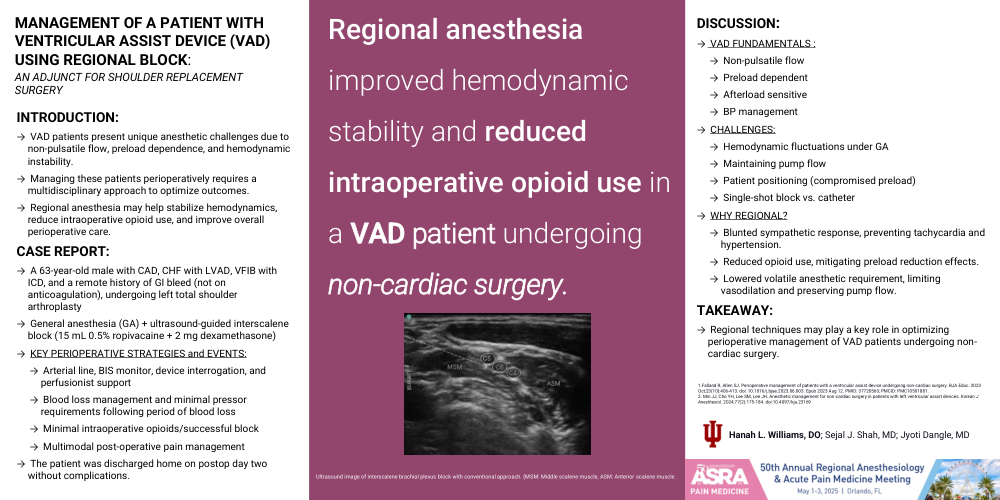
Regional anesthesia improved hemodynamic stability and reduced intraoperative opioid use in a VAD patient undergoing non-cardiac surgery.
DISCUSSION:
→ VAD FUNDAMENTALS :
→ Non-pulsatile flow
→ Preload dependent
→ Afterload sensitive
→ BP management
→ CHALLENGES:
→ Hemodynamic fluctuations under GA
→ Maintaining pump flow
→ Patient positioning (compromised preload) → Single-shot block vs. catheter
→ WHY REGIONAL?
→ Blunted sympathetic response, preventing tachycardia and hypertension.
→ Reduced opioid use, mitigating preload reduction effects.
→ Lowered volatile anesthetic requirement, limiting vasodilation and preserving pump flow.
TAKEAWAY:
→ Regional techniques may play a key role in optimizing perioperative management of VAD patients undergoing non-cardiac surgery.
1.Falland R, Allen SJ. Perioperative management of patients with a ventricular assist device undergoing non-cardiac surgery. BJA Educ. 2023 Oct;23(10):406-413. doi: 10.1016/j.bjae.2023.06.003. Epub 2023 Aug 12. PMID: 37720560; PMCID: PMC10501881.
2. Min JJ, Cho YH, Lee SM, Lee JH. Anesthetic management for non-cardiac surgery in patients with left ventricular assist devices. Korean J Anesthesiol. 2024;77(2):175-184. doi:10.4097/kja.23169
Hanah L. Williams, DO; Sejal J. Shah, MD; Jyoti Dangle, MD