383 posters, 2 videos, 1 audios, 8 topics, 28 sessions, 328 authors, 225 institutions
ePostersLive by SciGen Technologies S.A. All rights reserved.
50th Annual Regional Anesthesiology and Acute Pain Medicine Meeting
May 1 - 3, 2025 | Orlando, Florida

6742
STELLATE GANGLION BLOCK FOR TREATMENT POSTURAL ORTHOSTATIC TACHYCARDIA OF LONG COVID SYNDROME
Poster Presenter
Authors
Affiliations
Part of Topic
Medically Challenging Cases
Introduction:
Long COVID-19 syndrome is a sequelae of SARS-CoV2 that can persist more than 12 months after the initial infection. Patients with Long COVID-19 can lead to the development of dysautonomias. The pathophysiology of Long covid syndrome is theorized to be secondary to a dysregulation of the autonomic nervous system in response to pro-inflammatory cytokines. Postural orthostatic tachycardia syndrome (POTS) is an associated dysautonomia causing dizziness and increased heart rate with positional changes seen in 2 -14% of long covid patients. This case demonstrates the successful treatment of POTS in Long COVID syndrome using bilateral stellate ganglion block.
Methods:
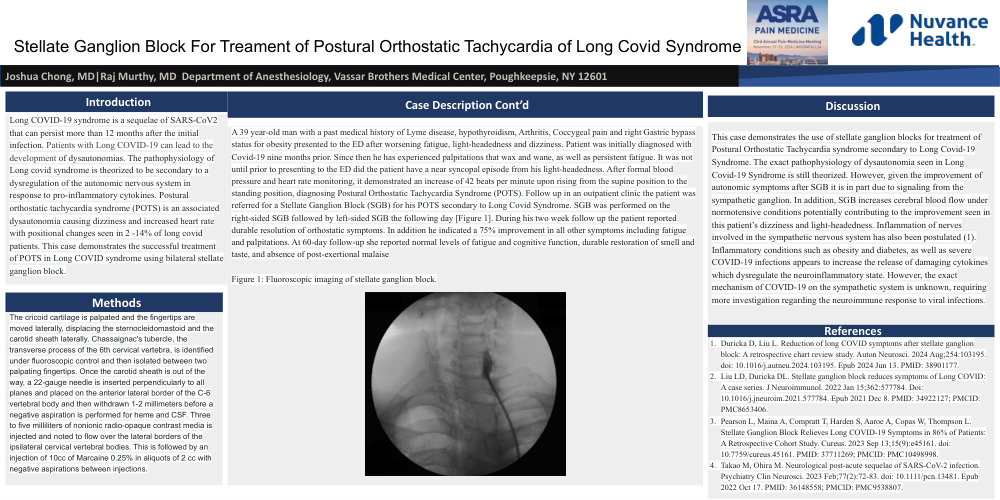
The cricoid cartilage is palpated and the fingertips are moved laterally, displacing the sternocleidomastoid and the carotid sheath laterally. Chassaignac's tubercle, the transverse process of the 6th cervical vertebra, is identified under fluoroscopic control and then isolated between two palpating fingertips. Once the carotid sheath is out of the way, a 22-gauge needle is inserted perpendicularly to all planes and placed on the anterior lateral border of the C-6 vertebral body and then withdrawn 1-2 millimeters before a negative aspiration is performed for heme and CSF. Three to five milliliters of nonionic radio-opaque contrast media is injected and noted to flow over the lateral borders of the ipsilateral cervical vertebral bodies. This is followed by an injection of 10cc of Marcaine 0.25% in aliquots of 2 cc with negative aspirations between injections.
Results/case report:
A 39 year-old man with a past medical history of Lyme disease, hypothyroidism, Arthritis, Coccygeal pain and right Gastric bypass status for obesity presented to the ED after worsening fatigue, light-headedness and dizziness. Patient was initially diagnosed with Covid-19 nine months prior. Since then he has experienced palpitations that wax and wane, as well as persistent fatigue. It was not until prior to presenting to the ED did the patient have a near syncopal episode from his light-headedness. After formal blood pressure and heart rate monitoring, it demonstrated an increase of 42 beats per minute upon rising from the supine position to the standing position, diagnosing Postural Orthostatic Tachycardia Syndrome (POTS). Follow up in an outpatient clinic the patient was referred for a Stellate Ganglion Block (SGB) for his POTS secondary to Long Covid Syndrome. SGB was performed on the right-sided SGB followed by left-sided SGB the following day [Figure 1]. During his two week follow up the patient reported durable resolution of orthostatic symptoms. In addition he indicated a 75% improvement in all other symptoms including fatigue and palpitations. At 60-day follow-up she reported normal levels of fatigue and cognitive function, durable restoration of smell and taste, and absence of post-exertional malaise.
Conclusion:
This case demonstrates the use of stellate ganglion blocks for treatment of Postural Orthostatic Tachycardia syndrome secondary to Long Covid-19 Syndrome. The exact pathophysiology of dysautonomia seen in Long Covid-19 Syndrome is still theorized. However, given the improvement of autonomic symptoms after SGB it is in part due to signaling from the sympathetic ganglion. In addition, SGB increases cerebral blood flow under normotensive conditions potentially contributing to the improvement seen in this patient’s dizziness and light-headedness. Inflammation of nerves involved in the sympathetic nervous system has also been postulated (1). Inflammatory conditions such as obesity and diabetes, as well as severe COVID-19 infections appears to increase the release of damaging cytokines which dysregulate the neuroinflammatory state. However, the exact mechanism of COVID-19 on the sympathetic system is unknown, requiring more investigation regarding the neuroimmune response to viral infections.