Loading...

383 posters, 2 videos, 1 audios, 8 topics, 28 sessions, 328 authors, 225 institutions

ePostersLive by SciGen Technologies S.A. All rights reserved.

6717

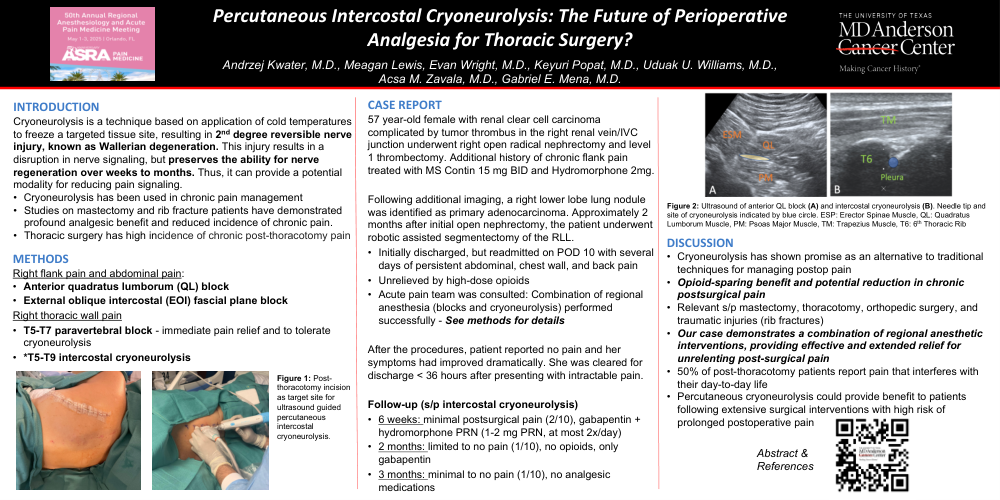
PERCUTANEOUS INTERCOSTAL CRYONEUROLYSIS: THE FUTURE OF PERIOPERATIVE ANALGESIA FOR THORACIC SURGERY?
Part of Topic

Medically Challenging Cases

INTRODUCTION

Cryoneurolysis is a technique based on application of cold temperatures to freeze a targeted tissue site, resulting in 2nd degree reversible nerve injury, known as Wallerian degeneration. This injury results in a disruption in nerve signaling, but preserves the ability for nerve regeneration over weeks to months. Thus, it can provide a potential modality for reducing pain signaling.

•Cryoneurolysis has been used in chronic pain management
•Studies on mastectomy and rib fracture patients have demonstrated profound analgesic benefit and reduced incidence of chronic pain.
•Thoracic surgery has high incidence of chronic post-thoracotomy pain

METHODS 

Right flank pain and abdominal pain:

•Anterior quadratus lumborum (QL) block
•External oblique intercostal (EOI) fascial plane block

Right thoracic wall pain

•T5-T7 paravertebral block - immediate pain relief and to tolerate cryoneurolysis
*T5-T9 intercostal cryoneurolysis

CASE REPORT

57 year-old female with renal clear cell carcinoma complicated by tumor thrombus in the right renal vein/IVC junction underwent right open radical nephrectomy and level 1 thrombectomy. Additional history of chronic flank pain treated with MS Contin 15 mg BID and Hydromorphone 2mg.

Following additional imaging, a right lower lobe lung nodule was identified as primary adenocarcinoma. Approximately 2 months after initial open nephrectomy, the patient underwent robotic assisted segmentectomy of the RLL. 

•Initially discharged, but readmitted on POD 10 with several days of persistent abdominal, chest wall, and back pain
•Unrelieved by high-dose opioids
•Acute pain team was consulted: Combination of regional anesthesia (blocks and cryoneurolysis) performed successfully - See methods for details

After the procedures, patient reported no pain and her symptoms had improved dramatically. She was cleared for discharge < 36 hours after presenting with intractable pain.

Follow-up (s/p intercostal cryoneurolysis)

•6 weeks: minimal postsurgical pain (2/10), gabapentin + hydromorphone PRN (1-2 mg PRN, at most 2x/day)
•2 months: limited to no pain (1/10), no opioids, only gabapentin
•3 months: minimal to no pain (1/10), no analgesic medications

DISCUSSION

•Cryoneurolysis has shown promise as an alternative to traditional techniques for managing postop pain
•Opioid-sparing benefit and potential reduction in chronic postsurgical pain 
•Relevant s/p mastectomy, thoracotomy, orthopedic surgery, and traumatic injuries (rib fractures)
•Our case demonstrates a combination of regional anesthetic interventions, providing effective and extended relief for unrelenting post-surgical pain  
•50% of post-thoracotomy patients report pain that interferes with their day-to-day life 
•Percutaneous cryoneurolysis could provide benefit to patients following extensive surgical interventions with high risk of prolonged postoperative pain
asraspring2025 banner
Copyright © 2015-2026, ePostersLive® SciGen is a registered trademark of SciGen Technologies S.A. Patent pending.

This website and third-party tools we use rely on cookies for the best user experience. By selecting "I agree", you agree to cookie usage as described in our Privacy Policy.
