383 posters, 2 videos, 1 audios, 8 topics, 28 sessions, 328 authors, 225 institutions
ePostersLive by SciGen Technologies S.A. All rights reserved.
50th Annual Regional Anesthesiology and Acute Pain Medicine Meeting
May 1 - 3, 2025 | Orlando, Florida

6655
FACILITATING PATIENT EDUCATION OF NURSES UTILIZING PATIENT EDUCATION HANDOUT
Poster Presenter
Authors
Affiliations
Part of Topic
Medically Challenging Cases
INTRODUCTION
Intravenous patient-controlled analgesia (IV PCA) has been an effective modality for pain management since it’s introduction in the 1970s (2). Opioid medications are commonly used for IVPCA and are administered through an infusion pump with a designated patient-controlled dose,with or without a basal continuous dose.
For optimal use of the IVPCA, it is crucial for patients to understand how the pump delivers medication and the proper method for it’s use. The Acute Pain Medicine team (APM) often encounters incidences where patients initially over-use the PCA pump, but after given proper education (both to patient and family), use significantly lower amounts of medication.
Educational tools are know to be effective in facilitating patient education, thus the aim of this project was to facilitate patient education on IVPCA use by implementing a standardized nursing-directed educational handout (3).
METHODS
To identify the knowledge gap on IVPCA patient education, surveyed 20 nurses working in post-surgical inpatient floor with a series of 8 questions.
Initial survey:
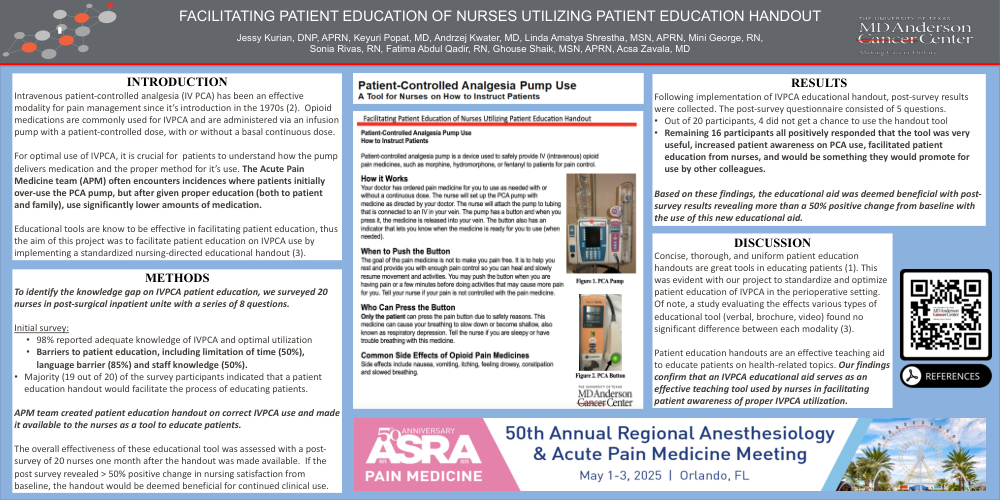
APM team created patiente ducation handout on correct IVPCA use and made it available to the nurses as a tool to educate patients.
The overall effectiveness of these educational tool was assessed with a post-survey of 20 nurses one month after the patient education handout was made available as a resource. If the post survey revealed > 50% positive change in nursing satisfaction from baseline, the educational handout would be deemed beneficial for continued clinical use.
RESULTS
Following implementation of IVPCA educational handout, post-survey results were collected. The post-survey questionnaire consisted of 5 questions.
Based on these findings, the educational aid was deemed beneficial with post-survey results revealing more than a 50% positive change from baseline with the use of this new educational aid.
DISCUSSION
Concise, thorough, and uniform patient education handouts are great tools in educating patients (1). This was evident with our project to standardize and optimize patient education of IVPCA in the perioperative setting. Of note, a study evaluating the effects various types of educational tool (verbal, brochure, video) found no significant difference between each modality (3).
Patient education handouts are known as an effective teaching aid to educate patients on health-related topics. Our findings confirm that an educational aid on IVPCA serves as an effective teaching tool used by post-surgical nurses in facilitating patient awareness of proper IVPCA utilization.