383 posters, 2 videos, 1 audios, 8 topics, 28 sessions, 328 authors, 225 institutions
ePostersLive by SciGen Technologies S.A. All rights reserved.
50th Annual Regional Anesthesiology and Acute Pain Medicine Meeting
May 1 - 3, 2025 | Orlando, Florida

6635
AMBULATORY MENISCECTOMY USING EPIDURAL DOSED 2-CHLOROPROCAINE 3%
Poster Presenter
Authors
Affiliations
Part of Topic
Medically Challenging Cases
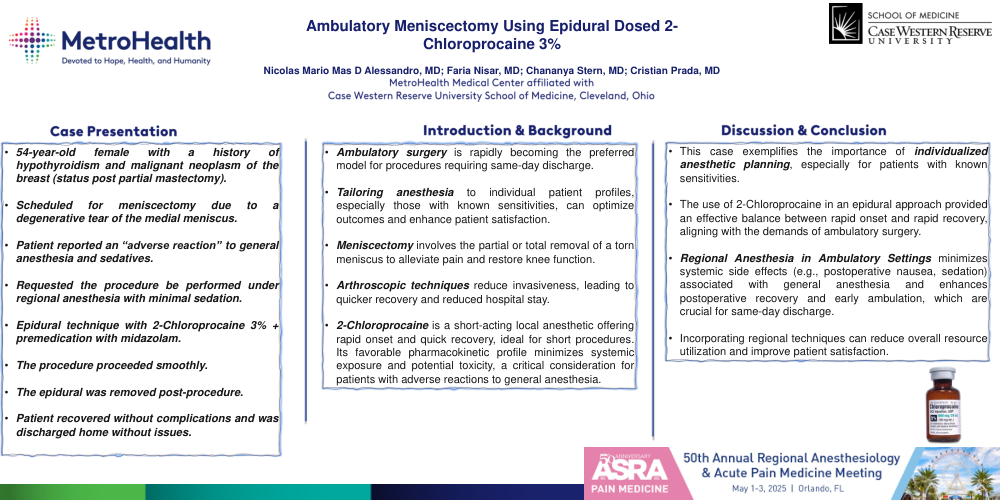
Ambulatory Meniscectomy Using Epidural Dosed 2-Chloroprocaine 3%
Nicolas Mario Mas D Alessandro, MD; Faria Nisar, MD; Chananya Stern, MD; Cristian Prada, MD
MetroHealth Medical Center affiliated with
Case Western Reserve University School of Medicine, Cleveland, Ohio
Case Presentation
•54-year-old female with a history of hypothyroidism and malignant neoplasm of the breast (status post partial mastectomy).
•Scheduled for meniscectomy due to a degenerative tear of the medial meniscus.
•Patient reported an “adverse reaction” to general anesthesia and sedatives.
•Requested the procedure be performed under regional anesthesia with minimal sedation.
•Epidural technique with 2-Chloroprocaine 3% + premedication with midazolam.
•The procedure proceeded smoothly.
•The epidural was removed post-procedure.
•Patient recovered without complications and was discharged home without issues.
Introduction and Background
•Ambulatory surgery is rapidly becoming the preferred model for procedures requiring same-day discharge.
•Tailoring anesthesia to individual patient profiles, especially those with known sensitivities, can optimize outcomes and enhance patient satisfaction.
•Meniscectomy involves the partial or total removal of a torn meniscus to alleviate pain and restore knee function.
•Arthroscopic techniques reduce invasiveness, leading to quicker recovery and reduced hospital stay.
•2-Chloroprocaine is a short-acting local anesthetic offering rapid onset and quick recovery, ideal for short procedures. Its favorable pharmacokinetic profile minimizes systemic exposure and potential toxicity, a critical consideration for patients with adverse reactions to general anesthesia.
Discussion and Conclusion
•This case exemplifies the importance of individualized anesthetic planning, especially for patients with known sensitivities.
•The use of 2-Chloroprocaine in an epidural approach provided an effective balance between rapid onset and rapid recovery, aligning with the demands of ambulatory surgery.
•Regional Anesthesia in Ambulatory Settings minimizes systemic side effects (e.g., postoperative nausea, sedation) associated with general anesthesia and enhances postoperative recovery and early ambulation, which are crucial for same-day discharge.
•Incorporating regional techniques can reduce overall resource utilization and improve patient satisfaction.