383 posters, 2 videos, 1 audios, 8 topics, 28 sessions, 328 authors, 225 institutions
ePostersLive by SciGen Technologies S.A. All rights reserved.
50th Annual Regional Anesthesiology and Acute Pain Medicine Meeting
May 1 - 3, 2025 | Orlando, Florida

6545
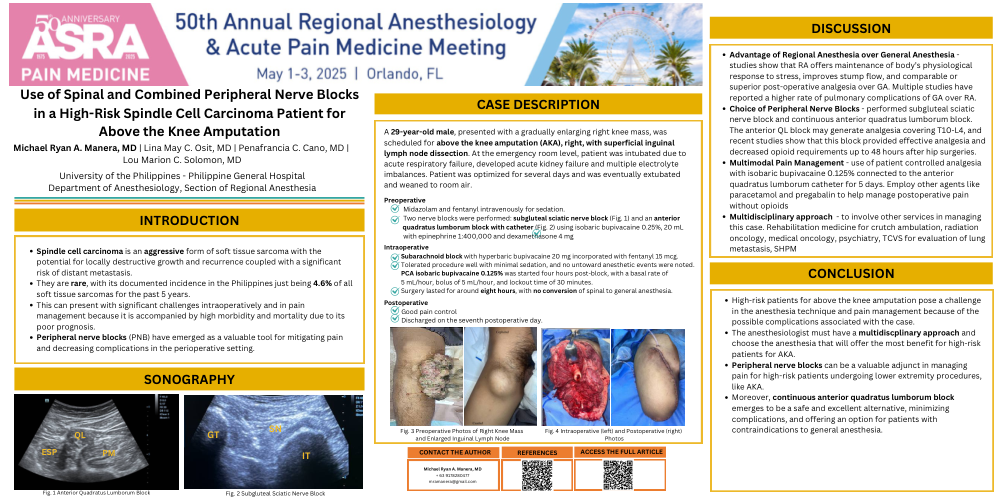
USE OF SPINAL AND COMBINED PERIPHERAL NERVE BLOCKS IN A HIGH-RISK SPINDLE CELL CARCINOMA PATIENT FOR ABOVE THE KNEE AMPUTATION
Poster Presenter
Authors
Affiliations
Part of Topic
Medically Challenging Cases
Use of Spinal and Combined Peripheral Nerve Blocks in a High-Risk Spindle Cell Carcinoma Patient for Above the Knee Amputation
Introduction
- Spindle cell carcinoma is an aggressive form of soft tissue sarcoma with the potential for locally destructive growth and recurrence coupled with a significant risk of distant metastasis.
- They are rare, with its documented incidence in the Philippines just being 4.6% of all soft tissue sarcomas for the past 5 years.
- This can present with significant challenges intraoperatively and in pain management because it is accompanied by high morbidity and mortality due to its poor prognosis.
- Peripheral nerve blocks (PNB) have emerged as a valuable tool for mitigating pain and decreasing complications in the perioperative setting.
Case Description
A 29-year-old male, presented with a gradually enlarging right knee mass, was scheduled for above the knee amputation (AKA), right, with superficial inguinal lymph node dissection. At the emergency room level, patient was intubated due to acute respiratory failure, developed acute kidney failure and multiple electrolyte imbalances. Patient was optimized for several days and was eventually extubated and weaned to room air.
Discussion
- Advantage of Regional Anesthesia over General Anesthesia - studies show that RA offers maintenance of body’s physiological response to stress, improves stump flow, and comparable or superior post-operative analgesia over GA. Multiple studies have reported a higher rate of pulmonary complications of GA over RA.
- Choice of Peripheral Nerve Blocks - performed subgluteal sciatic nerve block and continuous anterior quadratus lumborum block. The anterior QL block may generate analgesia covering T10-L4, and recent studies show that this block provided effective analgesia and decreased opioid requirements up to 48 hours after hip surgeries.
- Multimodal Pain Management - use of patient controlled analgesia with isobaric bupivacaine 0.125% connected to the anterior quadratus lumborum catheter for 5 days. Employ other agents like paracetamol and pregabalin to help manage postoperative pain without opioids
- Multidisciplinary approach - to involve other services in managing this case. Rehabilitation medicine for crutch ambulation, radiation oncology, medical oncology, psychiatry, TCVS for evaluation of lung metastasis, SHPM
Conclusion
- High-risk patients for above the knee amputation pose a challenge in the anesthesia technique and pain management because of the possible complications associated with the case.
- The anesthesiologist must have a multidiscplinary approach and choose the anesthesia that will offer the most benefit for high-risk patients for AKA.
- Peripheral nerve blocks can be a valuable adjunct in managing pain for high-risk patients undergoing lower extremity procedures, like AKA.
- Moreover, continuous anterior quadratus lumborum block emerges to be a safe and excellent alternative, minimizing complications, and offering an option for patients with contraindications to general anesthesia.