383 posters, 2 videos, 1 audios, 8 topics, 28 sessions, 328 authors, 225 institutions
ePostersLive by SciGen Technologies S.A. All rights reserved.
50th Annual Regional Anesthesiology and Acute Pain Medicine Meeting
May 1 - 3, 2025 | Orlando, Florida

6507
PERIPHERAL NERVE BLOCKS: A USEFUL ADJUNCT IN A DISABLED VETERAN WITH INCOMPLETE SPINAL CORD INJURY
Poster Presenter
Authors
Affiliations
Part of Topic
Medically Challenging Cases
Peripheral Nerve Blocks: A Useful Adjunct in a Disabled Veteran with Incomplete Spinal Cord Injury
Introduction:
Spinal cord injury (SCI) is a devastating injury that can result in a complex array of motor, sensory, and autonomic complications. These patients can present anesthetic challenges especially in patients with a history of autonomic dysreflexia, a potentially fatal syndrome associated with SCI above the level of T6. Autonomic dysreflexia is characterized by sudden severe hypertension with reflexive bradycardia in response to pain or pressure below the injury level1. In patients with high SCI, it is critical to mitigate stimuli that may trigger autonomic dysreflexia intraoperatively. This case describes the successful use of peripheral nerve blocks (PNB) in a veteran with incomplete SCI and history of autonomic dysreflexia.
Methods:
The patient provided written informed consent for the utilization of his medical condition and management. As the case report is devoid of patient identifiable information, it is exempt respective hospital IRB review.
Case Report:
A 38-year-old veteran with incomplete C3-4 SCI presented for right ankle ORIF followed by irrigation and debridement 10 weeks later for delayed wound healing. The patient received preoperative single injection nerve blocks in conjunction with general anesthesia. The PNBs performed were ultrasound guided adductor canal and popliteal fossa nerve blocks using 20 mL per site of 0.5% bupivacaine for the initial surgery, and 20 mL per site of 0.5% ropivacaine for the subsequent surgery. The patient reported a 24-36 hour pain free period postoperatively.
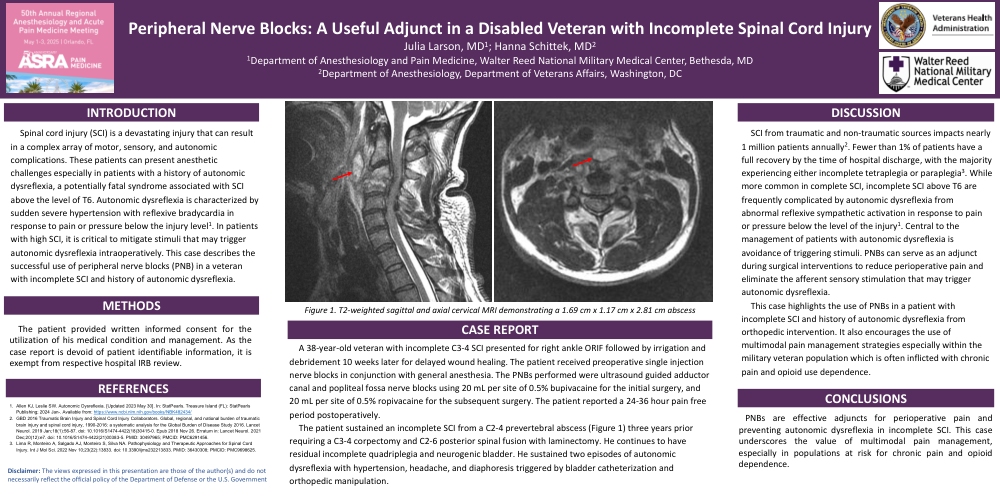
The patient sustained an incomplete SCI from a C2-4 prevertebral abscess (Figure 1) three years prior requiring a C3-4 corpectomy and C2-6 posterior spinal fusion with laminectomy. He continues to have residual incomplete quadriplegia and neurogenic bladder. He sustained two episodes of autonomic dysreflexia with hypertension, headache, and diaphoresis triggered by bladder catheterization and orthopedic manipulation.
Discussion:
SCI from traumatic and non-traumatic sources impacts nearly 1 million patients annually2. Fewer than 1% of patients have a full recovery by the time of hospital discharge, with the majority experiencing either incomplete tetraplegia or paraplegia3. While more common in complete SCI, incomplete SCI above T6 are frequently complicated by autonomic dysreflexia from abnormal reflexive sympathetic activation in response to pain or pressure below the level of the injury1. Central to the management of patients with autonomic dysreflexia is avoidance of triggering stimuli. PNBs can serve as an adjunct during surgical interventions to reduce perioperative pain and eliminate the afferent sensory stimulation that may trigger autonomic dysreflexia.
This case highlights the use of PNBs in a patient with incomplete SCI and history of autonomic dysreflexia from orthopedic intervention. It also encourages the use of multimodal pain management strategies especially within the military veteran population which is often inflicted with chronic pain and opioid use dependence.
Conclusion:
PNBs are effective adjuncts for perioperative pain and preventing autonomic dysreflexia in incomplete SCI. This case underscores the value of multimodal pain management, especially in populations at risk for chronic pain and opioid dependence.