383 posters, 2 videos, 1 audios, 8 topics, 28 sessions, 328 authors, 225 institutions
ePostersLive by SciGen Technologies S.A. All rights reserved.
50th Annual Regional Anesthesiology and Acute Pain Medicine Meeting
May 1 - 3, 2025 | Orlando, Florida

6476
LUMBAR PLEXUS AND TRANSGLUTEAL SCIATIC BLOCKS AS PRIMARY ANESTHETICS IN A PATIENT WITH PULMONARY HYPERTENSION
Poster Presenter
Authors
Affiliations
Part of Topic
Medically Challenging Cases
Lumbar Plexus and Transgluteal Sciatic blocks as primary anesthetics in a patient with Pulmonary Hypertension
Background
•Regional Anesthesia is a great option for patients who are considered high risk for general or neuraxial anesthetic due to significant pulmonary and/or cardiac comorbidities.
•Managing Pulmonary Hypertension requires maintaining of RV perfusion and inotropy, in addition to optimizing RV rate and Rhythm: sinus and normal-high
•Lumbar plexus block “LPB” provides good anesthetic coverage, but controversies remain about its safety
Case Description
•96-year-old female with complex history including COPD (on home O2), HTN, pAF on Apixaban, Anterior MI in the past, first-degree AV block, CHF, anemia on iron, depression, hypothyroidism. Presented with left sub-capital femoral neck fracture
•TEE revealed hyperdynamic LV with resultant intracavitary obstruction of 50 mmHg intracavitary gradient at rest, normal RV size and systolic function, at least moderate pulmonary hypertension with estimated PASP of 50-55 mmHg, EKG showed Q waves on anterior leads
•The Anesthesiology team opted for a Lumbar plexus block as a primary anesthetic and transgluteal sciatic block to supplement
•Apixaban was held and blocks were performed using landmark and nerve stimulation techniques with ultrasound assistance. Patient tolerated the block with small doses of Fentanyl, underwent surgery with a dexmedetomidine drip, and required no blood pressure support throughout the surgery
Discussion
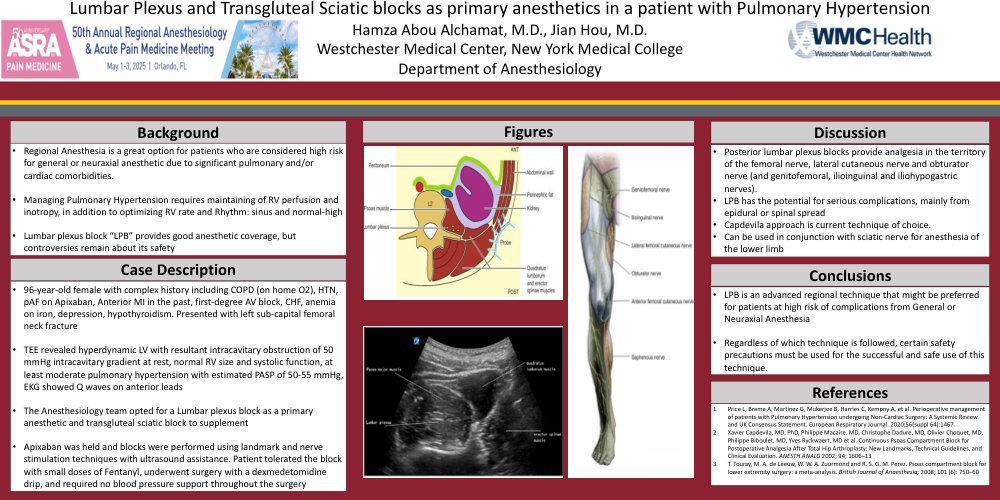
•Posterior lumbar plexus blocks provide analgesia in the territory of the femoral nerve, lateral cutaneous nerve and obturator nerve (and genitofemoral, ilioinguinal and iliohypogastric nerves).
•LPB has the potential for serious complications, mainly from epidural or spinal spread
•Capdevila approach is current technique of choice.
•Can be used in conjunction with sciatic nerve for anesthesia of the lower limb
Conclusions
•LPB is an advanced regional technique that might be preferred for patients at high risk of complications from General or Neuraxial Anesthesia
•Regardless of which technique is followed, certain safety precautions must be used for the successful and safe use of this technique.
References
1.Price L, Brame A, Martinez G, Mukerjee B, Harries C, Kempny A, et al. Perioperative management of patients with Pulmonary Hypertension undergoing Non-Cardiac Surgery: A Systemic Review and UK Consensus Statement. European Respiratory Journal. 2020;56(suppl 64):1467.
2.Xavier Capdevila, MD, PhD, Philippe Macaire, MD, Christophe Dadure, MD, Olivier Choquet, MD, Philippe Biboulet, MD, Yves Ryckwaert, MD et al. Continuous Psoas Compartment Block for Postoperative Analgesia After Total Hip Arthroplasty: New Landmarks, Technical Guidelines, and Clinical Evaluation. ANESTH ANALG 2002; 94; 1606–13
3.T. Touray, M. A. de Leeuw, W. W. A. Zuurmond and R. S. G. M. Perez. Psoas compartment block for lower extremity surgery: a meta-analysis. British Journal of Anaesthesia; 2008; 101 (6): 750–60