383 posters, 2 videos, 1 audios, 8 topics, 28 sessions, 328 authors, 225 institutions
ePostersLive by SciGen Technologies S.A. All rights reserved.
50th Annual Regional Anesthesiology and Acute Pain Medicine Meeting
May 1 - 3, 2025 | Orlando, Florida

6875
USE OF MULTI-ORIFICE PERIPHERAL NERVE CATHETER IN SERRATUS ANTERIOR PLANE FOR RIB FRACTURE ANALGESIA
Poster Presenter
Authors
Affiliations
Part of Topic
Medically Challenging Cases
Introduction
Pain secondary to rib fracture can be challenging to treat and poses significant risk of morbidity and mortality, especially to elderly patients1,2. While thoracic epidural analgesia can be considered the gold standard in rib fracture pain management, serratus anterior plane blocks can add to analgesia in patients in whom epidural anesthesia is contraindicated. A frequent problem encountered when using continuous peripheral nerve blocks is the distance of local anesthetic spread within a tissue plane, and the use of a multi-orifice peripheral nerve catheter may provide better analgesia than an end-hole catheter.
Materials and Methods
Written patient informed consent was obtained prior to presentation of this case. This case report is devoid of patient identifiable information and is exempt from IRB review requirements as per Lahey Hospital and Medical Center policy.
Case Report
We present a case of a 74 year old woman with a history of COPD requiring home oxygen and chronic opiate use who presented after a car accident and was found to have a sternal fracture, right 7th and 8th rib fractures, and left 5th through 8th fractures. Her left chest was the predominant source of her pain. An epidural catheter was deferred due to the patient having a dural meningioma at the T10 level.
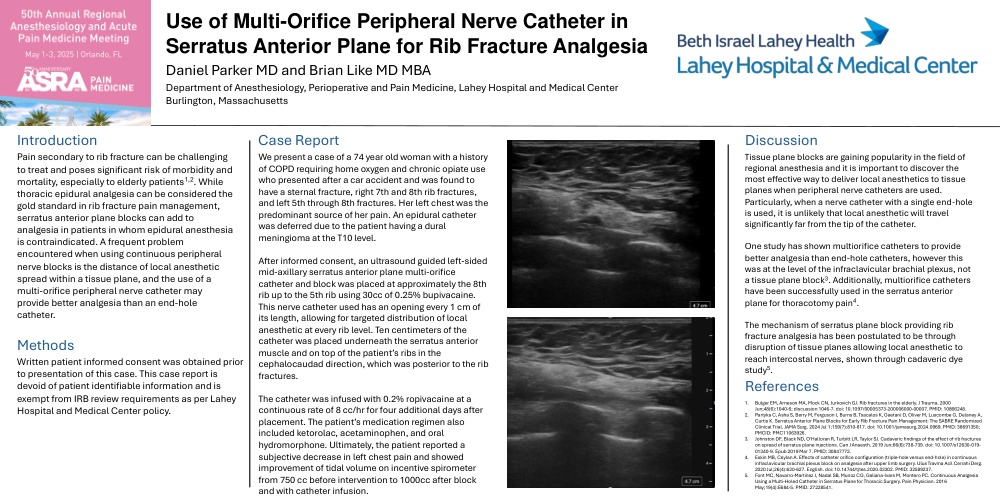
After informed consent, an ultrasound guided left-sided mid-axillary serratus anterior plane multi-orifice catheter and block was placed at approximately the 8th rib up to the 5th rib using 30cc of 0.25% bupivacaine. This nerve catheter used has an opening every 1 cm of its length, allowing for targeted distribution of local anesthetic at every rib level. Ten centimeters of the catheter was placed underneath the serratus anterior muscle and on top of the patient’s ribs in the cephalocaudad direction, which was posterior to the rib fractures.
The catheter was infused with 0.2% ropivacaine at a continuous rate of 8 cc/hr for four additional days after placement. The patient’s medication regimen also included ketorolac, acetaminophen, and oral hydromorphone. Ultimately, the patient reported a subjective decrease in left chest pain and showed improvement of tidal volume on incentive spirometer from 750 cc before intervention to 1000cc after block and with catheter infusion.
Discussion
Tissue plane blocks are gaining popularity in the field of regional anesthesia, it is important to discover the most effective way to deliver local anesthetics to tissue planes when peripheral nerve catheters are used. Particularly, when a nerve catheter with a single end-hole is used, it is unlikely that local anesthetic will travel significantly far from the tip of the catheter.
One study has shown multiorifice catheters to provide better analgesia than end-hole catheters, however this was at the level of the infraclavicular brachial plexus, not a tissue plane block3. Additionally, multiorifice catheters have been successfully used in the serratus anterior plane for thoracotomy pain4.
The mechanism of serratus plane block providing rib fracture analgesia has been postulated to be through disruption of tissue planes allowing local anesthetic to reach intercostal nerves, shown through cadaveric dye study5.