383 posters, 2 videos, 1 audios, 8 topics, 28 sessions, 328 authors, 225 institutions
ePostersLive by SciGen Technologies S.A. All rights reserved.
50th Annual Regional Anesthesiology and Acute Pain Medicine Meeting
May 1 - 3, 2025 | Orlando, Florida

6873
THE CURIOUS CASE OF FEMORAL WEAKNESS AFTER AN L4 ERECTOR SPINAE PLANE BLOCK
Poster Presenter
Authors
Part of Topic
Medically Challenging Cases
THE CURIOUS CASE OF FEMORAL WEAKNESS AFTER AN L4 ERECTOR SPINAE PLANE BLOCK
Deena Najjar BA1,2 , Zachary Adler MD1 , Preet Korani DO1 , Ilana Schoenbrun MD1 , Angelica Bialczak DO1 , Preeti Anand MD1,3 1. Department of Anesthesiology, Montefiore Medical Center, 111 E 210th Street, Bronx, NY, 10467 2. Albert Einstein College of Medicine, 1300 Morris Park Avenue, Bronx, NY, 10461 3. Department of Anesthesiology, RWJ Barnabas Health, 610 Washington Boulevard, Jersey City, NJ, 07310
Introduction
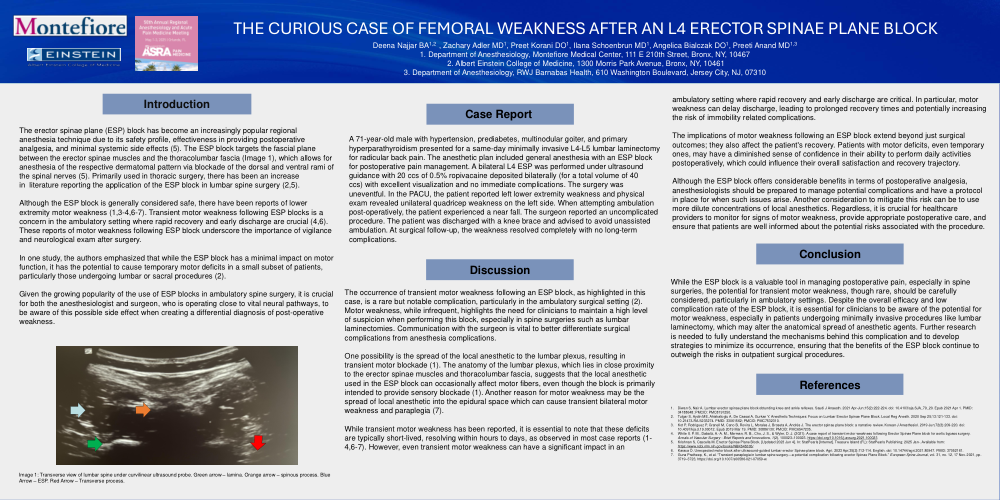
The erector spinae plane (ESP) block has become an increasingly popular regional anesthesia technique due to its safety profile, effectiveness in providing postoperative analgesia, and minimal systemic side effects (5). The ESP block targets the fascial plane between the erector spinae muscles and the thoracolumbar fascia (Image 1), which allows for anesthesia of the respective dermatomal pattern via blockade of the dorsal and ventral rami of the spinal nerves (5). Primarily used in thoracic surgery, there has been an increase in literature reporting the application of the ESP block in lumbar spine surgery (2,5). Although the ESP block is generally considered safe, there have been reports of lower extremity motor weakness (1,3-4,6-7). Transient motor weakness following ESP blocks is a concern in the ambulatory setting where rapid recovery and early discharge are crucial (4,6). These reports of motor weakness following ESP block underscore the importance of vigilance and neurological exam after surgery. In one study, the authors emphasized that while the ESP block has a minimal impact on motor function, it has the potential to cause temporary motor deficits in a small subset of patients, particularly those undergoing lumbar or sacral procedures (2). Given the growing popularity of the use of ESP blocks in ambulatory spine surgery, it is crucial for both the anesthesiologist and surgeon, who is operating close to vital neural pathways, to be aware of this possible side effect when creating a differential diagnosis of post-operative weakness.
Case Report
A 71-year-old male with hypertension, prediabetes, multinodular goiter, and primary hyperparathyroidism presented for a same-day minimally invasive L4-L5 lumbar laminectomy for radicular back pain. The anesthetic plan included general anesthesia with an ESP block for postoperative pain management. A bilateral L4 ESP was performed under ultrasound guidance with 20 ccs of 0.5% ropivacaine deposited bilaterally (for a total volume of 40 ccs) with excellent visualization and no immediate complications. The surgery was uneventful. In the PACU, the patient reported left lower extremity weakness and physical exam revealed unilateral quadricep weakness on the left side. When attempting ambulation post-operatively, the patient experienced a near fall. The surgeon reported an uncomplicated procedure. The patient was discharged with a knee brace and advised to avoid unassisted ambulation. At surgical follow-up, the weakness resolved completely with no long-term complications.
Discussion
The occurrence of transient motor weakness following an ESP block, as highlighted in this case, is a rare but notable complication, particularly in the ambulatory surgical setting (2). Motor weakness, while infrequent, highlights the need for clinicians to maintain a high level of suspicion when performing this block, especially in spine surgeries such as lumbar laminectomies. Communication with the surgeon is vital to better differentiate surgical complications from anesthesia complications. One possibility is the spread of the local anesthetic to the lumbar plexus, resulting in transient motor blockade (1). The anatomy of the lumbar plexus, which lies in close proximity to the erector spinae muscles and thoracolumbar fascia, suggests that the local anesthetic used in the ESP block can occasionally affect motor fibers, even though the block is primarily intended to provide sensory blockade (1). Another reason for motor weakness may be the spread of local anesthetic into the epidural space which can cause transient bilateral motor weakness and paraplegia (7). While transient motor weakness has been reported, it is essential to note that these deficits are typically short-lived, resolving within hours to days, as observed in most case reports (1- 4,6-7). However, even transient motor weakness can have a significant impact in an ambulatory setting where rapid recovery and early discharge are critical. In particular, motor weakness can delay discharge, leading to prolonged recovery times and potentially increasing the risk of immobility related complications. The implications of motor weakness following an ESP block extend beyond just surgical outcomes; they also affect the patient's recovery. Patients with motor deficits, even temporary ones, may have a diminished sense of confidence in their ability to perform daily activities postoperatively, which could influence their overall satisfaction and recovery trajectory. Although the ESP block offers considerable benefits in terms of postoperative analgesia, anesthesiologists should be prepared to manage potential complications and have a protocol in place for when such issues arise. Another consideration to mitigate this risk can be to use more dilute concentrations of local anesthetics. Regardless, it is crucial for healthcare providers to monitor for signs of motor weakness, provide appropriate postoperative care, and ensure that patients are well informed about the potential risks associated with the procedure.
Conclusion
While the ESP block is a valuable tool in managing postoperative pain, especially in spine surgeries, the potential for transient motor weakness, though rare, should be carefully considered, particularly in ambulatory settings. Despite the overall efficacy and low complication rate of the ESP block, it is essential for clinicians to be aware of the potential for motor weakness, especially in patients undergoing minimally invasive procedures like lumbar laminectomy, which may alter the anatomical spread of anesthetic agents. Further research is needed to fully understand the mechanisms behind this complication and to develop strategies to minimize its occurrence, ensuring that the benefits of the ESP block continue to outweigh the risks in outpatient surgical procedures.
References
1. Diwan S, Nair A. Lumbar erector spinae plane block obtunding knee and ankle reflexes. Saudi J Anaesth. 2021 Apr-Jun;15(2):222-224. doi: 10.4103/sja.SJA_79_20. Epub 2021 Apr 1. PMID: 34188648; PMCID: PMC8191250. 2. Tulgar S, Aydin ME, Ahiskalioglu A, De Cassai A, Gurkan Y. Anesthetic Techniques: Focus on Lumbar Erector Spinae Plane Block. Local Reg Anesth. 2020 Sep 25;13:121-133. doi: 10.2147/LRA.S233274. PMID: 33061562; PMCID: PMC7532310. 3. Kot P, Rodriguez P, Granell M, Cano B, Rovira L, Morales J, Broseta A, Andrés J. The erector spinae plane block: a narrative review. Korean J Anesthesiol. 2019 Jun;72(3):209-220. doi: 10.4097/kja.d.19.00012. Epub 2019 Mar 19. PMID: 30886130; PMCID: PMC6547235. 4. White II, P. M., Dabaliz, A.-A. M., Merman, R. B., Cho, J. S., & Wyler, D. J. (2021). A case report of transient motor weakness following Erector Spinae Plane block for aortic bypass surgery. Annals of Vascular Surgery - Brief Reports and Innovations, 1(2), 100023–100023. https://doi.org/10.1016/j.avsurg.2021.100023 5. Krishnan S, Cascella M. Erector Spinae Plane Block. [Updated 2023 Jun 4]. In: StatPearls [Internet]. Treasure Island (FL): StatPearls Publishing; 2025 Jan-. Available from: https://www.ncbi.nlm.nih.gov/books/NBK545305/ 6. Karaca Ö. Unexpected motor block after ultrasound-guided lumbar erector Spinae plane block. Agri. 2023 Apr;35(2):112-114. English. doi: 10.14744/agri.2021.80947. PMID: 37052161. 7. Guna Pratheep, K., et al. “Transient paraplegia in lumbar spine surgery—a potential complication following erector Spinae Plane Block.” European Spine Journal, vol. 31, no. 12, 17 Nov. 2021, pp. 3719–3723, https://doi.org/10.1007/s00586-021-07059-w