383 posters, 2 videos, 1 audios, 8 topics, 28 sessions, 328 authors, 225 institutions
ePostersLive by SciGen Technologies S.A. All rights reserved.
50th Annual Regional Anesthesiology and Acute Pain Medicine Meeting
May 1 - 3, 2025 | Orlando, Florida

6849
ERECTOR SPINAE PLANE BLOCK FOR PLEURITIC CHEST PAIN: A CASE REPORT
Poster Presenter
Authors
Affiliations
Part of Topic
Medically Challenging Cases
ERECTOR SPINAE PLANE BLOCK FOR PLEURITIC CHEST PAIN: A CASE REPORT
Spencer Brown, MD
Oktay Shuminov, MD
Northwell
Introduction
The erector spinae plane (ESP) block is the block for the future. Instead of performing intercostal blocks, transverse abdominal plane (TAP) blocks, or serratus anterior blocks for truncal analgesia, the ESP block can and should be your one block shop.
Case
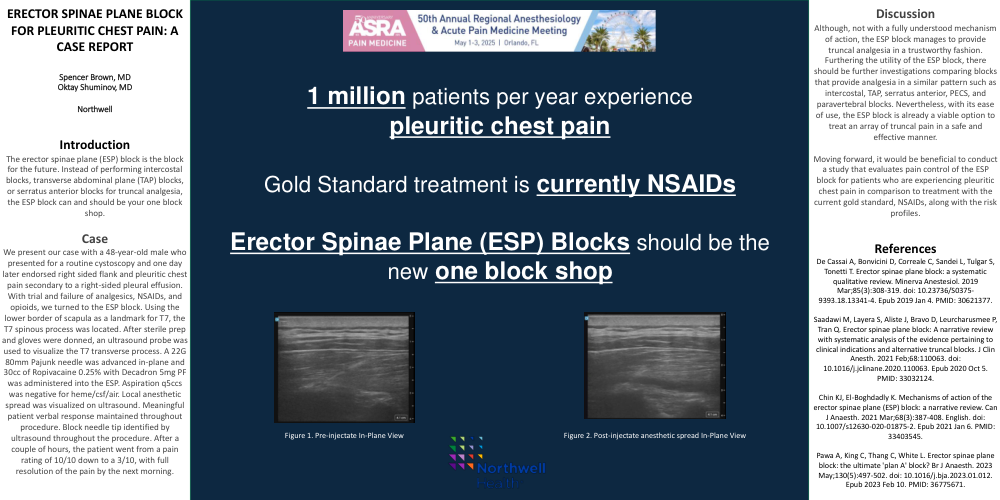
We present our case with a 48-year-old male who presented for a routine cystoscopy and one day later endorsed right sided flank and pleuritic chest pain secondary to a right-sided pleural effusion. With trial and failure of analgesics, NSAIDs, and opioids, we turned to the ESP block. Using the lower border of scapula as a landmark for T7, the T7 spinous process was located. After sterile prep and gloves were donned, an ultrasound probe was used to visualize the T7 transverse process. A 22G 80mm Pajunk needle was advanced in-plane and 30cc of Ropivacaine 0.25% with Decadron 5mg PF was administered into the ESP. Aspiration q5ccs was negative for heme/csf/air. Local anesthetic spread was visualized on ultrasound. Meaningful patient verbal response maintained throughout procedure. Block needle tip identified by ultrasound throughout the procedure. After a couple of hours, the patient went from a pain rating of 10/10 down to a 3/10, with full resolution of the pain by the next morning.
1 millionpatients per year experience
pleuritic chest pain
Gold Standard treatment iscurrently NSAIDs
Erector Spinae Plane (ESP) Blocks should be the newone block shop
Discussion
Although, not with a fully understood mechanism of action, the ESP block manages to provide truncal analgesia in a trustworthy fashion. Furthering the utility of the ESP block, there should be further investigations comparing blocks that provide analgesia in a similar pattern such as intercostal, TAP, serratus anterior, PECS, and paravertebral blocks. Nevertheless, with its ease of use, the ESP block is already a viable option to treat an array of truncal pain in a safe and effective manner.
Moving forward, it would be beneficial to conduct a study that evaluates pain control of the ESP block for patients who are experiencing pleuritic chest pain in comparison to treatment with the current gold standard, NSAIDs, along with the risk profiles.
References
De Cassai A, Bonvicini D, Correale C, Sandei L, Tulgar S, Tonetti T. Erector spinae plane block: a systematic qualitative review. Minerva Anestesiol. 2019 Mar;85(3):308-319. doi: 10.23736/S0375-9393.18.13341-4. Epub 2019 Jan 4. PMID: 30621377.
Saadawi M, Layera S, Aliste J, Bravo D, Leurcharusmee P, Tran Q. Erector spinae plane block: A narrative review with systematic analysis of the evidence pertaining to clinical indications and alternative truncal blocks. J Clin Anesth. 2021 Feb;68:110063. doi: 10.1016/j.jclinane.2020.110063. Epub 2020 Oct 5. PMID: 33032124.
Chin KJ, El-Boghdadly K. Mechanisms of action of the erector spinae plane (ESP) block: a narrative review. Can J Anaesth. 2021 Mar;68(3):387-408. English. doi: 10.1007/s12630-020-01875-2. Epub 2021 Jan 6. PMID: 33403545.
Pawa A, King C, Thang C, White L. Erector spinae plane block: the ultimate 'plan A' block? Br J Anaesth. 2023 May;130(5):497-502. doi: 10.1016/j.bja.2023.01.012. Epub 2023 Feb 10. PMID: 36775671.