383 posters, 2 videos, 1 audios, 8 topics, 28 sessions, 328 authors, 225 institutions
ePostersLive by SciGen Technologies S.A. All rights reserved.
50th Annual Regional Anesthesiology and Acute Pain Medicine Meeting
May 1 - 3, 2025 | Orlando, Florida

6706
ERECTOR SPINAE PLANE BLOCK CATHETER FOR RESPIRATORY RESCUE FOLLOWING OPEN NEPHRECTOMY
Poster Presenter
Authors
Affiliations
Part of Topic
Medically Challenging Cases
Erector Spinae Plane Block Catheter for Respiratory Rescue Following Open Nephrectomy
Charles P. Burke, M.D., Linda Amatya Shrestha MSN, APRN, Adebukola Owolabi, M.D., Keyuri Popat, M.D., Edward Tsai, M.D., Jessy Kurian DNP, APRN, Andrzej P. Kwater, M.D.
Erector spinae plane block (ESP) block provides segmental analgesia with cranial-caudal spread of local anesthetic into the paravertebral and epidural spaces.
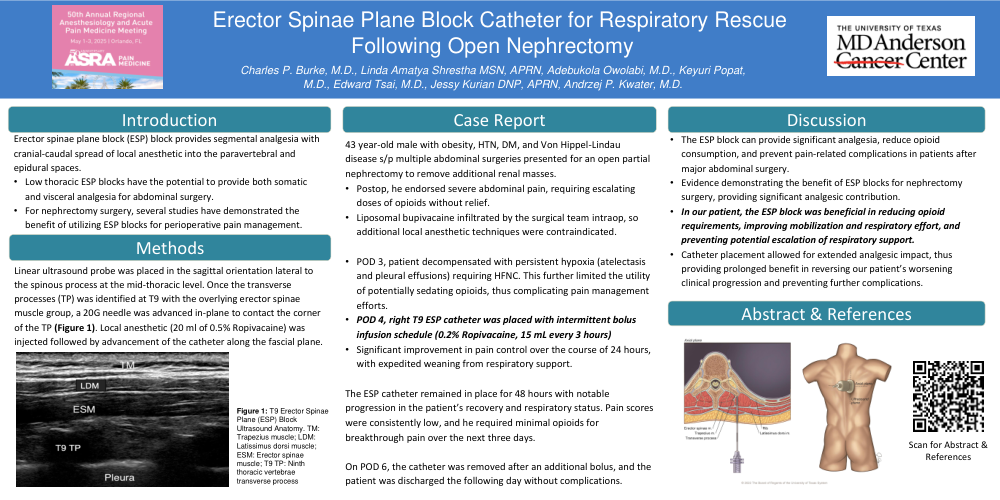
Linear ultrasound probe was placed in the sagittal orientation lateral to the spinous process at the mid-thoracic level. Once the transverse processes (TP) was identified at T9 with the overlying erector spinae muscle group, a 20G needle was advanced in-plane to contact the corner of the TP (Figure 1). Local anesthetic (20 ml of 0.5% Ropivacaine) was injected followed by advancement of the catheter along the fascial plane.
Figure 1: T9 Erector Spinae Plane (ESP) Block Ultrasound Anatomy. TM: Trapezius muscle; LDM: Latissimus dorsi muscle; ESM: Erector spinae muscle; T9 TP: Ninth thoracic vertebrae transverse process
43 year-old male with obesity, HTN, DM, and Von Hippel-Lindau disease s/p multiple abdominal surgeries presented for an open partial nephrectomy to remove additional renal masses.
The ESP catheter remained in place for 48 hours with notable progression in the patient’s recovery and respiratory status. Pain scores were consistently low, and he required minimal opioids for breakthrough pain over the next three days.
On POD 6, the catheter was removed after an additional bolus, and the patient was discharged the following day without complications.