383 posters, 2 videos, 1 audios, 8 topics, 28 sessions, 328 authors, 225 institutions
ePostersLive by SciGen Technologies S.A. All rights reserved.
50th Annual Regional Anesthesiology and Acute Pain Medicine Meeting
May 1 - 3, 2025 | Orlando, Florida

6486
DIRECT COMPARISON OF GENERAL ANESTHESIA AND NEURAXIAL ANESTHESIA IN A SINGLE PATIENT WITH SEVERE AORTIC STENOSIS
Poster Presenter
Authors
Affiliations
Part of Topic
Medically Challenging Cases
Introduction
-
Neuraxial anesthesia (NA) has historically been considered a relative contraindication for patients with severe aortic stenosis (AS) due to sympathetic block and potential for hypotension.
-
This precautionary recommendation has not been backed by significant published scientific evidence.
-
Recent research suggests that NA may be a viable option for severe AS patients, considering individual factors, and a literature review on its use in AS shows no reported cases of cardiovascular collapse or mortality.1,2
Case Presentation
-
A 76-year-old female with hypertension, severe bicuspid AS, and moderate aortic aneurysm presented for elective left total knee arthroplasty (TKA).
-
Preoperative evaluation revealed no cardiac symptoms (METs >4).
-
Transthoracic echocardiogram,
-
severe AS (peak valve velocity 4.28 m/s, mean gradient 41 mmHg, aortic valve area 0.97 cm², index 0.48 cm²/m²)
-
preserved left ventricular ejection fraction (67%).
-
Exercise stress echocardiogram revealed no ischemia or symptomatic angina identified at the achieved heart rate (141 bpm, 92% maximum predicted heart rate).
-
No significant changes in aortic valve characteristics were noted between anesthetics.
-
60mg of 2% mepivacaine injected intrathecally at the L3-L4 level
-
Sedation was maintained with propofol infusion with a native airway and oxygen supplementation via simple mask. Under NA, hemodynamics were supported with ephedrine and phenylephrine boluses and a phenylephrine infusion.
-
No opioids were required for this procedure.
-
Adductor canal catheter was placed postoperatively with no complications.
-
Hemodynamically stable and oxygenated well in PACU.
Discussion
-
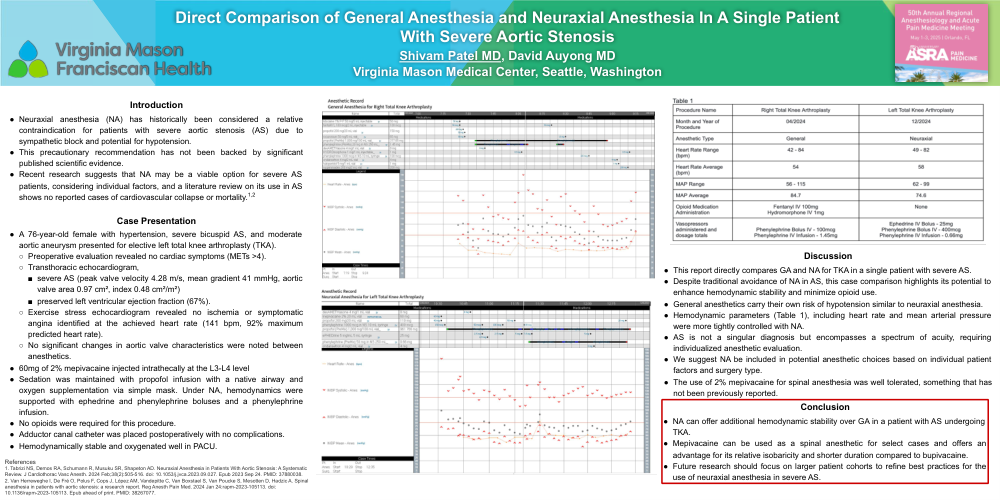
This report directly compares GA and NA for TKA in a single patient with severe AS.
-
Despite traditional avoidance of NA in AS, this case comparison highlights its potential to enhance hemodynamic stability and minimize opioid use.
-
General anesthetics carry their own risk of hypotension similar to neuraxial anesthesia.
-
Hemodynamic parameters (Table 1), including heart rate and mean arterial pressure were more tightly controlled with NA.
-
AS is not a singular diagnosis but encompasses a spectrum of acuity, requiring individualized anesthetic evaluation.
-
We suggest NA be included in potential anesthetic choices based on individual patient factors and surgery type.
-
The use of 2% mepivacaine for spinal anesthesia was well tolerated, something that has not been previously reported.
Conclusion
-
NA can offer additional hemodynamic stability over GA in a patient with AS undergoing TKA.
-
Mepivacaine can be used as a spinal anesthetic for select cases and offers an advantage for its relative isobaricity and shorter duration compared to bupivacaine.
-
Future research should focus on larger patient cohorts to refine best practices for the use of neuraxial anesthesia in severe AS.