383 posters, 2 videos, 1 audios, 8 topics, 28 sessions, 328 authors, 225 institutions
ePostersLive by SciGen Technologies S.A. All rights reserved.
50th Annual Regional Anesthesiology and Acute Pain Medicine Meeting
May 1 - 3, 2025 | Orlando, Florida

6422
REGIONAL ANESTHESIA TECHNIQUES FOR A PATIENT WITH SCAPULAR SPINE FRACTURE
Poster Presenter
Authors
Affiliations
Part of Topic
Medically Challenging Cases
REGIONAL ANESTHESIA TECHNIQUES FOR A PATIENT WITH SCAPULAR SPINE FRACTURE
Raji Naamani MD, Sindhuja Nimma MD
Scapular fractures present significant challenges in orthopedic trauma due to their complex anatomy and the potential for associated injuries. Historically, scapular fractures were considered rare and often associated with high-energy trauma. However, recent studies have observed increased incidence, partly attributed to enhanced diagnostic imaging techniques improving detection rates. Regional anesthesia techniques such as cervical paravertebral blocks, selective dorsal scapular nerve blocks, interscalene blocks, erector spinae blocks, and rhomboid intercostal blocks have provided adequate analgesia for surgical repair. However, there is limited consensus on the optimal approach.
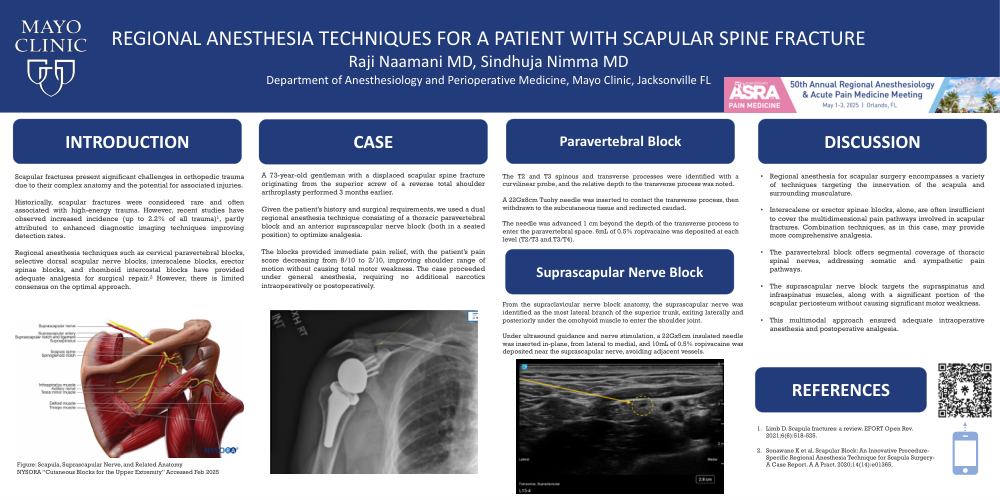
A 73-year-old gentleman with a displaced scapular spine fracture originating from the superior screw of a reverse total shoulder arthroplasty performed 3 months earlier. Given the patient’s history and surgical requirements, we used a dual regional anesthesia technique consisting of a thoracic paravertebral block and an anterior suprascapular nerve block (both in a seated position) to optimize analgesia. The blocks provided immediate pain relief, with the patient’s pain score decreasing from 8/10 to 2/10, improving shoulder range of motion without causing total motor weakness. The case proceeded under general anesthesia, requiring no additional narcotics intraoperatively or postoperatively.
Paravertebral Block, Suprascapular Nerve Block