383 posters, 2 videos, 1 audios, 8 topics, 28 sessions, 328 authors, 225 institutions
ePostersLive by SciGen Technologies S.A. All rights reserved.
50th Annual Regional Anesthesiology and Acute Pain Medicine Meeting
May 1 - 3, 2025 | Orlando, Florida

6390
SPINAL ANESTHESIA FOR AUTONOMIC DYSREFLEXIA PREVENTION: A CASE REPORT IN A QUADRIPLEGIC PATIENT
Poster Presenter
Authors
Affiliations
Part of Topic
Medically Challenging Cases
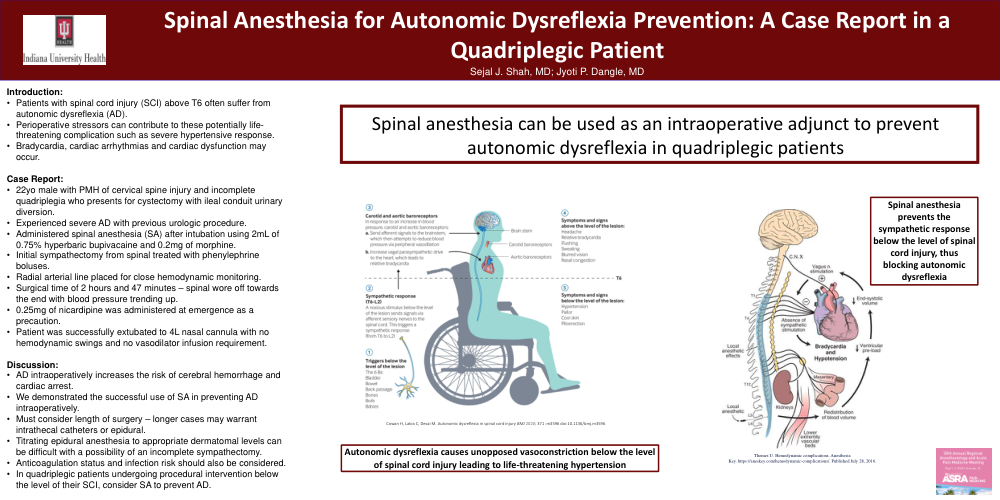
Spinal Anesthesia for Autonomic Dysreflexia Prevention: A Case Report in a Quadriplegic Patient
Sejal J. Shah, MD; Jyoti P. Dangle, MD
Introduction:
• Patients with spinal cord injury (SCI) above T6 often suffer from autonomic dysreflexia (AD).
• Perioperative stressors can contribute to these potentially lifethreatening complication such as severe hypertensive response.
• Bradycardia, cardiac arrhythmias and cardiac dysfunction may occur.
Case Report:
• 22yo male with PMH of cervical spine injury and incomplete quadriplegia who presents for cystectomy with ileal conduit urinary diversion.
• Experienced severe AD with previous urologic procedure.
• Administered spinal anesthesia (SA) after intubation using 2mL of 0.75% hyperbaric bupivacaine and 0.2mg of morphine.
• Initial sympathectomy from spinal treated with phenylephrine boluses.
• Radial arterial line placed for close hemodynamic monitoring.
• Surgical time of 2 hours and 47 minutes – spinal wore off towards the end with blood pressure trending up.
• 0.25mg of nicardipine was administered at emergence as a precaution.
• Patient was successfully extubated to 4L nasal cannula with no hemodynamic swings and no vasodilator infusion requirement.
Discussion:
• AD intraoperatively increases the risk of cerebral hemorrhage and cardiac arrest.
•We demonstrated the successful use of SA in preventing AD intraoperatively.
•Must consider length of surgery – longer cases may warrant intrathecal catheters or epidural.
• Titrating epidural anesthesia to appropriate dermatomal levels can be difficult with a possibility of an incomplete sympathectomy.
• Anticoagulation status and infection risk should also be considered.
• In quadriplegic patients undergoing procedural intervention below the level of their SCI, consider SA to prevent AD.