383 posters, 2 videos, 1 audios, 8 topics, 28 sessions, 328 authors, 225 institutions
ePostersLive by SciGen Technologies S.A. All rights reserved.
50th Annual Regional Anesthesiology and Acute Pain Medicine Meeting
May 1 - 3, 2025 | Orlando, Florida

6383
A CALL FOR INCLUSION OF THE THROMBOELASTOGRAM IN FUTURE ASRA ANTICOAGULATION GUIDELINES
Poster Presenter
Authors
Affiliations
Part of Topic
Medically Challenging Cases
A Call for Inclusion of the Thromboelastogram in Future ASRA Anticoagulation Guidelines
Noah LaBelle MD1, Aidan Hoie MD1, Mike Canepa MD1,
1-Department of Anesthesiology, University of Colorado School of Medicine, Aurora, CO
Introduction
•ASRA Anticoagulation Guidelines have provided critical recommendations for safe neuraxial and peripheral nerve procedures since 2018
•These guidelines incorporate various coagulation markers, including:
•platelet count (PLT)
•activated partial thromboplastin time (aPTT)
•international normalized ratio (INR)
•anti-factor Xa levels
•activated clotting time (ACT)
•ecarin clotting time (ECT)
•thrombin time (TT)
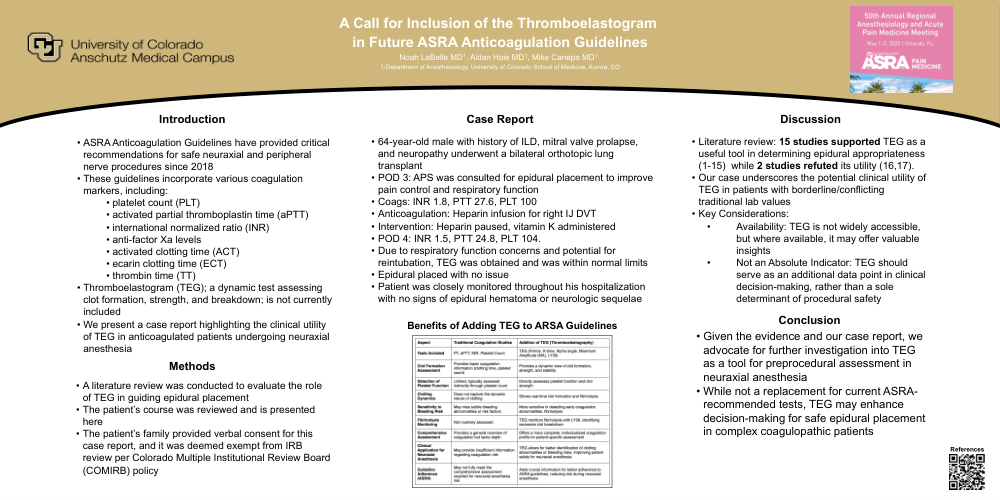
•Thromboelastogram (TEG); a dynamic test assessing clot formation, strength, and breakdown; is not currently included
•We present a case report highlighting the clinical utility of TEG in anticoagulated patients undergoing neuraxial anesthesia
Methods
•A literature review was conducted to evaluate the role of TEG in guiding epidural placement
•The patient’s course was reviewed and is presented here
•The patient’s family provided verbal consent for this case report, and it was deemed exempt from IRB review per Colorado Multiple Institutional Review Board (COMIRB) policy
Case Report
•64-year-old male with history of ILD, mitral valve prolapse, and neuropathy underwent a bilateral orthotopic lung transplant
•POD 3: APS was consulted for epidural placement to improve pain control and respiratory function
•Coags: INR 1.8, PTT 27.6, PLT 100
•Anticoagulation: Heparin infusion for right IJ DVT
•Intervention: Heparin paused,vitamin K administered
•POD 4: INR 1.5, PTT 24.8, PLT 104.
•Due to respiratory function concerns and potential for reintubation, TEG was obtained and was within normal limits
•Epidural placed with no issue
•Patient was closely monitored throughout his hospitalization with no signs of epidural hematoma or neurologic sequelae
Discussion
•Literature review: 15 studies supported TEG as a useful tool in determining epidural appropriateness (1-15) while 2 studies refuted its utility (16,17).
•Our case underscores the potential clinical utility of TEG in patients with borderline/conflicting traditional lab values
•Key Considerations:
•Availability: TEG is not widely accessible, but where available, it may offer valuable insights
•Not an Absolute Indicator: TEG should serve as an additional data point in clinical decision-making, rather than a sole determinant of procedural safety
Conclusion
•Given the evidence and our case report, we advocate for further investigation into TEG as a tool for preprocedural assessment in neuraxial anesthesia
•While not a replacement for current ASRA-recommended tests, TEG may enhance decision-making for safe epidural placement in complex coagulopathic patients