383 posters, 2 videos, 1 audios, 8 topics, 28 sessions, 328 authors, 225 institutions
ePostersLive by SciGen Technologies S.A. All rights reserved.
50th Annual Regional Anesthesiology and Acute Pain Medicine Meeting
May 1 - 3, 2025 | Orlando, Florida

6380
AN INTERMEDIATE TECHNIQUE BETWEEN INTERSCALENE AND SUPRACLAVICULAR BLOCKS FOR COMBINED CLAVICLE AND OLECRANON SURGERY
Poster Presenter
Authors
Affiliations
Part of Topic
Medically Challenging Cases
•Conventionally, interscalene brachial plexus blocks (ISBs) are utilized for postoperative analgesia following shoulder surgery as the suprascapular nerve is generally spared with more distal blocks.
•For clavicle surgery, the combination of ISB and cervical plexus block has been reported to provide excellent analgesia2.
•More distal blocks of the brachial plexus must be utilized for surgery distal to the mid-humerus, as the ISB is associated with sparing of the ulnar nerve3.
•A 73-year-old male presented after falling from his bike and sustaining right medial clavicle and intra-articular olecranon fractures requiring surgical fixation and a CPNB was planned for postoperative analgesia.
•A single injection superficial cervical plexus block was performed with bupivacaine 0.5% (10 mL).
•The patient was discharged approximately 1-hour following surgery with an infusion of ropivacaine 0.2% via the perineural catheter (8 mL per hour continuous, 4 mL patient-controlled bolus, 30-minute lockout, 500 mL reservoir) and, upon follow up, the patient described excellent pain control.
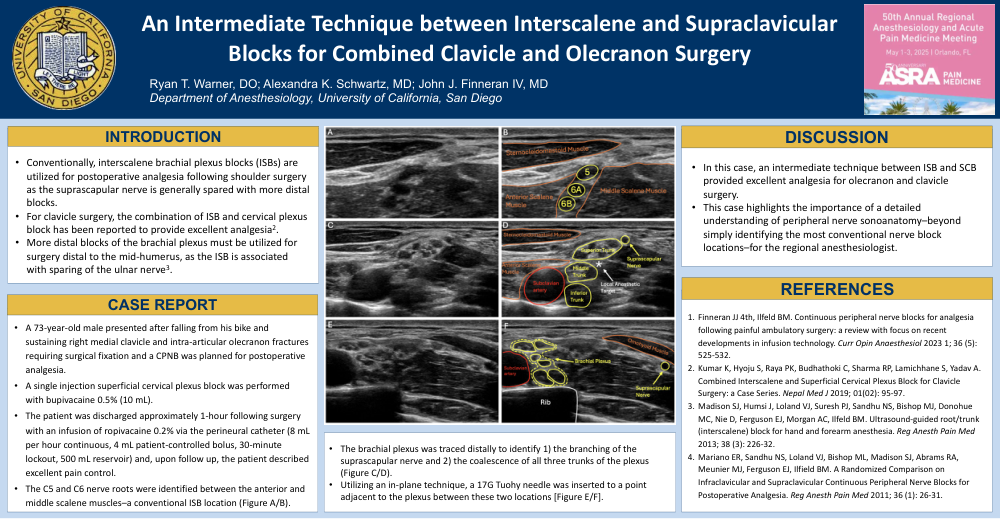
•The C5 and C6 nerve roots were identified between the anterior and middle scalene muscles–a conventional ISB location (Figure A/B).
•The brachial plexus was traced distally to identify 1) the branching of the suprascapular nerve and 2) the coalescence of all three trunks of the plexus (Figure C/D).
•Utilizing an in-plane technique, a 17G Tuohy needle was inserted to a point adjacent to the plexus between these two locations [Figure E/F].
•In this case, an intermediate technique between ISB and SCB provided excellent analgesia for olecranon and clavicle surgery.
•This case highlights the importance of a detailed understanding of peripheral nerve sonoanatomy–beyond simply identifying the most conventional nerve block locations–for the regional anesthesiologist.