383 posters, 2 videos, 1 audios, 8 topics, 28 sessions, 328 authors, 225 institutions
ePostersLive by SciGen Technologies S.A. All rights reserved.
50th Annual Regional Anesthesiology and Acute Pain Medicine Meeting
May 1 - 3, 2025 | Orlando, Florida

6897
ALTERNATE LOCAL ANESTHETICS IN A RAPID METABOLIZER PATIENT. A CASE REPORT.
Poster Presenter
Authors
Affiliations
Part of Topic
Medically Challenging Cases
Title:
Alternate local anesthetics in a rapid metabolizer patient – A Case Report
Authors:
Hadia Maqsood, MD; Erika Taco-Vasquez, MD, Andrey Suprun, MD
(Department of Anesthesiology, University of Florida College of Medicine, Gainesville)
Introduction:
Local anesthetics (LA) function by blocking sodium conductance through voltage-gated sodium channels. While local anesthetic resistance remains poorly defined and its causes are unclear, atypical responses to LA are often attributed to suboptimal techniques, such as improper needle positioning, insufficient dosage, or uneven distribution of the anesthetic. Despite the execution of a proper block, variability in patient responses to LA can still occur. Thus, while these atypical responses are rare, further research is essential to better understand this phenomenon and its implications for clinical practice.
Case report:
A 70-year-old female, weighing 72 kg, presented to the outpatient surgical center for an elective right open carpal tunnel release. Her past medical history is significant for hypertension (HTN), gastroesophageal reflux disease (GERD), obstructive sleep apnea (OSA), and a history of pulmonary embolism (PE). She also has a surgical history of left rotator cuff repair and left knee replacement, both of which were associated with ineffective blocks.
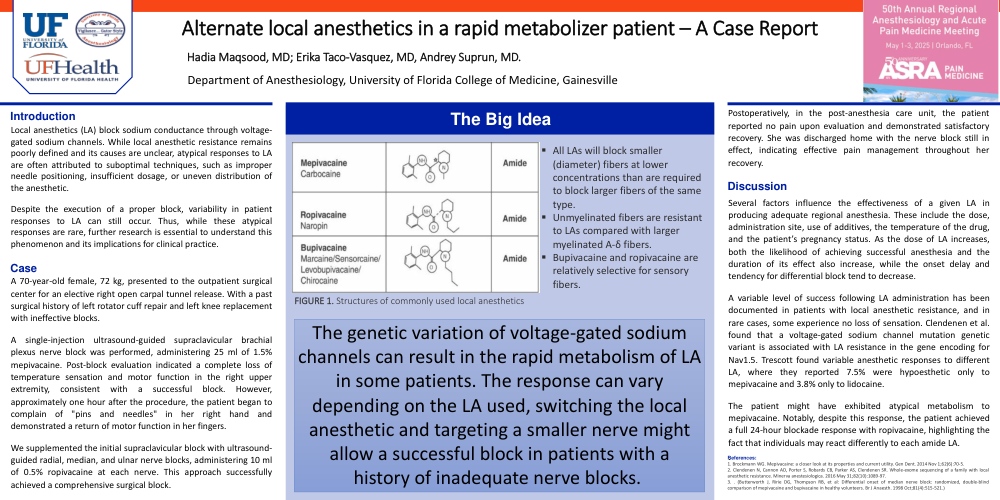
A single-injection ultrasound-guided supraclavicular brachial plexus nerve block was performed, administering 25 ml of 1.5% mepivacaine. Post-block evaluation indicated a complete loss of temperature sensation and motor function in the right upper extremity, consistent with a successful block. However, approximately one hour after the procedure, the patient began to complain of "pins and needles" in her right hand and demonstrated a return of motor function in her fingers.
To resolve the lack of analgesia, we supplemented the initial supraclavicular block with ultrasound-guided radial, median, and ulnar nerve blocks, administering 10 ml of 0.5% ropivacaine at each nerve. This approach successfully achieved a comprehensive surgical block.
Postoperatively, in the post-anesthesia care unit, the patient reported no pain upon evaluation and demonstrated satisfactory recovery. She was discharged home with the nerve block still in effect, indicating effective pain management throughout her recovery.
Discussion
Several factors influence the effectiveness of a given LA in producing adequate regional anesthesia. These include the dose, administration site, use of additives, the temperature of the drug, and the patient’s pregnancy status. As the dose of LA increases, both the likelihood of achieving successful anesthesia and the duration of its effect also increase, while the onset delay and tendency for differential block tend to decrease.
A variable level of success following LA administration has been documented in patients with local anesthetic resistance, and in rare cases, some experience no loss of sensation. Clendenen et al. found a voltage-gated sodium channel mutation genetic variant that is associated with LA resistance in the gene encoding for Nav1.5. Trescott found variable hypoesthetic responses to different LA, where they reported 7.5% were hypoesthetic only to mepivicaine and 3.8% only to lidocaine.
In this case, the patient might have exhibited atypical metabolism to mepivacaine. Notably, despite this response, the patient achieved a full 24-hour blockade response with ropivacaine, highlighting the fact that individuals may react differently to each amide LA.