383 posters, 2 videos, 1 audios, 8 topics, 28 sessions, 328 authors, 225 institutions
ePostersLive by SciGen Technologies S.A. All rights reserved.
50th Annual Regional Anesthesiology and Acute Pain Medicine Meeting
May 1 - 3, 2025 | Orlando, Florida

6817
INTRATHECAL BACLOFEN PUMP PLACEMENT FOR CHRONIC SPASTICITY FOLLOWING EPENDYMOMA RESECTION
Poster Presenter
Authors
Affiliations
Part of Topic
Medically Challenging Cases
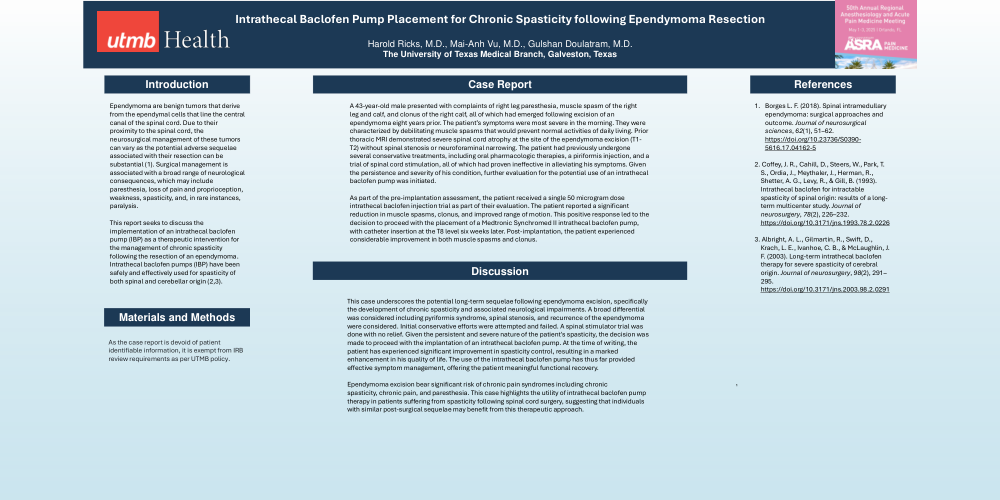
Title: Intrathecal baclofen pump placement for chronic spasticity following ependymoma resection
Introduction
Ependymoma are benign tumors that derive from the ependymal cells that line the central canal of the spinal cord. Due to their proximity to the spinal cord, the neurosurgical management of these tumors can vary as the potential adverse sequelae associated with their resection can be substantial (1). Surgical management is associated with a broad range of neurological consequences, which may include paresthesia, loss of pain and proprioception, weakness, spasticity, and, in rare instances, paralysis.
This report seeks to discuss the implementation of an intrathecal baclofen pump (IBP) as a therapeutic intervention for the management of chronic spasticity following the resection of an ependymoma. Intrathecal baclofen pumps (IBP) have been safely and effectively used for spasticity of both spinal and cerebellar origin (2,3).
Material and Methods
As the case report is devoid of patient identifiable information, it is exempt from IRB review requirements as per UTMB policy.
Results / Case Report
A 43-year-old male presented with complaints of right leg paresthesia, muscle spasm of the right leg and calf, and clonus of the right calf, all of which had emerged following excision of an ependymoma eight years prior. The patient’s symptoms were most severe in the morning. They were characterized by debilitating muscle spasms that would prevent normal activities of daily living. Prior thoracic MRI demonstrated severe spinal cord atrophy at the site of the ependymoma excision (T1-T2) without spinal stenosis or neuroforaminal narrowing. The patient had previously undergone several conservative treatments, including oral pharmacologic therapies, a piriformis injection, and a trial of spinal cord stimulation, all of which had proven ineffective in alleviating his symptoms. Given the persistence and severity of his condition, further evaluation for the potential use of an intrathecal baclofen pump was initiated.
As part of the pre-implantation assessment, the patient received a single 50 microgram dose intrathecal baclofen injection trial as part of their evaluation. The patient reported a significant reduction in muscle spasms, clonus, and improved range of motion. This positive response led to the decision to proceed with the placement of a Medtronic Synchromed II intrathecal baclofen pump, with catheter insertion at the T8 level six weeks later. Post-implantation, the patient experienced considerable improvement in both muscle spasms and clonus.
Discussion
This case underscores the potential long-term sequelae following ependymoma excision, specifically the development of chronic spasticity and associated neurological impairments. A broad differential was considered including pyriformis syndrome, spinal stenosis, and recurrence of the ependymoma were considered. Initial conservative efforts were attempted and failed. A spinal stimulator trial was done with no relief. Given the persistent and severe nature of the patient's spasticity, the decision was made to proceed with the implantation of an intrathecal baclofen pump. At the time of writing, the patient has experienced significant improvement in spasticity control, resulting in a marked enhancement in his quality of life. The use of the intrathecal baclofen pump has thus far provided effective symptom management, offering the patient meaningful functional recovery.
Ependymoma excision bear significant risk of chronic pain syndromes including chronic spasticity, chronic pain, and paresthesia. This case highlights the utility of intrathecal baclofen pump therapy in patients suffering from spasticity following spinal cord surgery, suggesting that individuals with similar post-surgical sequelae may benefit from this therapeutic approach.
References
- Borges L. F. (2018). Spinal intramedullary ependymoma: surgical approaches and outcome. Journal of neurosurgical sciences, 62(1), 51–62. https://doi.org/10.23736/S0390-5616.17.04162-5
- Coffey, J. R., Cahill, D., Steers, W., Park, T. S., Ordia, J., Meythaler, J., Herman, R., Shetter, A. G., Levy, R., & Gill, B. (1993). Intrathecal baclofen for intractable spasticity of spinal origin: results of a long-term multicenter study. Journal of neurosurgery, 78(2), 226–232. https://doi.org/10.3171/jns.1993.78.2.0226
- Albright, A. L., Gilmartin, R., Swift, D., Krach, L. E., Ivanhoe, C. B., & McLaughlin, J. F. (2003). Long-term intrathecal baclofen therapy for severe spasticity of cerebral origin. Journal of neurosurgery, 98(2), 291–295. https://doi.org/10.3171/jns.2003.98.2.0291