383 posters, 2 videos, 1 audios, 8 topics, 28 sessions, 328 authors, 225 institutions
ePostersLive by SciGen Technologies S.A. All rights reserved.
50th Annual Regional Anesthesiology and Acute Pain Medicine Meeting
May 1 - 3, 2025 | Orlando, Florida

6810
INTRATHECAL MORPHINE FOR PAIN CONTROL FOLLOWING THE COMPLEX RESECTION OF SPINDLE-CELL CARCINOMA INVOLVING THE POSTERIOR CHEST WALL
Poster Presenter
Authors
Affiliations
Part of Topic
Medically Challenging Cases
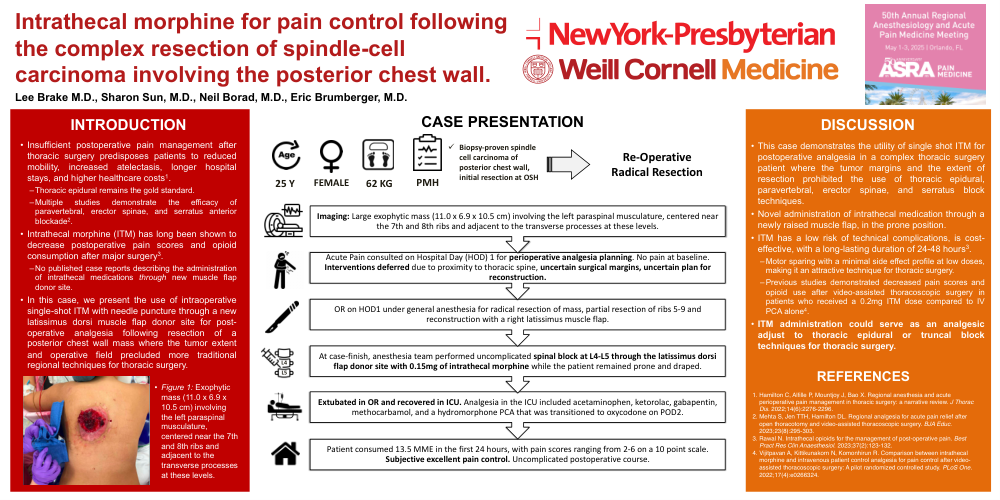
Intrathecal morphine for pain control following the complex resection of spindle-cell carcinoma involving the posterior chest wall.
Insufficient postoperative pain management after thoracic surgery predisposes patients to reduced mobility, increased atelectasis, longer hospital stays, and higher healthcare costs.
– Thoracic epidural remains the gold standard.
– Multiple studies demonstrate the efficacy of paravertebral, erector spinae, and serratus anterior blockade.
Intrathecal morphine (ITM) has long been shown to decrease postoperative pain scores and opioid consumption after major surgery.
– No published case reports describing the administration of intrathecal medications through new muscle flap donor site.
In this case, we present the use of intraoperative single-shot ITM with needle puncture through a new latissimus dorsi muscle flap donor site for post- operative analgesia following resection of a posterior chest wall mass where the tumor extent and operative field precluded more traditional regional techniques for thoracic surgery.
Imaging: Large exophytic mass (11.0 x 6.9 x 10.5 cm) involving the left paraspinal musculature, centered near the 7th and 8th ribs and adjacent to the transverse processes at these levels.
Acute Pain consulted on Hospital Day (HOD) 1 for perioperative analgesia planning. No pain at baseline. Interventions deferred due to proximity to thoracic spine, uncertain surgical margins, uncertain plan for reconstruction.
OR on HOD1 under general anesthesia for radical resection of mass, partial resection of ribs 5-9 and reconstruction with a right latissimus muscle flap.
At case-finish, anesthesia team performed uncomplicated spinal block at L4-L5 through the latissimus dorsi flap donor site with 0.15mg of intrathecal morphine while the patient remained prone and draped.
Extubated in OR and recovered in ICU. Analgesia in the ICU included acetaminophen, ketorolac, gabapentin, methocarbamol, and a hydromorphone PCA that was transitioned to oxycodone on POD2.
Patient consumed 13.5 MME in the first 24 hours, with pain scores ranging from 2-6 on a 10 point scale. Subjective excellent pain control. Uncomplicated postoperative course.
This case demonstrates the utility of single shot ITM for postoperative analgesia in a complex thoracic surgery patient where the tumor margins and the extent of resection prohibited the use of thoracic epidural, paravertebral, erector spinae, and serratus block techniques.
Novel administration of intrathecal medication through a newly raised muscle flap, in the prone position.
ITM has a low risk of technical complications, is cost-effective, with a long-lasting duration of 24-48 hours.
- Motor sparing with a minimal side effect profile at low doses, making it an attractive technique for thoracic surgery.
– Previous studies demonstrated decreased pain scores and opioid use after video-assisted thoracoscopic surgery in patients who received a 0.2mg ITM dose compared to IV PCA alone.
ITM administration could serve as an analgesic adjust to thoracic epidural or truncal block techniques for thoracic surgery.