383 posters, 2 videos, 1 audios, 8 topics, 28 sessions, 328 authors, 225 institutions
ePostersLive by SciGen Technologies S.A. All rights reserved.
50th Annual Regional Anesthesiology and Acute Pain Medicine Meeting
May 1 - 3, 2025 | Orlando, Florida

6789
PERCUTANEOUS CRYONEUROLYSIS FOR SUBACUTE TRAUMATIC LOWER EXTREMITY AMPUTATION PAIN
Poster Presenter
Authors
Affiliations
Part of Topic
Medically Challenging Cases
Percutaneous Cryoneurolysis for Subacute Traumatic Lower Extremity Amputation
Sarah Al Azzawi MD1, Tiffany Luu L.T. MD1, John Finneran MD1
1Department of Anesthesiology, UC San Diego Health, La Jolla, CA, USA
Background
Percutaneous cryoneurolysis is a pain management technique that employs extreme cold to temporarily disrupt nerve function and provide analgesia in the distribution of the target nerve(s). 1 During the procedure, a cryoprobe is inserted under sonographic or radiographic guidance to a point immediately adjacent to the targeted nerve. Within the probe, gas—usually nitrous oxide—flows from a high-pressure source to an annulus at the tip of the probe. At the tip, the volume expands with a resulting drop in temperature. The resulting cold freezes the surrounding tissue, including the nerve, resulting in Wallerian degeneration of the axons within and produces a reversible—but ultralong lasting—nerve block. As the nerve regenerates, normal sensation gradually returns over weeks or months. 1 Limited evidence supports the use of preoperative percutaneous cryoneurolysis of the femoral and sciatic nerves prior to below knee amputation (BKA). 2 to prevent postoperative pain as well as for treatment of established chronic post-amputation pain. 3Cryoneurolysis of the lateral femoral cutaneous nerve (LFCN) has also been utilized for split thickness skin graft (STSG) donor site analgesia.
Case Discription
A 29-year-old female presented with a traumatic injury of the lower extremity requiring emergent BKA. Postoperative pain was initially managed with a lumbar epidural. However, her recovery was significant for multiple revision surgeries and a pulmonary embolism on POD 8, necessitating therapeutic anticoagulation. Thus, the epidural catheter was removed, and sciatic and femoral continuous peripheral nerve blocks (CPNBs) were placed to provide analgesia.
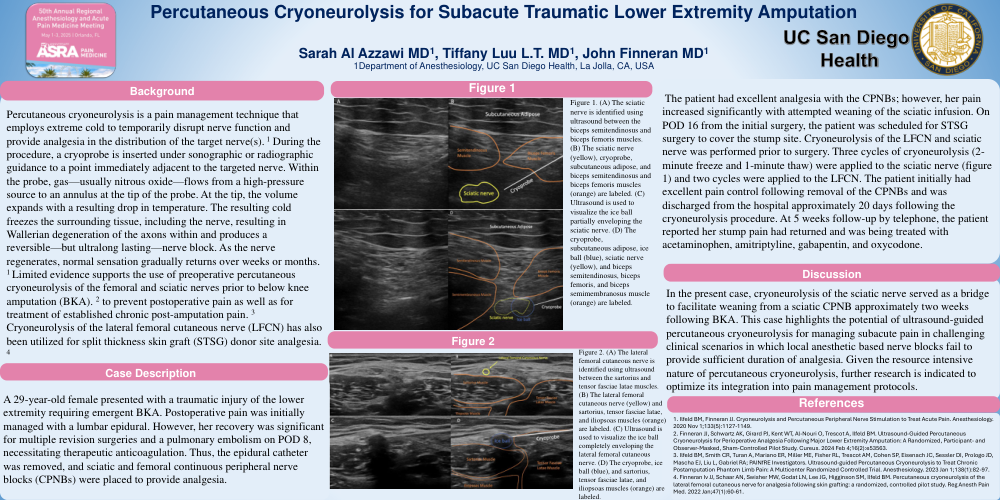
The patient had excellent analgesia with the CPNBs; however, her pain increased significantly with attempted weaning of the sciatic infusion. On POD 16 from the initial surgery, the patient was scheduled for STSG surgery to cover the stump site. Cryoneurolysis of the LFCN and sciatic nerve was performed prior to surgery. Three cycles of cryoneurolysis (2-minute freeze and 1-minute thaw) were applied to the sciatic nerve (figure 1) and two cycles were applied to the LFCN. The patient initially had excellent pain control following removal of the CPNBs and was discharged from the hospital approximately 20 days following the cryoneurolysis procedure. At 5 weeks follow-up by telephone, the patient reported her stump pain had returned and was being treated with acetaminophen, amitriptyline, gabapentin, and oxycodone.
Discussion
In the present case, cryoneurolysis of the sciatic nerve served as a bridge to facilitate weaning from a sciatic CPNB approximately two weeks following BKA. This case highlights the potential of ultrasound-guided percutaneous cryoneurolysis for managing subacute pain in challenging clinical scenarios in which local anesthetic based nerve blocks fail to provide sufficient duration of analgesia. Given the resource intensive nature of percutaneous cryoneurolysis, further research is indicated to optimize its integration into pain management protocols.
References
1. Ilfeld BM, Finneran JJ. Cryoneurolysis and Percutaneous Peripheral Nerve Stimulation to Treat Acute Pain. Anesthesiology. 2020 Nov 1;133(5):1127-1149.
2. Finneran JJ, Schwartz AK, Girard PJ, Kent WT, Al-Nouri O, Trescot A, Ilfeld BM. Ultrasound-Guided Percutaneous Cryoneurolysis for Perioperative Analgesia Following Major Lower Extremity Amputation: A Randomized, Participant- and Observer-Masked, Sham-Controlled Pilot Study. Cureus. 2024 Feb 4;16(2):e53563.
3. Ilfeld BM, Smith CR, Turan A, Mariano ER, Miller ME, Fisher RL, Trescot AM, Cohen SP, Eisenach JC, Sessler DI, Prologo JD, Mascha EJ, Liu L, Gabriel RA; PAINfRE Investigators. Ultrasound-guided Percutaneous Cryoneurolysis to Treat Chronic Postamputation Phantom Limb Pain: A Multicenter Randomized Controlled Trial. Anesthesiology. 2023 Jan 1;138(1):82-97.
4. Finneran Iv JJ, Schaar AN, Swisher MW, Godat LN, Lee JG, Higginson SM, Ilfeld BM. Percutaneous cryoneurolysis of the lateral femoral cutaneous nerve for analgesia following skin grafting: a randomized, controlled pilot study. Reg Anesth Pain Med. 2022 Jan;47(1):60-61.